Department of Physiology, University of Alberta, Edmonton, Alberta, Canada.
PLoS One. 2013 Jul 30;8(7):e70411. doi: 10.1371/journal.pone.0070411. Print 2013.
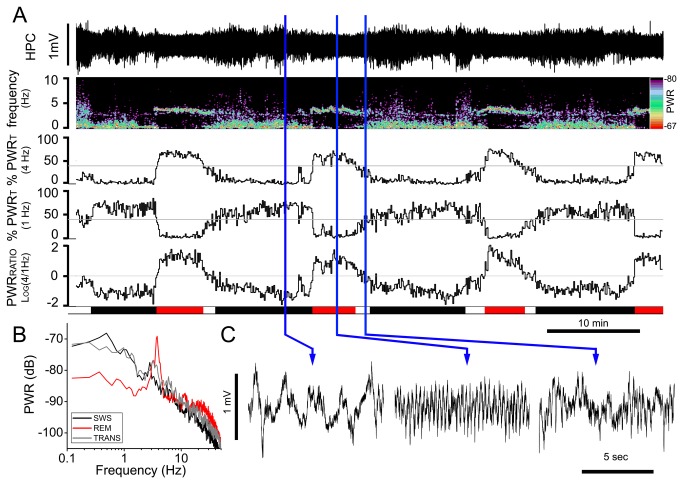
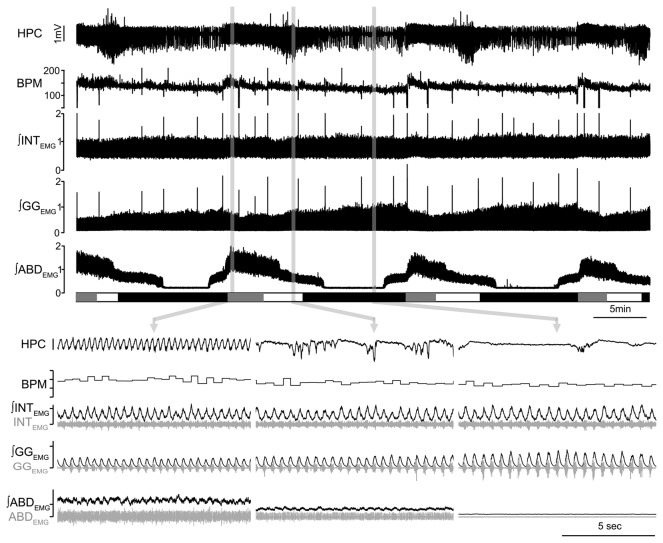
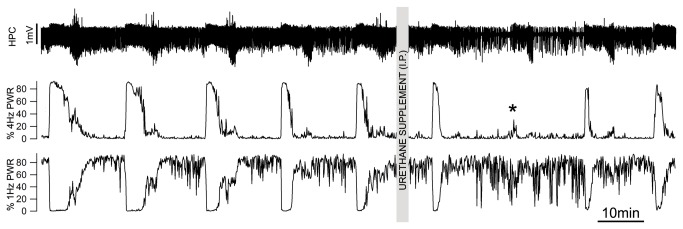
Brain state alternations resembling those of sleep spontaneously occur in rats under urethane anesthesia and they are closely linked with sleep-like respiratory changes. Although rats are a common model for both sleep and respiratory physiology, we sought to determine if similar brain state and respiratory changes occur in mice under urethane. We made local field potential recordings from the hippocampus and measured respiratory activity by means of EMG recordings in intercostal, genioglossus, and abdominal muscles. Similar to results in adult rats, urethane anesthetized mice displayed quasi-periodic spontaneous forebrain state alternations between deactivated patterns resembling slow wave sleep (SWS) and activated patterns resembling rapid eye movement (REM) sleep. These alternations were associated with an increase in breathing rate, respiratory variability, a depression of inspiratory related activity in genioglossus muscle and an increase in expiratory-related abdominal muscle activity when comparing deactivated (SWS-like) to activated (REM-like) states. These results demonstrate that urethane anesthesia consistently induces sleep-like brain state alternations and correlated changes in respiratory activity across different rodent species. They open up the powerful possibility of utilizing transgenic mouse technology for the advancement and translation of knowledge regarding sleep cycle alternations and their impact on respiration.
在乌拉坦麻醉的大鼠中,会自发出现类似于睡眠的脑状态交替,并且它们与类似睡眠的呼吸变化密切相关。尽管大鼠是睡眠和呼吸生理学的常见模型,但我们试图确定在乌拉坦麻醉的小鼠中是否会发生类似的脑状态和呼吸变化。我们从海马体进行局部场电位记录,并通过肋间肌、颏舌肌和腹肌的肌电图记录来测量呼吸活动。与成年大鼠的结果相似,乌拉坦麻醉的小鼠表现出准周期性的自发前脑状态交替,从类似于慢波睡眠(SWS)的去激活模式到类似于快速眼动(REM)睡眠的激活模式。这些交替伴随着呼吸频率的增加、呼吸变异性的增加、颏舌肌吸气相关活动的抑制以及呼气相关腹肌活动的增加,与去激活(类似于 SWS)状态相比,激活(类似于 REM)状态。这些结果表明,乌拉坦麻醉一致地诱导了不同啮齿动物物种的类似于睡眠的脑状态交替和相关的呼吸活动变化。它们为利用转基因小鼠技术推进和转化关于睡眠周期交替及其对呼吸影响的知识提供了强大的可能性。