Departamento de Botánica, Instituto de Biología, Universidad Nacional Autónoma de México, México City, Mexico.
PLoS One. 2013 Jul 30;8(7):e70501. doi: 10.1371/journal.pone.0070501. Print 2013.
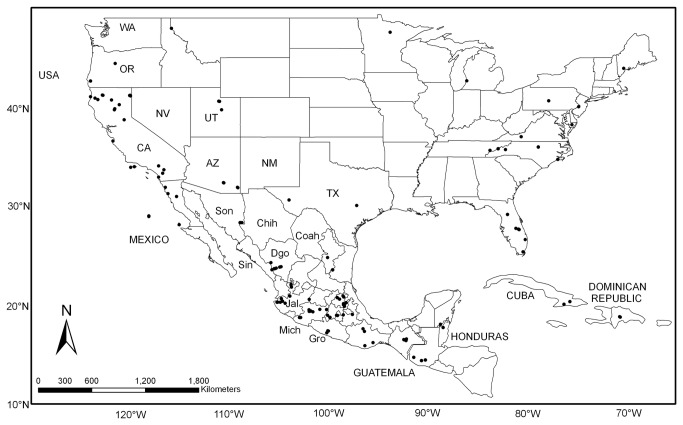
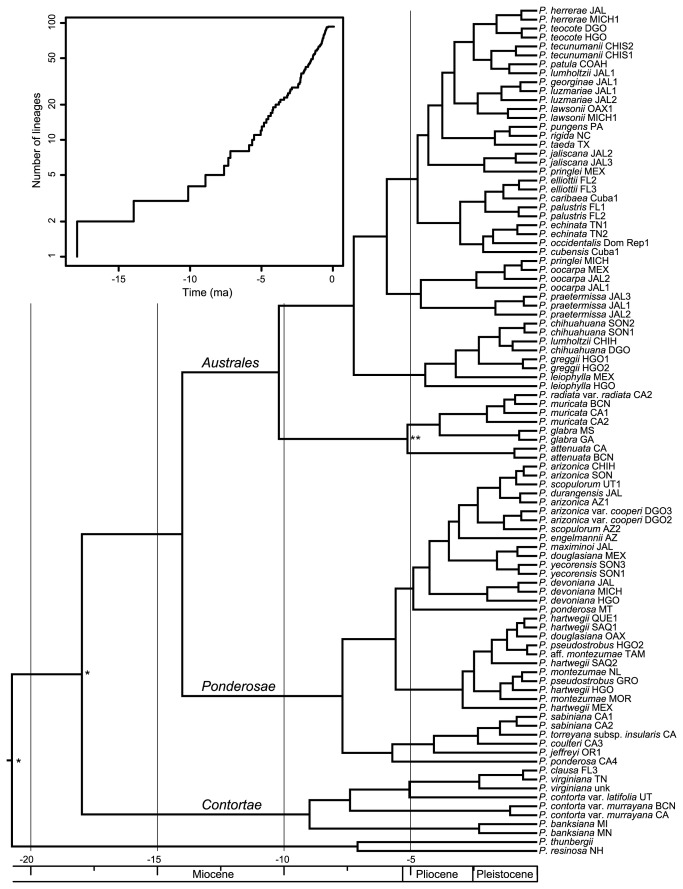
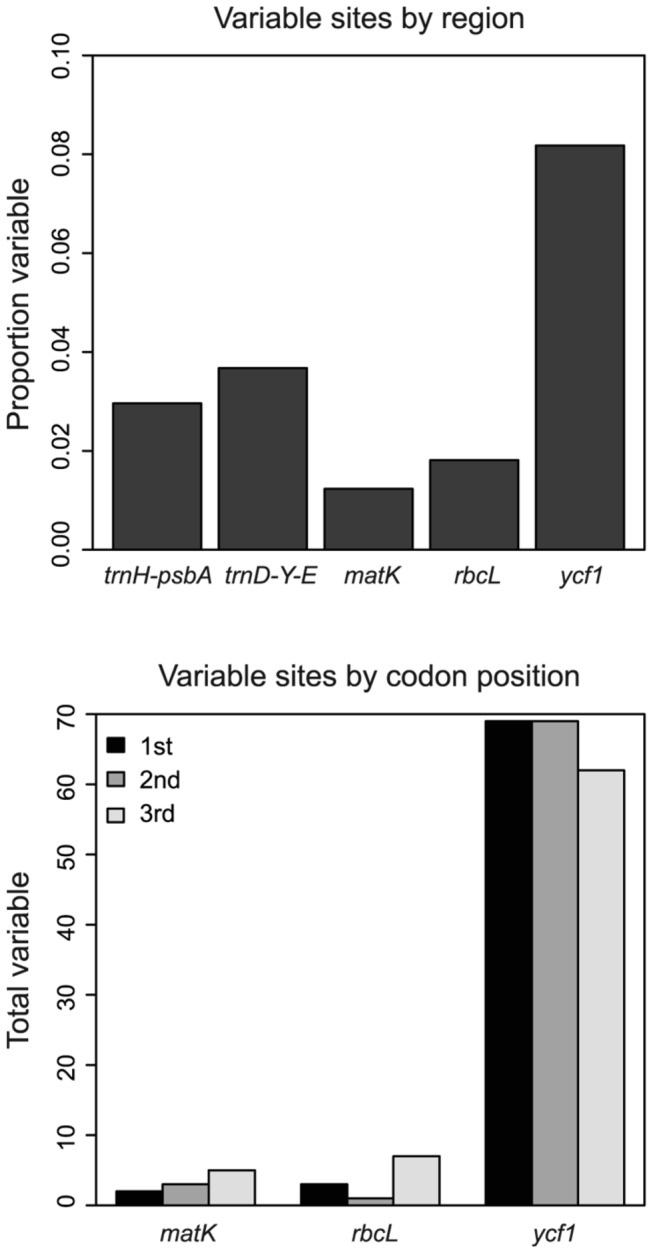
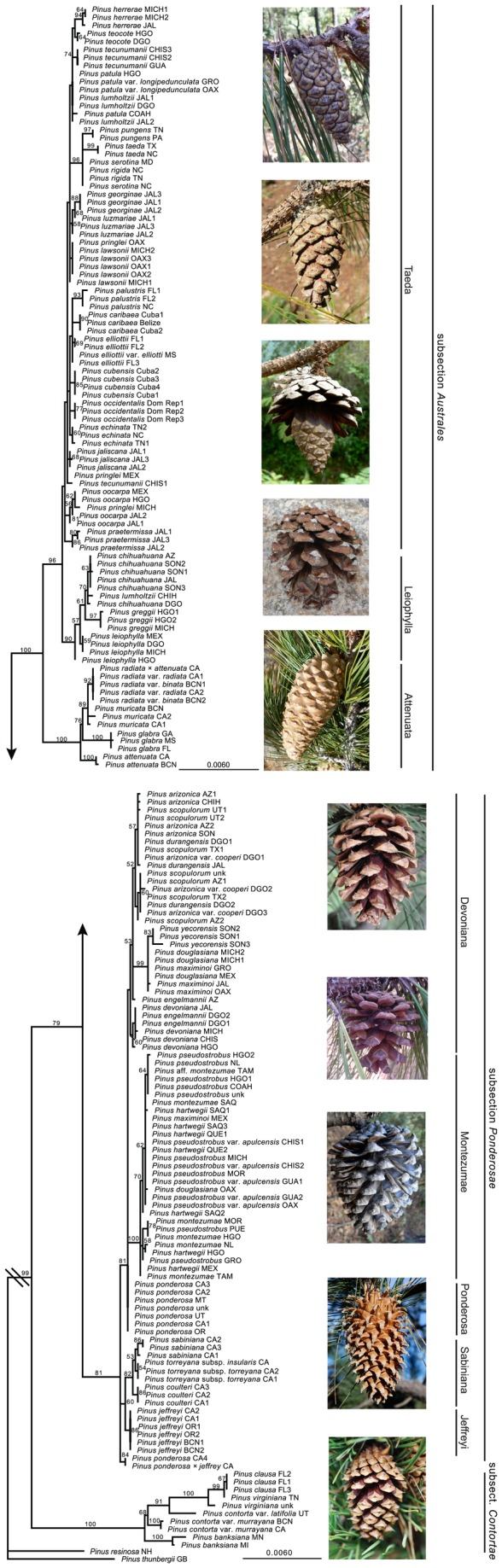
Recent diversification followed by secondary contact and hybridization may explain complex patterns of intra- and interspecific morphological and genetic variation in the North American hard pines (Pinus section Trifoliae), a group of approximately 49 tree species distributed in North and Central America and the Caribbean islands. We concatenated five plastid DNA markers for an average of 3.9 individuals per putative species and assessed the suitability of the five regions as DNA bar codes for species identification, species delimitation, and phylogenetic reconstruction. The ycf1 gene accounted for the greatest proportion of the alignment (46.9%), the greatest proportion of variable sites (74.9%), and the most unique sequences (75 haplotypes). Phylogenetic analysis recovered clades corresponding to subsections Australes, Contortae, and Ponderosae. Sequences for 23 of the 49 species were monophyletic and sequences for another 9 species were paraphyletic. Morphologically similar species within subsections usually grouped together, but there were exceptions consistent with incomplete lineage sorting or introgression. Bayesian relaxed molecular clock analyses indicated that all three subsections diversified relatively recently during the Miocene. The general mixed Yule-coalescent method gave a mixed model estimate of only 22 or 23 evolutionary entities for the plastid sequences, which corresponds to less than half the 49 species recognized based on morphological species assignments. Including more unique haplotypes per species may result in higher estimates, but low mutation rates, recent diversification, and large effective population sizes may limit the effectiveness of this method to detect evolutionary entities.
最近的多样化,随后是二次接触和杂交,可能解释了北美硬松(松科三叶松组)的种内和种间形态和遗传变异的复杂模式,这是一组约 49 种分布在北美洲、中美洲和加勒比海岛屿的树种。我们将五个质体 DNA 标记连接起来,每个假定物种的个体平均为 3.9 个,并评估了这五个区域作为物种鉴定、物种划分和系统发育重建的 DNA 条形码的适宜性。ycf1 基因占比对的比例最大(46.9%),变异位点的比例最大(74.9%),独特序列最多(75 个单倍型)。系统发育分析恢复了与澳瑞勒斯、扭叶松和黄松亚组相对应的分支。49 个物种中的 23 个物种的序列为单系,另有 9 个物种的序列为并系。亚组内形态相似的物种通常聚在一起,但也有例外情况与不完全谱系分选或基因渗入一致。贝叶斯松弛分子钟分析表明,所有三个亚组在中新世都相对较新地多样化。一般混合 Yule 合并方法仅对质体序列给出了 22 或 23 个进化实体的混合模型估计,这相当于根据形态学物种分配识别的 49 个物种的不到一半。每个物种包含更多独特的单倍型可能会导致更高的估计值,但低突变率、最近的多样化和大的有效种群大小可能会限制这种方法检测进化实体的有效性。