Department of Food Science and Technology, University of California Davis, Davis, California, USA.
PLoS One. 2013 Jul 30;8(7):e70643. doi: 10.1371/journal.pone.0070643. Print 2013.
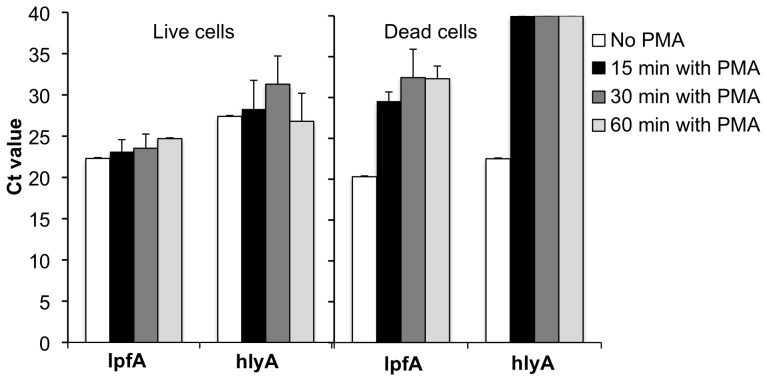
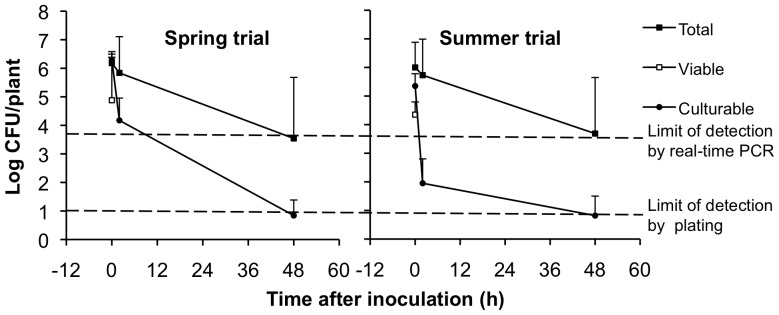
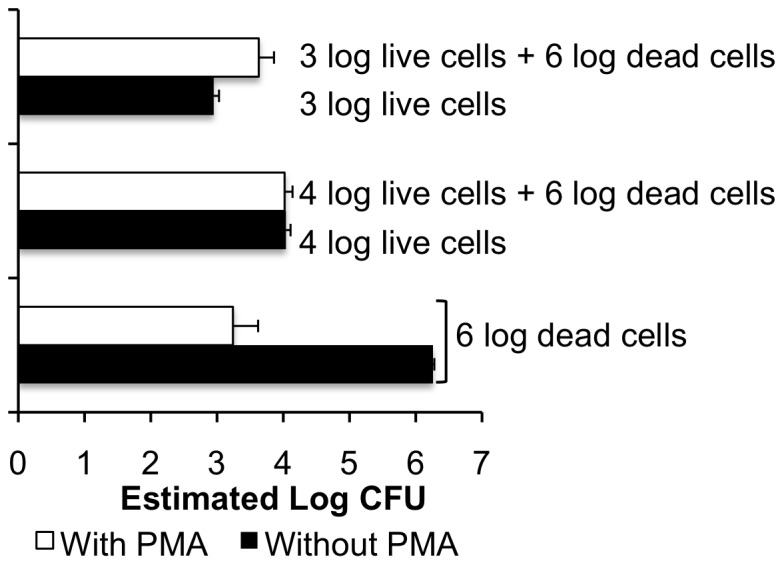
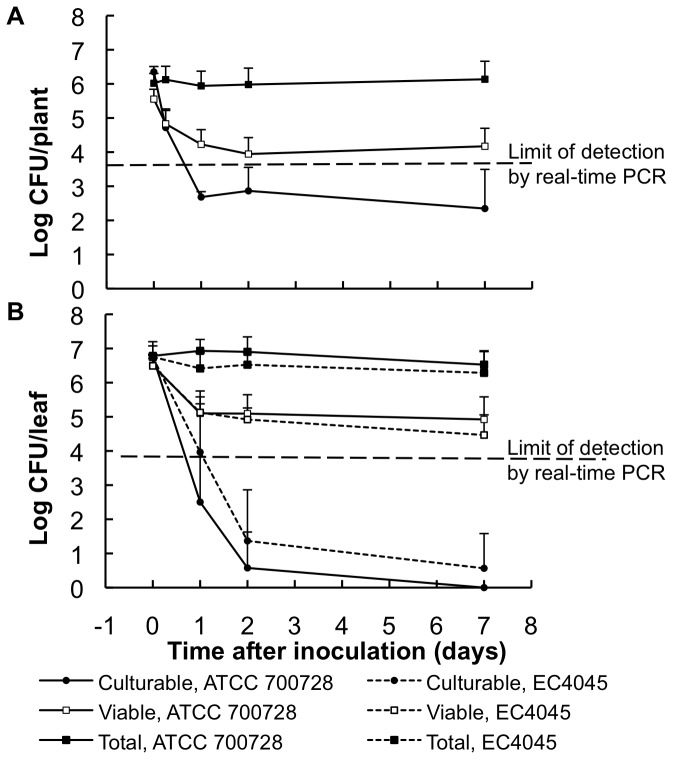
Leafy green produce has been associated with numerous outbreaks of foodborne illness caused by strains of Escherichia coli O157:H7. While the amounts of culturable E. coli O157:H7 rapidly decline after introduction onto lettuce in the field, it remains to be determined whether the reduction in cell numbers is due to losses in cell viability, cell injury and a subsequent inability to be detected by standard laboratory culturing methods, or a lack of adherence and hence rapid removal of the organism from the plants during application. To assess which of these options is most relevant for E. coli O157:H7 on leafy green produce, we developed and applied a propidium monoazide (PMA) real-time PCR assay to quantify viable (with PMA) and total (without PMA) E. coli O157:H7 cells on growth chamber and field-grown lettuce. E. coli O157:H7, suspended in 0.1% peptone, was inoculated onto 4-week-old lettuce plants at a level of approximately 10(6) CFU/plant. In the growth chamber at low relative humidity (30%), culturable amounts of the nontoxigenic E. coli O157:H7 strain ATCC 700728 and the virulent strain EC4045 declined 100 to 1000-fold in 24 h. Fewer E. coli O157:H7 cells survived when applied onto plants in droplets with a pipette compared with a fine spray inoculation. Total cells for both strains were equivalent to inoculum levels for 7 days after application, and viable cell quantities determined by PMA real-time PCR were approximately 10(4) greater than found by colony enumeration. Within 2 h after application onto plants in the field, the number of culturable E. coli ATCC 700728 was reduced by up to 1000-fold, whereas PCR-based assessments showed that total cell amounts were equivalent to inoculum levels. These findings show that shortly after inoculation onto plants, the majority of E. coli O157:H7 cells either die or are no longer culturable.
绿叶蔬菜与许多由大肠杆菌 O157:H7 引起的食源性疾病爆发有关。虽然在田间引入生菜后,可培养的大肠杆菌 O157:H7 的数量迅速下降,但仍需确定细胞数量的减少是由于细胞活力的丧失、细胞损伤以及随后无法通过标准实验室培养方法检测到,还是由于缺乏粘附性以及在应用过程中生物体从植物中迅速去除。为了评估这些选项中哪一个与叶菜类农产品上的大肠杆菌 O157:H7 最相关,我们开发并应用了一种吖啶单酰胺(PMA)实时 PCR 测定法来定量生长室和田间生长的生菜上的活(用 PMA)和总(不用 PMA)大肠杆菌 O157:H7 细胞。将大肠杆菌 O157:H7 悬浮在 0.1% 蛋白胨中,以约 10(6)CFU/植物的水平接种到 4 周龄的生菜植物上。在相对湿度(30%)低的生长室中,非毒性大肠杆菌 O157:H7 菌株 ATCC 700728 和毒力菌株 EC4045 的可培养量在 24 小时内下降了 100 到 1000 倍。与细喷雾接种相比,用移液器将大肠杆菌 O157:H7 接种到植物上的滴液中时,存活的大肠杆菌 O157:H7 细胞更少。两种菌株的总细胞数在接种后 7 天内相当于接种水平,PMA 实时 PCR 确定的活菌数量比菌落计数高约 10(4)倍。在田间接种到植物上后 2 小时内,可培养的大肠杆菌 ATCC 700728 数量减少了 1000 倍以上,而基于 PCR 的评估表明,总细胞数量相当于接种水平。这些发现表明,在接种到植物后不久,大多数大肠杆菌 O157:H7 细胞要么死亡,要么不再可培养。