Buchanan Rachelle M, Mertins Sonja, Wilson Heather L
BMC Vet Res. 2013 Aug 12;9:160. doi: 10.1186/1746-6148-9-160.
Previous investigations in newborn lambs determined that adenovirus-mediated expression of antigen to a localized region of the gut induced antigen-specific mucosal and systemic immunity. These experiments were limited in that the localized region of the gut to which antigen was introduced was sterile and the influence of colostrum on the antigen was not assessed but they do suggest that mucosal vaccines may be an effective vaccination strategy to protect neonatal lambs. We propose that persistent oral antigen exposure introduced in extreme early life can induce immunity in lambs, despite the presence of commensal bacteria and colostrum.
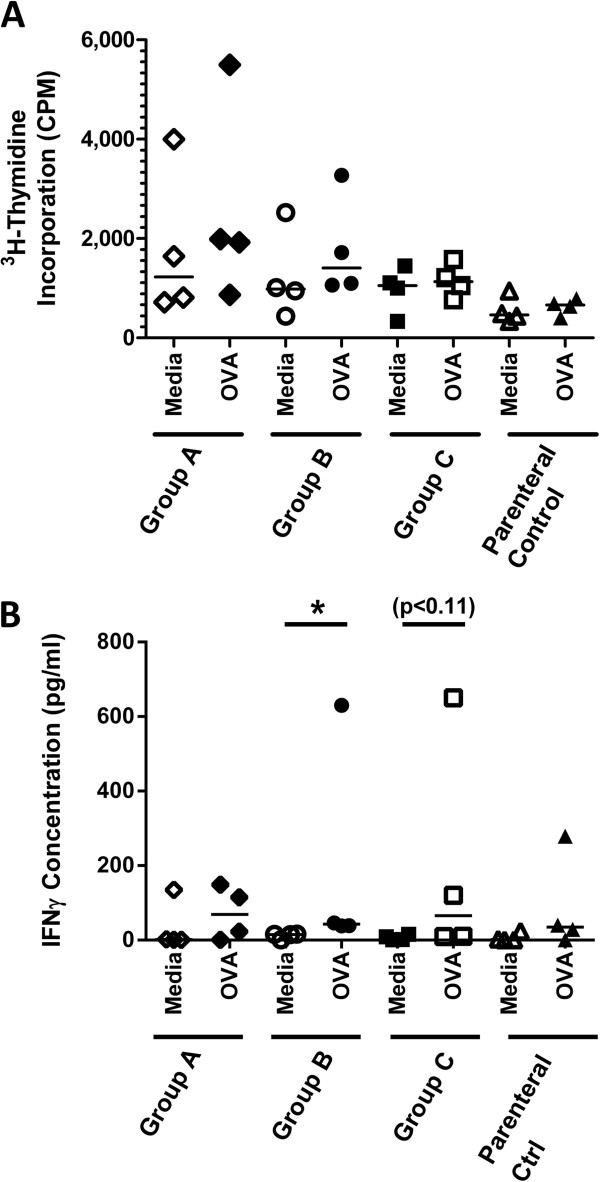
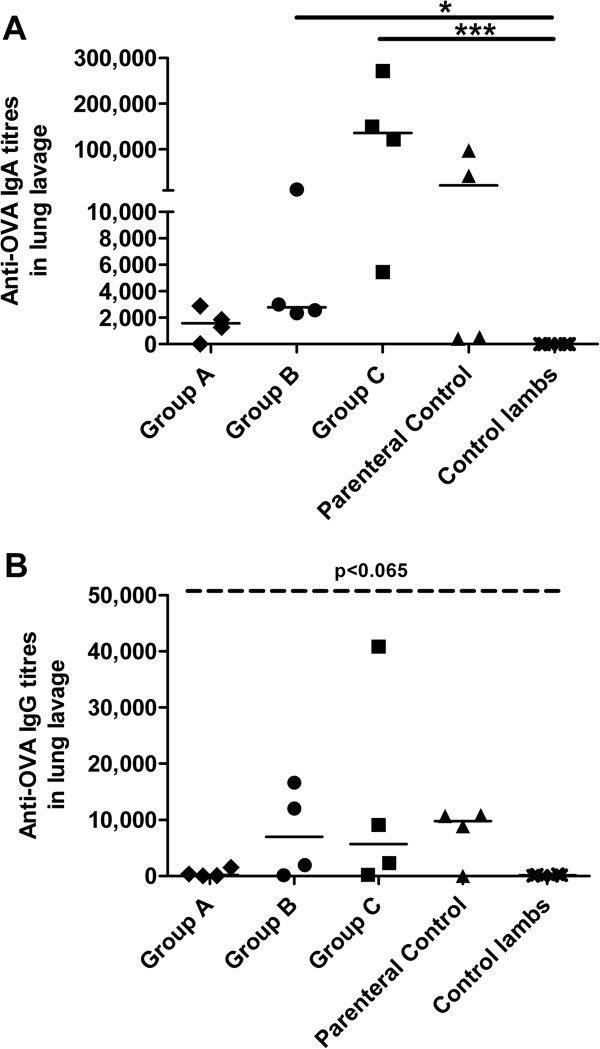
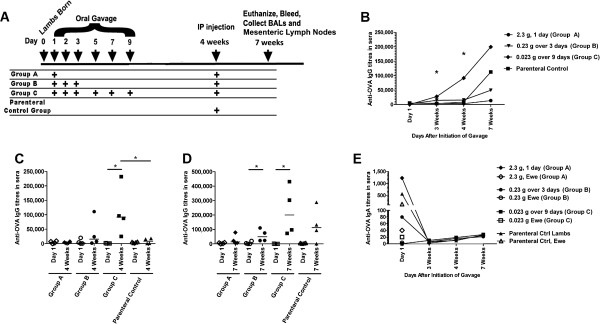
To test this hypothesis, conventionally raised newborn lambs (n = 4 per group) were gavaged with ovalbumin (OVA) starting the day after birth for either a single day (2.27 g), every day for 3 days (0.23 g/day), or every day for 3 days then every second day until nine days of age (0.023 g/day). Lambs gavaged with OVA for 3 to 9 days developed significant serum anti-OVA IgG titres (p < 0.05), but not IgA titres, relative to control lambs (n = 4) after 3 and 4 weeks. At 4 weeks of age, lambs were immunized with OVA in Incomplete Freund's Adjuvant via intraperitoneal (i.p.) injection then lambs were euthanized at 7 weeks. Serum anti-OVA IgG titres were further augmented after i.p. immunization indicating immunity persisted and tolerance was not induced. Serum IgA titres remained low regardless of treatment. It is known that i.p. priming of sheep with antigen in Freund's complete adjuvant leads to an enhanced number of IgA and IgG antibody containing cells in the respiratory mucosa (Immunology 53(2):375-384, 1984). Lambs gavaged with a single bolus of 2.27 g OVA prior to i.p. immunization showed very low titres of anti-OVA IgA in the lung lavage. These data suggest that a single, high dose exposure to OVA can promote tolerance which impacts response to systemic vaccination in later life. Lambs gavaged with 0.023 g OVA for 9 days (Group C) generated significant anti-OVA IgA titres in lung (p < 0.001) compared to negative control lambs but no additive effect was observed compared to parenteral control lambs. When splenocytes were re-stimulated with OVA ex vivo, all groups failed to show increased lymphocyte proliferation or interferon (IFN)-γ production relative to the parenteral control group.
In agreement with our hypothesis, persistent low dose antigen exposure primes humoral antibody production in serum in conventionally raised newborn lambs. In contrast, a single high dose bolus of antigen triggered oral tolerance which negatively impacted the quality and magnitude of the immune response to i.p. immunization in later life. These tangential responses are important as they indicate that the dose and/or repeated oral exposure to antigen, such as that which may be found in the neonate's environment, may promote immunity or alternatively it may negatively impact responses to parenteral vaccination.
先前对新生羔羊的研究确定,腺病毒介导的抗原在肠道局部区域的表达可诱导抗原特异性黏膜和全身免疫。这些实验存在局限性,即引入抗原的肠道局部区域是无菌的,且未评估初乳对抗原的影响,但它们确实表明黏膜疫苗可能是保护新生羔羊的一种有效疫苗接种策略。我们提出,在生命极早期持续口服抗原暴露可在羔羊中诱导免疫,尽管存在共生细菌和初乳。
为了验证这一假设,从出生后第二天开始,对常规饲养的新生羔羊(每组n = 4)灌胃给予卵清蛋白(OVA),分别为单次给药(2.27 g)、连续3天每天给药(0.23 g/天)或连续3天每天给药,然后每两天给药一次直至9日龄(0.023 g/天)。与对照羔羊(n = 4)相比,在3周和4周后,接受OVA灌胃3至9天的羔羊产生了显著的血清抗OVA IgG滴度(p < 0.05),但IgA滴度未升高。在4周龄时,通过腹腔内(i.p.)注射用不完全弗氏佐剂中的OVA对羔羊进行免疫,然后在7周时对羔羊实施安乐死。腹腔内免疫后血清抗OVA IgG滴度进一步升高,表明免疫持续存在且未诱导耐受性。无论治疗如何,血清IgA滴度均保持较低水平。已知用弗氏完全佐剂中的抗原对绵羊进行腹腔内初次免疫会导致呼吸道黏膜中含IgA和IgG抗体的细胞数量增加(《免疫学》53(2):375 - 384, 1984)。在腹腔内免疫前单次灌胃2.27 g OVA的羔羊在肺灌洗中显示出极低的抗OVA IgA滴度。这些数据表明,单次高剂量暴露于OVA可促进耐受性,这会影响后期对全身疫苗接种的反应。与阴性对照羔羊相比,连续9天灌胃0.023 g OVA的羔羊(C组)在肺中产生了显著的抗OVA IgA滴度(p < 0.001),但与非肠道对照羔羊相比未观察到累加效应。当用OVA在体外重新刺激脾细胞时,与非肠道对照组相比,所有组均未显示淋巴细胞增殖增加或干扰素(IFN)-γ产生增加。
与我们的假设一致,在常规饲养的新生羔羊中,持续低剂量抗原暴露可引发血清中的体液抗体产生。相比之下,单次高剂量推注抗原会引发口服耐受性,这对后期腹腔内免疫的免疫反应质量和强度产生负面影响。这些附带反应很重要,因为它们表明抗原的剂量和/或反复口服暴露,例如在新生儿环境中可能出现的情况,可能促进免疫,或者可能对非肠道疫苗接种的反应产生负面影响。