Department of Ophthalmology, VU University Medical Centre, PO Box 7057, Amsterdam, MB, 1007, The Netherlands.
BMC Psychiatry. 2013 Aug 9;13:209. doi: 10.1186/1471-244X-13-209.
Subthreshold depression and anxiety are common in the growing population of visually impaired older adults and increase the risk of full-blown depressive or anxiety disorders. Adequate treatment may prevent the development of depression or anxiety in this high risk group.
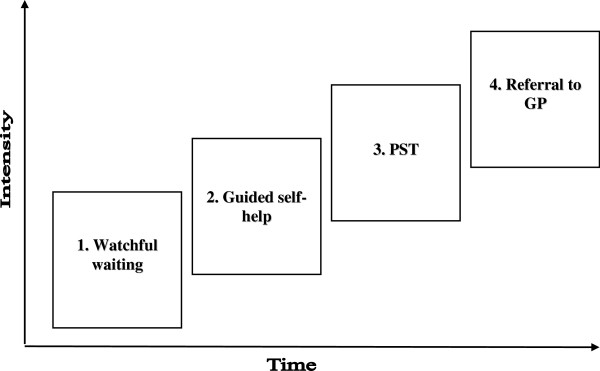
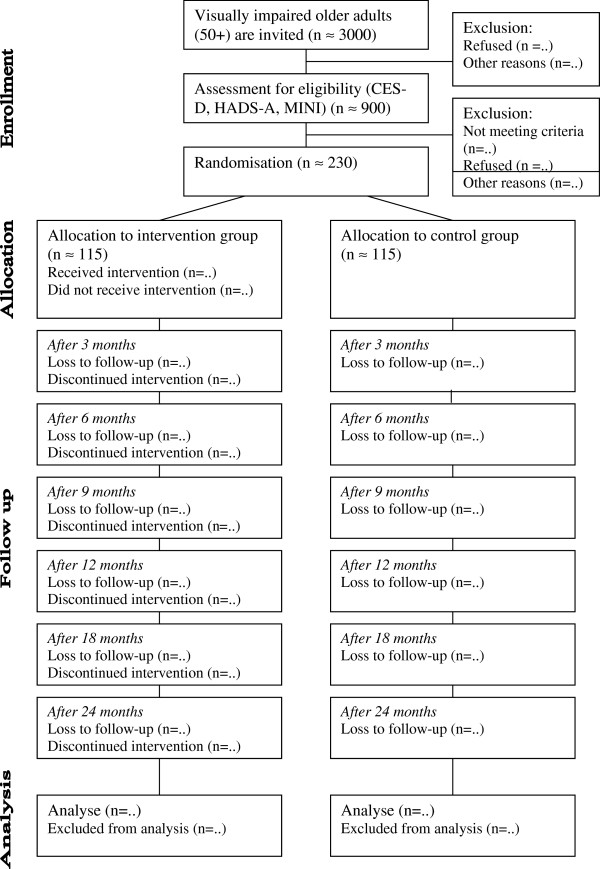
METHOD/DESIGN: A stepped-care programme was developed based on other effective interventions and focus groups with professionals and patient representatives of three low vision rehabilitation organisations in The Netherlands and Belgium. The final programme consists of four steps: 1) watchful waiting, 2) guided self-help, 3) problem solving treatment, 4) referral to general practitioner. The (cost-)effectiveness of this programme is evaluated in a randomised controlled trial. Patients (N = 230) are randomly assigned to either a treatment group (stepped-care) or a control group (usual care). The primary outcome is the incidence of depressive and anxiety disorders, measured with the Mini International Neuropsychiatric Interview (MINI).
Preventive interventions for depression and anxiety have received little attention in the field of low vision. A stepped-care programme that focuses on both depression and anxiety has never been investigated in visually impaired older adults before. If the intervention is shown to be effective, this study will result in an evidence based treatment programme to prevent depression or anxiety in patients from low vision rehabilitation organisations. The pragmatic design of the study greatly enhances the generalisability of the results. However, a possible limitation is the difficulty to investigate the contribution of each individual step.
Identifier: NTR3296.
亚临床抑郁和焦虑在视力受损的老年人群中较为常见,且会增加发展为重度抑郁或焦虑障碍的风险。对于这一高风险群体,充分的治疗可能有助于预防抑郁或焦虑的发生。
方法/设计:以其他有效的干预措施为基础,结合荷兰和比利时的 3 个低视力康复组织的专业人员和患者代表的焦点小组,制定了一种递进式护理方案。最终方案包括四个步骤:1)观察等待,2)指导自助,3)解决问题治疗,4)转介给全科医生。该方案的(成本)效益将在一项随机对照试验中进行评估。患者(N=230)被随机分配到治疗组(递进式护理)或对照组(常规护理)。主要结局是使用 Mini 国际神经精神访谈(MINI)评估抑郁和焦虑障碍的发生率。
在低视力领域,针对抑郁和焦虑的预防干预措施受到的关注较少。以前从未在视力受损的老年人中研究过专注于抑郁和焦虑的递进式护理方案。如果干预措施被证明有效,本研究将为低视力康复组织的患者提供一种基于证据的预防抑郁或焦虑的治疗方案。研究的实用设计极大地提高了结果的普遍性。但是,一个可能的局限性是难以调查每个单独步骤的贡献。
标识符:NTR3296。