Department of Biochemistry, Molecular Biology and Biophysics, Institute for Molecular Virology, Center for Genome Engineering, Masonic Cancer Center, University of Minnesota, Minneapolis, MN 55455, USA.
J Mol Biol. 2013 Nov 15;425(22):4442-54. doi: 10.1016/j.jmb.2013.07.040. Epub 2013 Aug 11.
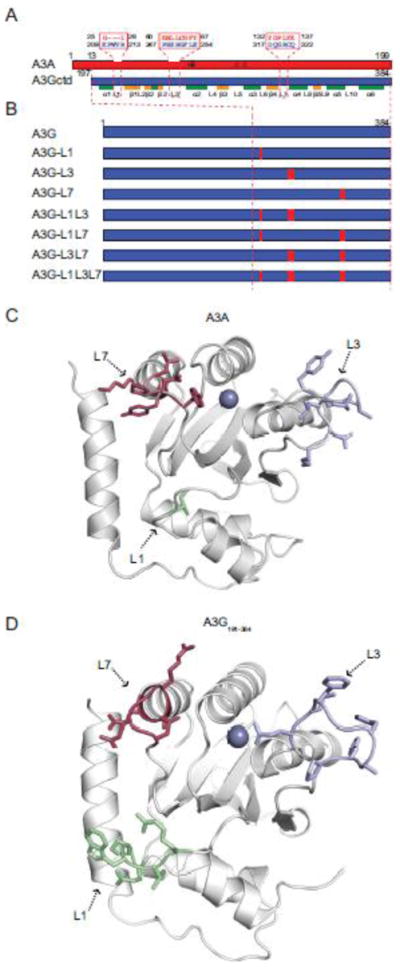
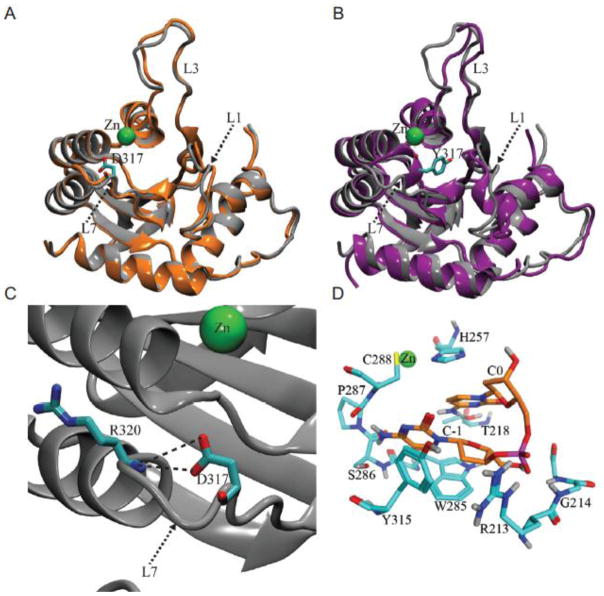
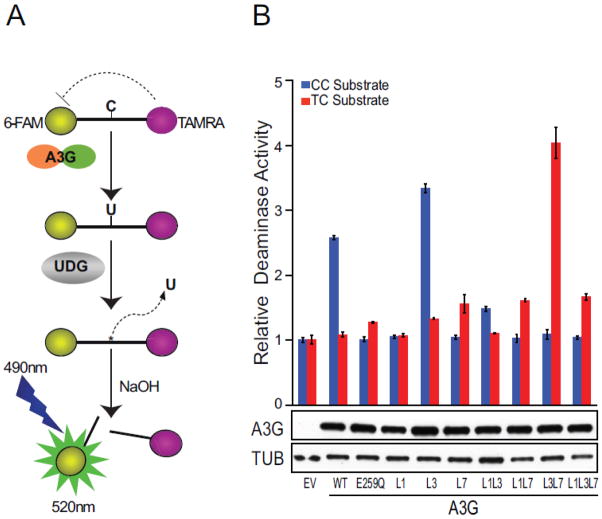
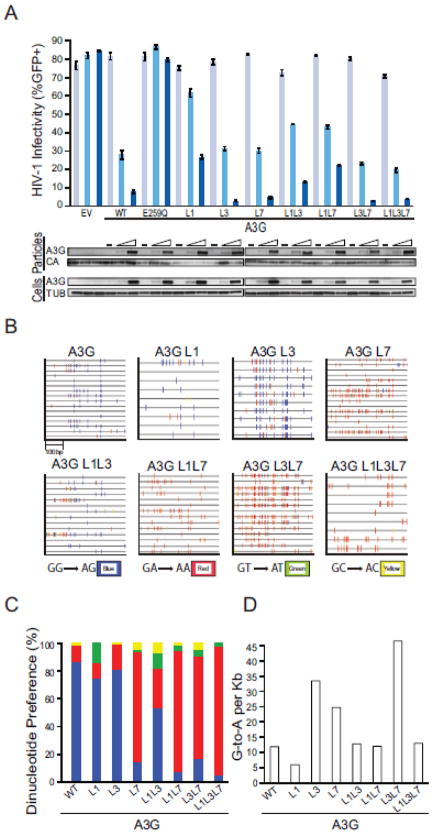
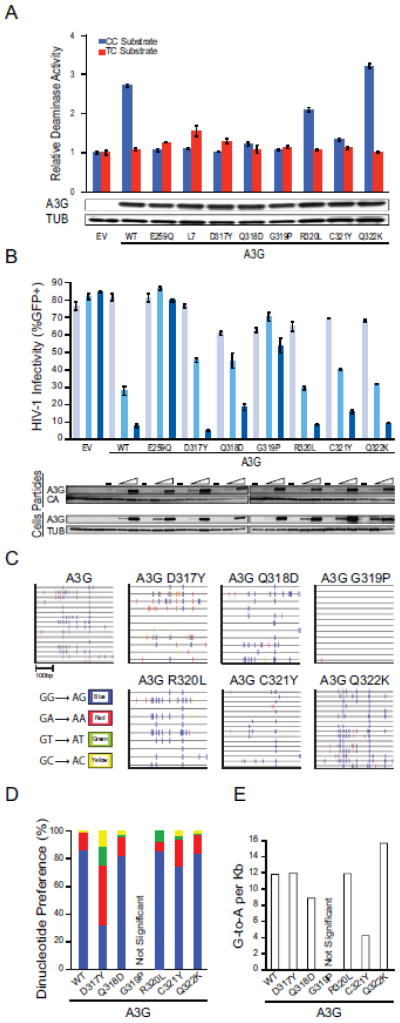
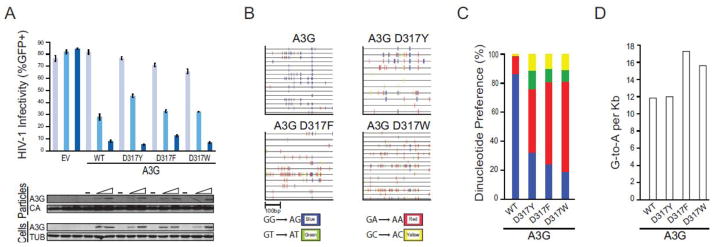
APOBEC3A and APOBEC3G are DNA cytosine deaminases with biological functions in foreign DNA and retrovirus restriction, respectively. APOBEC3A has an intrinsic preference for cytosine preceded by thymine (5'-TC) in single-stranded DNA substrates, whereas APOBEC3G prefers the target cytosine to be preceded by another cytosine (5'-CC). To determine the amino acids responsible for these strong dinucleotide preferences, we analyzed a series of chimeras in which putative DNA binding loop regions of APOBEC3G were replaced with the corresponding regions from APOBEC3A. Loop 3 replacement enhanced APOBEC3G catalytic activity but did not alter its intrinsic 5'-CC dinucleotide substrate preference. Loop 7 replacement caused APOBEC3G to become APOBEC3A-like and strongly prefer 5'-TC substrates. Simultaneous loop 3/7 replacement resulted in a hyperactive APOBEC3G variant that also preferred 5'-TC dinucleotides. Single amino acid exchanges revealed D317 as a critical determinant of dinucleotide substrate specificity. Multi-copy explicitly solvated all-atom molecular dynamics simulations suggested a model in which D317 acts as a helix-capping residue by constraining the mobility of loop 7, forming a novel binding pocket that favorably accommodates cytosine. All catalytically active APOBEC3G variants, regardless of dinucleotide preference, retained human immunodeficiency virus type 1 restriction activity. These data support a model in which the loop 7 region governs the selection of local dinucleotide substrates for deamination but is unlikely to be part of the higher level targeting mechanisms that direct these enzymes to biological substrates such as human immunodeficiency virus type 1 cDNA.
APOBEC3A 和 APOBEC3G 是 DNA 胞嘧啶脱氨酶,分别具有对异源 DNA 和逆转录病毒的限制作用。APOBEC3A 对单链 DNA 底物中胸腺嘧啶前导的胞嘧啶(5'-TC)具有内在偏好,而 APOBEC3G 则倾向于靶胞嘧啶前导另一个胞嘧啶(5'-CC)。为了确定导致这些强烈二核苷酸偏好的氨基酸,我们分析了一系列嵌合体,其中 APOBEC3G 的假定 DNA 结合环区被 APOBEC3A 的相应区域取代。环 3 取代增强了 APOBEC3G 的催化活性,但没有改变其内在的 5'-CC 二核苷酸底物偏好。环 7 取代使 APOBEC3G 成为 APOBEC3A 样,并强烈偏好 5'-TC 底物。同时环 3/7 取代导致 APOBEC3G 成为超活性变体,也偏好 5'-TC 二核苷酸。单个氨基酸交换显示 D317 是二核苷酸底物特异性的关键决定因素。多拷贝显式溶剂化全原子分子动力学模拟提出了一个模型,其中 D317 通过限制环 7 的流动性来充当螺旋帽残基,形成一个有利于容纳胞嘧啶的新结合口袋。所有具有催化活性的 APOBEC3G 变体,无论二核苷酸偏好如何,都保留了人类免疫缺陷病毒 1 型的限制活性。这些数据支持这样一种模型,即环 7 区域控制脱氨酶局部二核苷酸底物的选择,但不太可能是指导这些酶到生物底物(如人类免疫缺陷病毒 1 cDNA)的更高水平靶向机制的一部分。