School of Biological and Chemical Sciences, Queen Mary, University of London, London, United Kingdom.
PLoS One. 2013 Aug 5;8(8):e71125. doi: 10.1371/journal.pone.0071125. Print 2013.
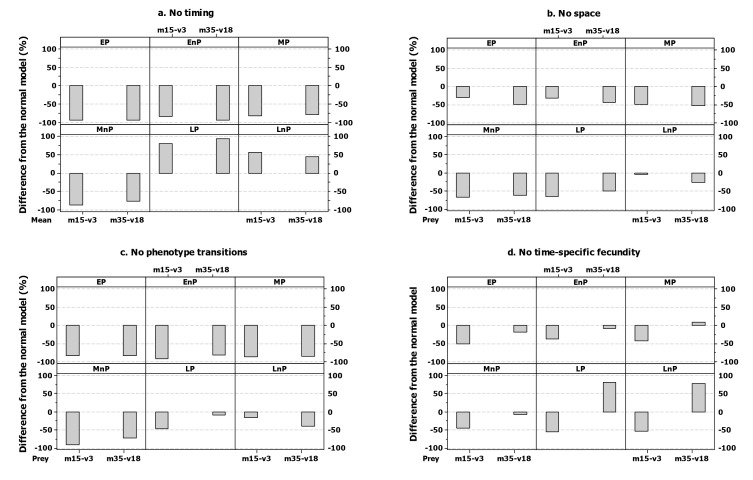
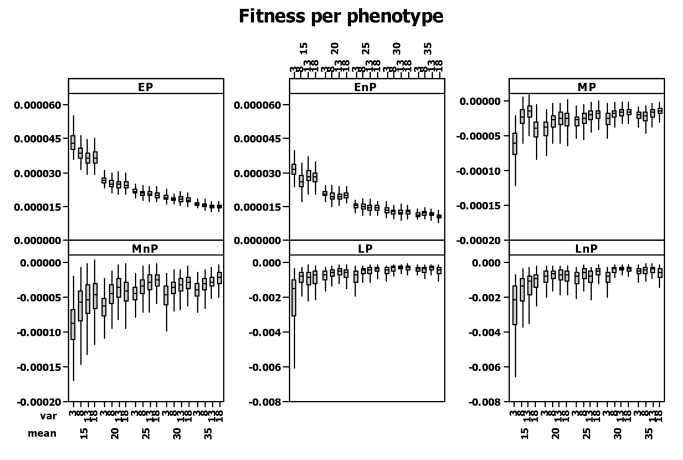
Evolutionary change is a characteristic of living organisms and forms one of the ways in which species adapt to changed conditions. However, most ecological models do not incorporate this ubiquitous phenomenon. We have developed a model that takes a 'phenotypic gambit' approach and focuses on changes in the frequency of phenotypes (which differ in timing of breeding and fecundity) within a population, using, as an example, seasonal breeding. Fitness per phenotype calculated as the individual's contribution to population growth on an annual basis coincide with the population dynamics per phenotype. Simplified model variants were explored to examine whether the complexity included in the model is justified. Outputs from the spatially implicit model underestimated the number of individuals across all phenotypes. When no phenotype transitions are included (i.e. offspring always inherit their parent's phenotype) numbers of all individuals are always underestimated. We conclude that by using a phenotypic gambit approach evolutionary dynamics can be incorporated into individual based models, and that all that is required is an understanding of the probability of offspring inheriting the parental phenotype.
进化变化是生物体的特征之一,也是物种适应变化条件的方式之一。然而,大多数生态模型并未纳入这一普遍现象。我们开发了一种模型,采用“表型策略”方法,重点关注种群中表型频率的变化(表型在繁殖时间和繁殖力方面存在差异),以季节性繁殖为例。每个表型的适合度计算为个体对年度种群增长的贡献,与每个表型的种群动态相吻合。我们还探索了简化模型变体,以检验模型中包含的复杂性是否合理。空间隐式模型的输出结果低估了所有表型的个体数量。当不包括任何表型转变时(即后代总是继承其父母的表型),所有个体的数量总是被低估。我们得出结论,通过采用表型策略方法,可以将进化动态纳入基于个体的模型中,而所需的只是理解后代继承父母表型的概率。