• 文献检索
  • 文档翻译
  • 深度研究
  • 学术资讯
  • Suppr Zotero 插件Zotero 插件
  • 邀请有礼
  • 套餐&价格
  • 历史记录
应用&插件
Suppr Zotero 插件Zotero 插件浏览器插件Mac 客户端Windows 客户端微信小程序
定价
高级版会员购买积分包购买API积分包
服务
文献检索文档翻译深度研究API 文档MCP 服务
关于我们
关于 Suppr公司介绍联系我们用户协议隐私条款
关注我们

Suppr 超能文献

核心技术专利:CN118964589B侵权必究
粤ICP备2023148730 号-1Suppr @ 2026

文献检索

告别复杂PubMed语法,用中文像聊天一样搜索,搜遍4000万医学文献。AI智能推荐,让科研检索更轻松。

立即免费搜索

文件翻译

保留排版,准确专业,支持PDF/Word/PPT等文件格式,支持 12+语言互译。

免费翻译文档

深度研究

AI帮你快速写综述,25分钟生成高质量综述,智能提取关键信息,辅助科研写作。

立即免费体验

谁学得更多?内隐序列学习中的文化差异。

Who learns more? Cultural differences in implicit sequence learning.

机构信息

State Key Laboratory of Brain and Cognitive Science, Institute of Psychology, Chinese Academy of Sciences, Beijing, China.

出版信息

PLoS One. 2013 Aug 7;8(8):e71625. doi: 10.1371/journal.pone.0071625. Print 2013.

DOI:10.1371/journal.pone.0071625
PMID:23940773
原文链接:https://pmc.ncbi.nlm.nih.gov/articles/PMC3737123/
Abstract

BACKGROUND

It is well documented that East Asians differ from Westerners in conscious perception and attention. However, few studies have explored cultural differences in unconscious processes such as implicit learning.

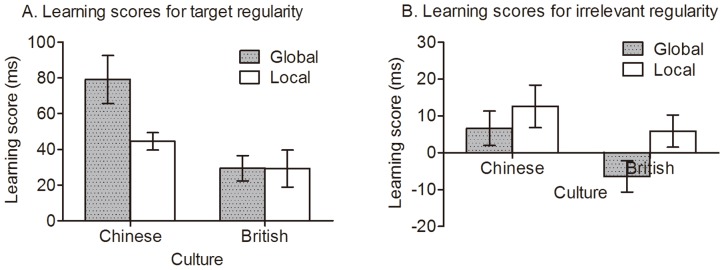
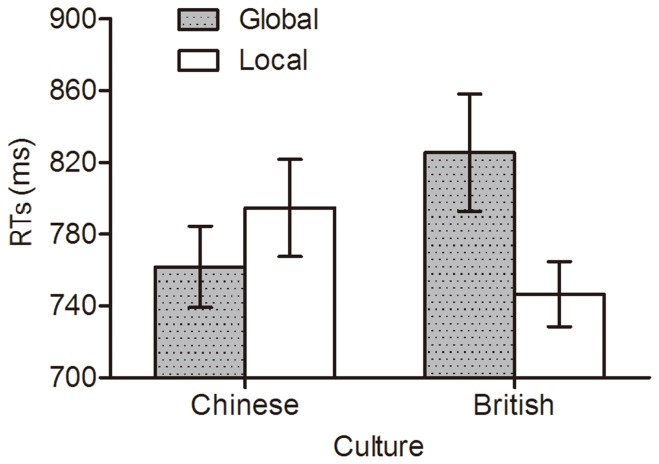
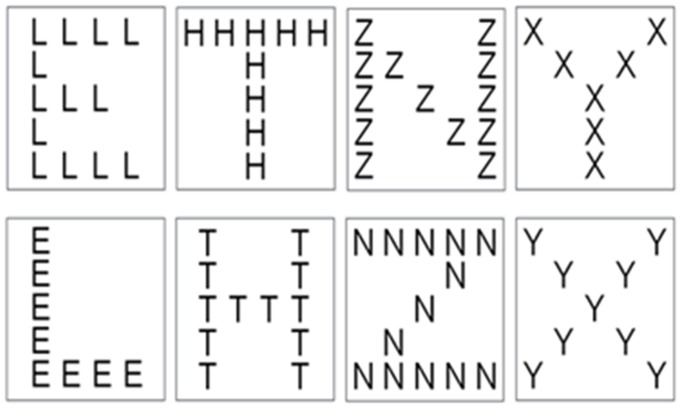
METHODOLOGY/PRINCIPAL FINDINGS: The global-local Navon letters were adopted in the serial reaction time (SRT) task, during which Chinese and British participants were instructed to respond to global or local letters, to investigate whether culture influences what people acquire in implicit sequence learning. Our results showed that from the beginning British expressed a greater local bias in perception than Chinese, confirming a cultural difference in perception. Further, over extended exposure, the Chinese learned the target regularity better than the British when the targets were global, indicating a global advantage for Chinese in implicit learning. Moreover, Chinese participants acquired greater unconscious knowledge of an irrelevant regularity than British participants, indicating that the Chinese were more sensitive to contextual regularities than the British.

CONCLUSIONS/SIGNIFICANCE: The results suggest that cultural biases can profoundly influence both what people consciously perceive and unconsciously learn.

摘要

背景

有大量文献证明东亚人与西方人在意识感知和注意力方面存在差异。然而,很少有研究探索无意识过程中的文化差异,如内隐学习。

方法/主要发现:本研究采用全局-局部纳冯字母任务,在序列反应时间(SRT)任务中,中国和英国参与者被指示对全局或局部字母做出反应,以调查文化是否影响人们在内隐序列学习中获得的内容。结果表明,从一开始,英国人在感知上的局部偏见就大于中国人,这证实了感知方面的文化差异。此外,在长时间的暴露后,当目标为全局时,中国人比英国人更好地学习了目标规则,这表明中国人在内隐学习方面具有全局优势。此外,中国参与者获得了比英国参与者更多的无关规则的无意识知识,这表明中国人比英国人更敏感于上下文规则。

结论/意义:结果表明,文化偏见可以深刻地影响人们有意识地感知和无意识地学习的内容。
https://cdn.ncbi.nlm.nih.gov/pmc/blobs/b98f/3737123/8097be8f4660/pone.0071625.g005.jpg
https://cdn.ncbi.nlm.nih.gov/pmc/blobs/b98f/3737123/8150785d3ea4/pone.0071625.g001.jpg
https://cdn.ncbi.nlm.nih.gov/pmc/blobs/b98f/3737123/800fe6c24b71/pone.0071625.g002.jpg
https://cdn.ncbi.nlm.nih.gov/pmc/blobs/b98f/3737123/17d49e2f24d4/pone.0071625.g003.jpg
https://cdn.ncbi.nlm.nih.gov/pmc/blobs/b98f/3737123/9cb3dbcdddfd/pone.0071625.g004.jpg
https://cdn.ncbi.nlm.nih.gov/pmc/blobs/b98f/3737123/8097be8f4660/pone.0071625.g005.jpg
https://cdn.ncbi.nlm.nih.gov/pmc/blobs/b98f/3737123/8150785d3ea4/pone.0071625.g001.jpg
https://cdn.ncbi.nlm.nih.gov/pmc/blobs/b98f/3737123/800fe6c24b71/pone.0071625.g002.jpg
https://cdn.ncbi.nlm.nih.gov/pmc/blobs/b98f/3737123/17d49e2f24d4/pone.0071625.g003.jpg
https://cdn.ncbi.nlm.nih.gov/pmc/blobs/b98f/3737123/9cb3dbcdddfd/pone.0071625.g004.jpg
https://cdn.ncbi.nlm.nih.gov/pmc/blobs/b98f/3737123/8097be8f4660/pone.0071625.g005.jpg

相似文献

1
Who learns more? Cultural differences in implicit sequence learning.谁学得更多?内隐序列学习中的文化差异。
PLoS One. 2013 Aug 7;8(8):e71625. doi: 10.1371/journal.pone.0071625. Print 2013.
2
Cross cultural differences in unconscious knowledge.无意识知识的跨文化差异。
Cognition. 2012 Jul;124(1):16-24. doi: 10.1016/j.cognition.2012.03.009. Epub 2012 May 5.
3
Theta Signal Transfer from Parietal to Prefrontal Cortex Ignites Conscious Awareness of Implicit Knowledge during Sequence Learning.顶叶到前额叶的θ信号传递在序列学习中点燃了隐性知识的意识觉察。
J Neurosci. 2023 Oct 4;43(40):6760-6778. doi: 10.1523/JNEUROSCI.2172-22.2023. Epub 2023 Aug 22.
4
Unconsciously learning task-irrelevant perceptual sequences.无意识学习任务无关的知觉序列。
Conscious Cogn. 2013 Mar;22(1):203-11. doi: 10.1016/j.concog.2012.12.001. Epub 2013 Jan 12.
5
Negative affect reduces performance in implicit sequence learning.消极情绪会降低内隐序列学习的表现。
PLoS One. 2013;8(1):e54693. doi: 10.1371/journal.pone.0054693. Epub 2013 Jan 22.
6
Dopamine transporter genotype predicts implicit sequence learning.多巴胺转运体基因型预测内隐序列学习。
Behav Brain Res. 2011 Jan 1;216(1):452-7. doi: 10.1016/j.bbr.2010.08.043. Epub 2010 Sep 8.
7
Lateralized implicit sequence learning in uni- and bi-manual conditions.单侧和双手条件下的内隐序列学习。
Brain Cogn. 2013 Feb;81(1):1-9. doi: 10.1016/j.bandc.2012.09.002. Epub 2012 Nov 9.
8
How implicit is visual statistical learning?视觉统计学习有多隐式?
J Exp Psychol Learn Mem Cogn. 2012 Sep;38(5):1425-31. doi: 10.1037/a0027210. Epub 2012 Feb 13.
9
What is the impact of the explicit knowledge of sequence regularities on both deterministic and probabilistic serial reaction time task performance?序列规律的显性知识对确定性和概率性序列反应时任务表现有何影响?
Mem Cognit. 2008 Oct;36(7):1283-98. doi: 10.3758/MC.36.7.1283.
10
A sequence identification measurement model to investigate the implicit learning of metrical temporal patterns.一个用于研究韵律时间模式内隐学习的序列识别测量模型。
PLoS One. 2013 Sep 25;8(9):e75163. doi: 10.1371/journal.pone.0075163. eCollection 2013.

引用本文的文献

1
What is the optimal neuropsychological test battery for schizophrenia in China?在中国,精神分裂症的最佳神经心理学测试组合是什么?
Schizophr Res. 2019 Jun;208:317-323. doi: 10.1016/j.schres.2019.01.034. Epub 2019 Feb 1.
2
Cross-cultural differences in implicit learning of chunks versus symmetries.组块与对称性内隐学习中的跨文化差异。
R Soc Open Sci. 2018 Oct 17;5(10):180469. doi: 10.1098/rsos.180469. eCollection 2018 Oct.
3
Using Bayes to get the most out of non-significant results.贝叶斯推断在不显著结果中的应用。

本文引用的文献

1
Bayesian Versus Orthodox Statistics: Which Side Are You On?贝叶斯统计与经典统计:你站在哪一边?
Perspect Psychol Sci. 2011 May;6(3):274-90. doi: 10.1177/1745691611406920.
2
Self-insight in probabilistic category learning.概率性类别学习中的自我洞察
J Gen Psychol. 2013 Jan-Mar;140(1):57-81. doi: 10.1080/00221309.2012.735284.
3
Negative affect reduces performance in implicit sequence learning.消极情绪会降低内隐序列学习的表现。
Front Psychol. 2014 Jul 29;5:781. doi: 10.3389/fpsyg.2014.00781. eCollection 2014.
PLoS One. 2013;8(1):e54693. doi: 10.1371/journal.pone.0054693. Epub 2013 Jan 22.
4
Implicit learning of mappings between forms and metaphorical meanings.形式与隐喻意义之间映射的内隐学习。
Conscious Cogn. 2013 Mar;22(1):174-83. doi: 10.1016/j.concog.2012.11.011. Epub 2013 Jan 8.
5
Cross cultural differences in unconscious knowledge.无意识知识的跨文化差异。
Cognition. 2012 Jul;124(1):16-24. doi: 10.1016/j.cognition.2012.03.009. Epub 2012 May 5.
6
Rapidly measuring the speed of unconscious learning: amnesics learn quickly and happy people slowly.快速测量无意识学习的速度:健忘症患者学得快,快乐者学得慢。
PLoS One. 2012;7(3):e33400. doi: 10.1371/journal.pone.0033400. Epub 2012 Mar 23.
7
Unconscious structural knowledge of tonal symmetry: Tang poetry redefines limits of implicit learning.无意识的声调对称结构知识:唐诗重新定义了内隐学习的极限。
Conscious Cogn. 2012 Mar;21(1):476-86. doi: 10.1016/j.concog.2011.12.009. Epub 2012 Jan 23.
8
Culture and change blindness.文化与变化盲视。
Cogn Sci. 2006 Mar 4;30(2):381-99. doi: 10.1207/s15516709cog0000_63.
9
Perceptual effect on motor learning in the serial reaction-time task.序列反应时任务中的知觉效应对运动学习的影响。
J Gen Psychol. 2011 Apr-Jun;138(2):110-26. doi: 10.1080/00221309.2010.542509.
10
Interference between sentence processing and probabilistic implicit sequence learning.句子处理与概率性内隐序列学习的相互干扰。
PLoS One. 2011 Mar 8;6(3):e17577. doi: 10.1371/journal.pone.0017577.