School of Geography and Environmental Studies, University of Tasmania, Hobart, Tasmania, Australia.
PLoS One. 2013 Aug 5;8(8):e72093. doi: 10.1371/journal.pone.0072093. Print 2013.
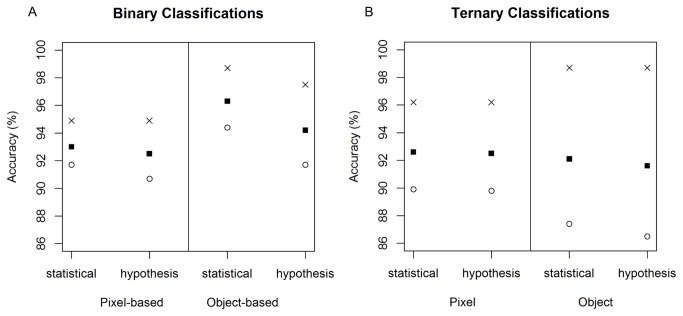
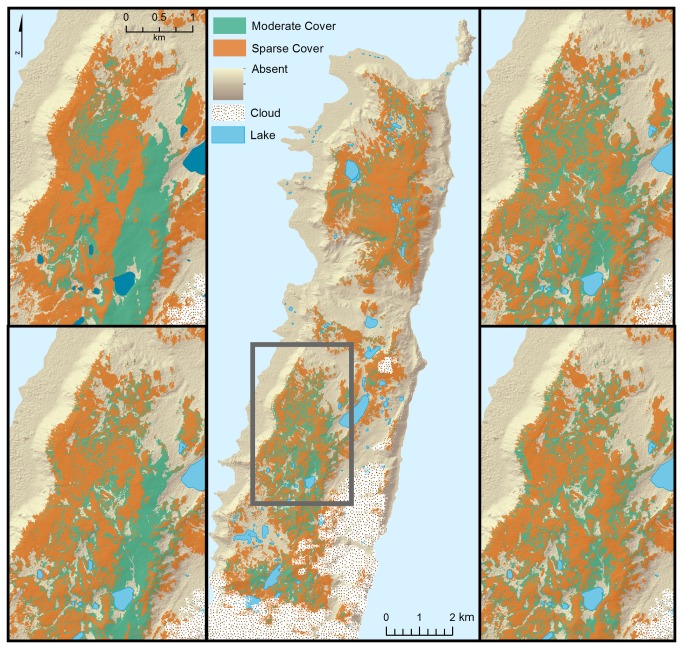
Monitoring changes in the distribution and density of plant species often requires accurate and high-resolution baseline maps of those species. Detecting such change at the landscape scale is often problematic, particularly in remote areas. We examine a new technique to improve accuracy and objectivity in mapping vegetation, combining species distribution modelling and satellite image classification on a remote sub-Antarctic island. In this study, we combine spectral data from very high resolution WorldView-2 satellite imagery and terrain variables from a high resolution digital elevation model to improve mapping accuracy, in both pixel- and object-based classifications. Random forest classification was used to explore the effectiveness of these approaches on mapping the distribution of the critically endangered cushion plant Azorella macquariensis Orchard (Apiaceae) on sub-Antarctic Macquarie Island. Both pixel- and object-based classifications of the distribution of Azorella achieved very high overall validation accuracies (91.6-96.3%, κ = 0.849-0.924). Both two-class and three-class classifications were able to accurately and consistently identify the areas where Azorella was absent, indicating that these maps provide a suitable baseline for monitoring expected change in the distribution of the cushion plants. Detecting such change is critical given the threats this species is currently facing under altering environmental conditions. The method presented here has applications to monitoring a range of species, particularly in remote and isolated environments.
监测植物物种分布和密度的变化通常需要这些物种的准确和高分辨率的基线地图。在景观尺度上检测这种变化通常是有问题的,尤其是在偏远地区。我们研究了一种新的技术,以提高在偏远的亚南极岛屿上绘制植被图的准确性和客观性。在这项研究中,我们将高分辨率数字高程模型中的地形变量与高分辨率 WorldView-2 卫星图像的光谱数据相结合,以提高像素和基于对象的分类中的制图精度。随机森林分类用于探索这些方法在绘制极度濒危垫状植物 Azorella macquariensis Orchard(伞形科)在亚南极麦夸里岛的分布上的有效性。Azorella 分布的基于像素和基于对象的分类都达到了非常高的总体验证精度(91.6-96.3%,κ=0.849-0.924)。两分类和三分类都能够准确一致地识别出 Azorella 不存在的区域,这表明这些地图为监测垫状植物分布的预期变化提供了合适的基线。鉴于该物种目前在不断变化的环境条件下面临的威胁,检测这种变化至关重要。这里提出的方法适用于监测一系列物种,特别是在偏远和孤立的环境中。