Center for Gerontology and Health Care Research, Brown University, 121 S. Main St., Providence, RI 02912, USA.
J Rural Health. 2013 Aug;29 Suppl 1(0 1):s1-6. doi: 10.1111/jrh.12007. Epub 2013 Feb 22.
Observation care is used to evaluate patients prior to admission or discharge. Often beneficial, such care also imposes greater financial liability on Medicare beneficiaries. While the use of observation care has increased recently, critical access hospitals (CAHs) face different policies than prospective payment (PPS) hospitals, which may influence their observation care use.
We used 100% Medicare inpatient and outpatient claims files and enrollment data for years 2007 to 2009, and the 2007 American Hospital Association data to compare trends in the likelihood, prevalence and duration of observation stays between CAHs and PPS hospitals in metro and non-metro areas among fee-for-service Medicare beneficiaries over age 65.
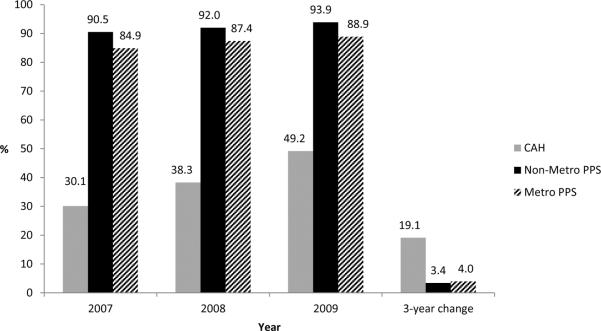
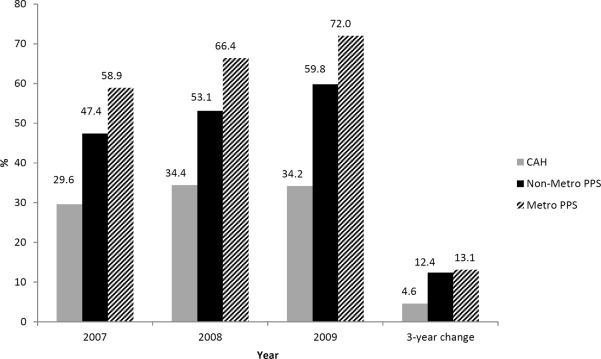
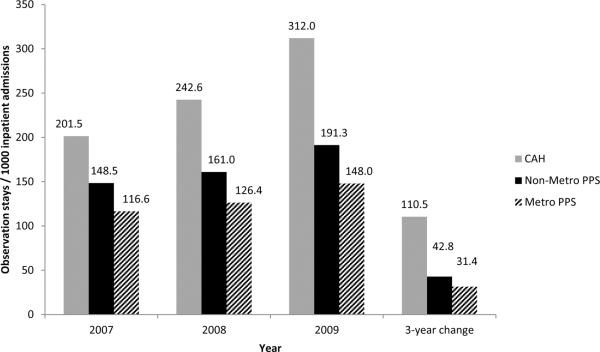
While PPS hospitals are more likely to provide any observation care, the 3-year increase in the proportion of CAHs providing any observation care is approximately 5 times as great as the increase among PPS hospitals. Among hospitals providing any observation care in 2007, the prevalence at CAHs was 35.7% higher than at non-metro PPS hospitals and 72.8% higher than at metro PPS hospitals. By 2009, these respective figures had increased to 63.1% and 111%. Average stay duration increased more slowly for CAHs than for PPS hospitals.
These data suggest that a growing proportion of CAHs are providing observation care and that CAHs provide relatively more observation care than PPS hospitals, but they have shorter average stays. This may have important financial implications for Medicare beneficiaries.
观察护理用于在患者入院或出院前进行评估。这种护理通常是有益的,但也会给医疗保险受益人的财务带来更大的负担。尽管观察护理的使用最近有所增加,但基层医疗机构(CAHs)面临的政策与预期支付(PPS)医院不同,这可能会影响它们的观察护理使用。
我们使用了 2007 年至 2009 年的 100%医疗保险住院和门诊理赔文件和参保数据,以及 2007 年美国医院协会的数据,比较了在服务收费制医疗保险受益人中,65 岁以上的大都市和非大都市地区的基层医疗机构和 PPS 医院之间观察护理住院的可能性、流行率和持续时间趋势。
虽然 PPS 医院更有可能提供任何观察护理,但基层医疗机构提供任何观察护理的比例在 3 年内增加了约 5 倍,而 PPS 医院的这一比例仅增加了 1 倍。在 2007 年提供任何观察护理的医院中,基层医疗机构的观察护理患病率比非大都市 PPS 医院高 35.7%,比大都市 PPS 医院高 72.8%。到 2009 年,这一数字分别增加到 63.1%和 111%。基层医疗机构的平均住院时间增加速度比 PPS 医院慢。
这些数据表明,越来越多的基层医疗机构提供观察护理,而且基层医疗机构提供的观察护理比 PPS 医院相对更多,但它们的平均住院时间较短。这可能对医疗保险受益人产生重要的财务影响。