Nordin Annica, Jensen-Urstad Kerstin, Björnådal Lena, Pettersson Susanne, Larsson Anders, Svenungsson Elisabet
Arthritis Res Ther. 2013 Aug 14;15(4):R87. doi: 10.1186/ar4267.
While microvascular disease is well described in systemic sclerosis (SSc), it is still unclear whether the occurrence of ischemic macrovascular events and atherosclerosis is enhanced among patients with SSc.
In this study, 111 SSc patients (74% of prevalent cases in Stockholm County) and 105 age- and sex-comparable population controls were investigated. Previous ischemic arterial events were tabulated. As surrogate measures of atherosclerosis, plaque occurrence and intima-media thickness (IMT) were determined with carotid ultrasound and the ankle-brachial index (ABI) was calculated. Traditional cardiovascular risk factors were recorded and we also measured biomarkers indicating systemic inflammation and endothelial activation/dysfunction.
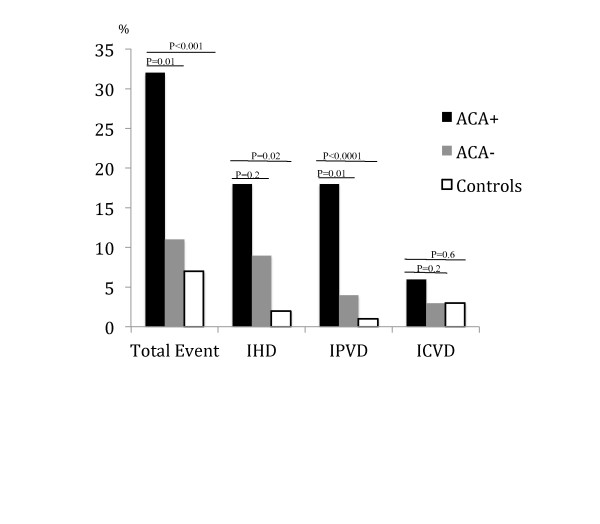
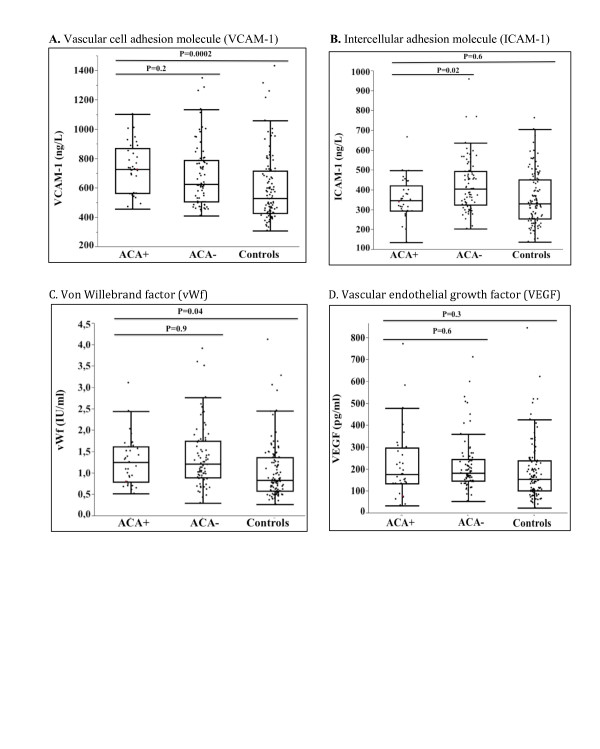
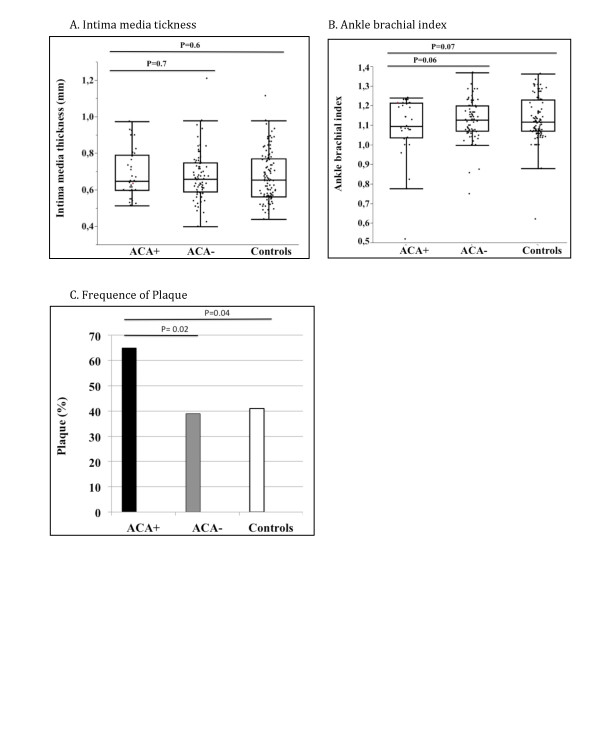
Mean age was 62 ± 12 years for patients and controls. Ischemic arterial events were more common, due to increased occurrence of ischemic heart disease (IHD) and ischemic peripheral vascular disease (IPVD), in the patient group (12% vs. 4%, P = 0.03 and 9% vs. 0%, P = 0.003 respectively). On a group level, there was no difference regarding the occurrence of ischemic cerebrovascular disease, the frequency of plaques, IMT or ABI between SSc patients and controls. Subgroup analyses revealed that patients with anticentromere antibodies (ACA+) had more plaques and more ischemic arterial events compared to other SSc patients (67% vs. 39% and 32% vs. 11%; P = 0.006 and P = 0.01, respectively) and compared to controls (67% vs. 41% and 32% vs. 7%, P = 0.02 and P = 0.0003, respectively). Biomarkers of inflammation/endothelial activation were generally increased among SSc patients.
Patients with SSc are at enhanced risk for IHD and IPVD. The ACA+ SSc subgroup was particularly affected with both ischemic arterial events and premature atherosclerosis. The microvascular vulnerability of ACA+ patients is previously well documented. We demonstrate that ACA+ SSc patients have an enhanced risk of macrovascular injury as well. This group should be followed closely and modifiable cardiovascular risk factors should be treated at an early stage.
虽然系统性硬化症(SSc)中的微血管疾病已有详尽描述,但SSc患者发生缺血性大血管事件和动脉粥样硬化的风险是否增加仍不明确。
在本研究中,对111例SSc患者(占斯德哥尔摩县现患病例的74%)和105例年龄及性别匹配的人群对照进行了调查。统计既往缺血性动脉事件。通过颈动脉超声测定斑块发生率和内膜中层厚度(IMT)作为动脉粥样硬化的替代指标,并计算踝臂指数(ABI)。记录传统心血管危险因素,同时我们还检测了提示全身炎症和内皮激活/功能障碍的生物标志物。
患者和对照组的平均年龄均为62±12岁。患者组因缺血性心脏病(IHD)和缺血性外周血管疾病(IPVD)发生率增加,缺血性动脉事件更为常见(分别为12%对4%,P = 0.03;9%对0%,P = 0.003)。在组间水平上,SSc患者和对照组在缺血性脑血管疾病的发生率、斑块频率、IMT或ABI方面无差异。亚组分析显示,与其他SSc患者相比,抗着丝点抗体阳性(ACA+)的患者有更多斑块和更多缺血性动脉事件(分别为67%对39%和32%对11%;P = 0.006和P = 0.01),与对照组相比也更多(分别为67%对41%和32%对7%,P = 0.02和P = 0.0003)。SSc患者中炎症/内皮激活的生物标志物普遍升高。
SSc患者发生IHD和IPVD的风险增加。ACA+ SSc亚组尤其受到缺血性动脉事件和过早动脉粥样硬化的影响。ACA+患者的微血管易损性此前已有充分记录。我们证明ACA+ SSc患者发生大血管损伤的风险也增加。应对该组患者密切随访,并应在早期治疗可改变的心血管危险因素。