Nga Tran T, Nguyen Marie, Mathisen Roger, Hoa Do T B, Minh Nguyen H, Berger Jacques, Wieringa Frank T
UMR 204 NUTRIPASS « Prevention of Malnutrition and associated pathologies », IRD-UMR2-UMR1, Institute of Research for Development (IRD), Montpellier, France.
Nutr J. 2013 Aug 15;12:120. doi: 10.1186/1475-2891-12-120.
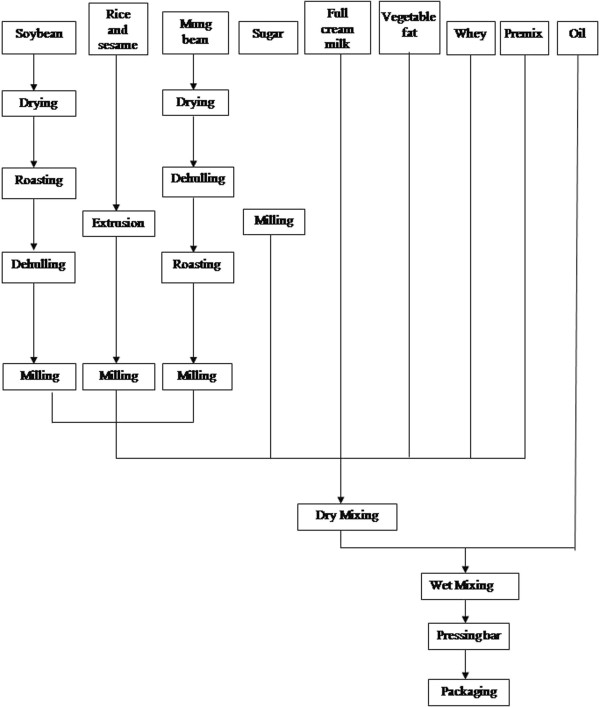
In South East Asia, concerns exist about the acceptability of peanut-based Ready-to-Use-Therapeutic-Foods (RUTF) for the treatment of severe acute malnutrition (SAM). Therefore, an alternative, culturally acceptable RUTF made from locally available ingredients and complying with local food traditions and preferences was developed. The current study evaluated its acceptability and impact on anthropometry.
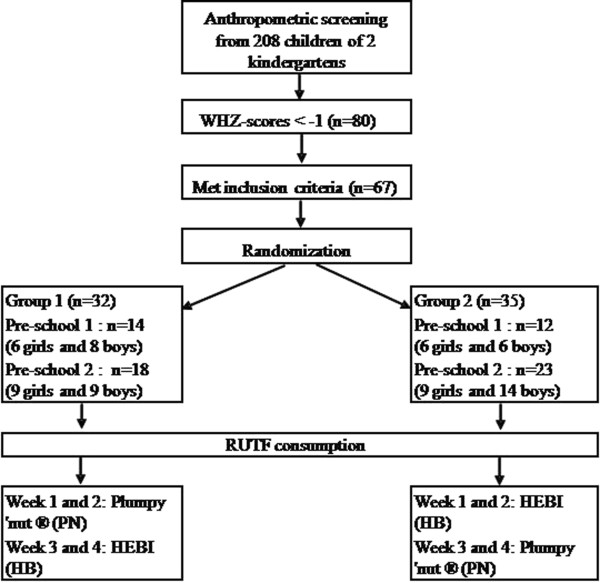
The study was a randomized, two-arm, cross-over intervention trial to test the acceptability of the local product (bar) against a commercially available, peanut-based RUTF paste (Plumpy'nut®). Children (n = 67) from two kindergartens in a rural area of North Vietnam were recruited. The age of the children was between 3 and 5 years.
The Vietnamese RUTF was well-accepted, although overall acceptability was less than of Plumpy'nut®, with the latter scoring higher on palatability (P < 0.05). In contrast, reluctance to eat Plumpy'nut® was higher than for the Vietnamese RUTF (P < 0.05). Impact on anthropmetrical indices was similar for both RUTF. The nutritional status of the children who consumed the two RUTF over a 4 week period improved significantly, with a mean weight gain of 0.64 (SD 0.27) Kg, and increases in WHZ and HAZ z-scores of 0.48 (SD 0.30) and 0.05 (SD 0.13) respectively (P < 0.01 both). Weight gain was similar between the 2 products (0.32 kg per 2 weeks for both).
Both the commercial Plumpy'nut® and the local produced RUTF were accepted although the harder consistency of the local product might have caused the lower overall acceptance. The promising increase in nutritional status needs to be confirmed in a controlled trial in children with SAM.
在东南亚地区,人们对以花生为基础的即食治疗性食品(RUTF)用于治疗重度急性营养不良(SAM)的可接受性存在担忧。因此,开发了一种由当地可得食材制成、符合当地饮食传统和偏好且在文化上可接受的替代RUTF。本研究评估了其可接受性以及对人体测量学的影响。
该研究是一项随机、双臂、交叉干预试验,旨在测试当地产品(棒状)与市售花生基RUTF糊剂(Plumpy'nut®)的可接受性。招募了来自越南北部农村地区两所幼儿园的儿童(n = 67)。儿童年龄在3至5岁之间。
越南RUTF的接受度良好,尽管总体接受度低于Plumpy'nut®,后者在适口性方面得分更高(P < 0.05)。相比之下,不愿食用Plumpy'nut®的情况比越南RUTF更高(P < 0.05)。两种RUTF对人体测量指标的影响相似。在4周内食用这两种RUTF的儿童营养状况显著改善,平均体重增加0.64(标准差0.27)千克,WHZ和HAZ z评分分别增加0.48(标准差0.30)和0.05(标准差0.13)(两者P均< 0.01)。两种产品的体重增加相似(均为每2周0.32千克)。
市售的Plumpy'nut®和当地生产的RUTF均被接受,尽管当地产品较硬的质地可能导致总体接受度较低。营养状况的显著改善需要在SAM儿童的对照试验中得到证实。