Department of Human Biometry and Biomechanics, Faculty of Physical Education and Physical Therapy, Vrije Universiteit Brussel, Pleinlaan 2, B-1050 Brussels, Belgium.
Int J Health Geogr. 2013 Aug 14;12:37. doi: 10.1186/1476-072X-12-37.
The physical environment may play a crucial role in promoting older adults' walking for transportation. However, previous studies on relationships between the physical environment and older adults' physical activity behaviors have reported inconsistent findings. A possible explanation for these inconsistencies is the focus upon studying environmental factors separately rather than simultaneously. The current study aimed to investigate the cumulative influence of perceived favorable environmental factors on older adults' walking for transportation. Additionally, the moderating effect of perceived distance to destinations on this relationship was studied.
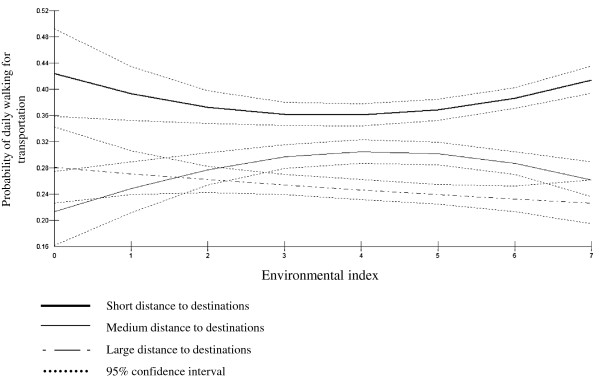
The sample was comprised of 50,685 non-institutionalized older adults residing in Flanders (Belgium). Cross-sectional data on demographics, environmental perceptions and frequency of walking for transportation were collected by self-administered questionnaires in the period 2004-2010. Perceived distance to destinations was categorized into short, medium, and large distance to destinations. An environmental index (=a sum of favorable environmental factors, ranging from 0 to 7) was constructed to investigate the cumulative influence of favorable environmental factors. Multilevel logistic regression analyses were applied to predict probabilities of daily walking for transportation.
For short distance to destinations, probability of daily walking for transportation was significantly higher when seven compared to three, four or five favorable environmental factors were present. For medium distance to destinations, probabilities significantly increased for an increase from zero to four favorable environmental factors. For large distance to destinations, no relationship between the environmental index and walking for transportation was observed.
Our findings suggest that the presence of multiple favorable environmental factors can motivate older adults to walk medium distances to facilities. Future research should focus upon the relationship between older adults' physical activity and multiple environmental factors simultaneously instead of separately.
物理环境可能在促进老年人进行交通出行的步行活动中发挥关键作用。然而,先前关于物理环境与老年人身体活动行为之间关系的研究报告结果并不一致。造成这些不一致的一个可能原因是,研究仅侧重于分别研究环境因素,而不是同时研究。本研究旨在调查感知到的有利环境因素对老年人交通出行步行的累积影响。此外,还研究了目的地感知距离对此关系的调节作用。
该样本由居住在佛兰德斯(比利时)的 50685 名非机构化老年人组成。2004 年至 2010 年间,通过自我管理的问卷收集了关于人口统计学、环境感知和交通出行步行频率的数据。目的地感知距离分为短距离、中距离和长距离。构建了一个环境指数(=有利环境因素的总和,范围从 0 到 7),以研究有利环境因素的累积影响。应用多水平逻辑回归分析预测每日交通出行步行的概率。
对于短距离目的地,与存在三个、四个或五个有利环境因素相比,当存在七个有利环境因素时,每日交通出行步行的概率显著更高。对于中距离目的地,当从零个有利环境因素增加到四个有利环境因素时,概率显著增加。对于长距离目的地,环境指数与交通出行步行之间没有关系。
我们的研究结果表明,存在多个有利环境因素可以激励老年人步行前往中等距离的设施。未来的研究应集中研究同时存在的多个环境因素与老年人身体活动之间的关系,而不是分别研究。