Department of Human Biometry and Biomechanics, Faculty of Physical Education and Physical Therapy, Vrije Universiteit Brussel, Pleinlaan 2, B-1050, Brussels, Belgium.
Int J Behav Nutr Phys Act. 2012 Jul 10;9:85. doi: 10.1186/1479-5868-9-85.
Current knowledge on the relationship between the physical environment and walking for transportation among older adults (≥ 65 years) is limited. Qualitative research can provide valuable information and inform further research. However, qualitative studies are scarce and fail to include neighborhood outings necessary to study participants' experiences and perceptions while interacting with and interpreting the local social and physical environment. The current study sought to uncover the perceived environmental influences on Flemish older adults' walking for transportation. To get detailed and context-sensitive environmental information, it used walk-along interviews.
Purposeful convenience sampling was used to recruit 57 older adults residing in urban or semi-urban areas. Walk-along interviews to and from a destination (e.g. a shop) located within a 15 minutes' walk from the participants' home were conducted. Content analysis was performed using NVivo 9 software (QSR International). An inductive approach was used to derive categories and subcategories from the data.
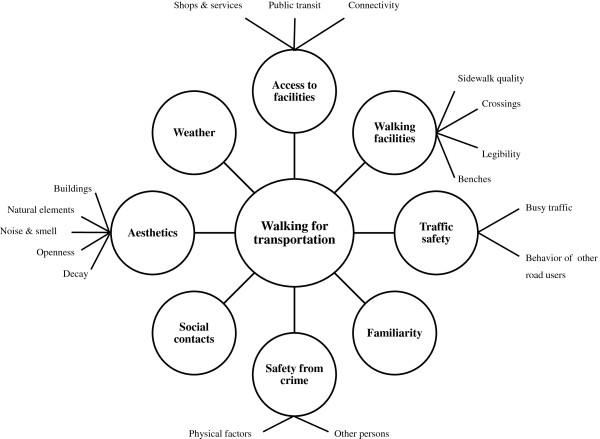
Data were categorized in the following categories and subcategories: access to facilities (shops & services, public transit, connectivity), walking facilities (sidewalk quality, crossings, legibility, benches), traffic safety (busy traffic, behavior of other road users), familiarity, safety from crime (physical factors, other persons), social contacts, aesthetics (buildings, natural elements, noise & smell, openness, decay) and weather.
The findings indicate that to promote walking for transportation a neighborhood should provide good access to shops and services, well-maintained walking facilities, aesthetically appealing places, streets with little traffic and places for social interaction. In addition, the neighborhood environment should evoke feelings of familiarity and safety from crime. Future quantitative studies should investigate if (changes in) these environmental factors relate to (changes in) older adults' walking for transportation.
目前关于老年人(≥65 岁)身体环境与交通性步行之间关系的知识有限。定性研究可以提供有价值的信息,并为进一步的研究提供信息。然而,定性研究很少,并且未能包括必要的邻里出行,以研究参与者在与当地社会和物理环境互动并对其进行解释时的经验和看法。本研究旨在揭示感知环境对 Flemish 老年人交通性步行的影响。为了获取详细和敏感的环境信息,使用了步行访谈。
采用目的性便利抽样招募了 57 名居住在城市或半城市地区的老年人。从参与者家步行 15 分钟范围内的目的地(如商店)进行往返步行访谈。使用 NVivo 9 软件(QSR International)进行内容分析。采用归纳法从数据中得出类别和子类别。
数据分为以下类别和子类别:设施可达性(商店和服务、公共交通、连通性)、步行设施(人行道质量、交叉口、易读性、长凳)、交通安全(繁忙的交通、其他道路使用者的行为)、熟悉度、犯罪安全感(物理因素、其他人)、社会联系、美学(建筑、自然元素、噪音和气味、开放性、衰败)和天气。
研究结果表明,为了促进交通性步行,邻里应提供良好的商店和服务可达性、维护良好的步行设施、美观宜人的场所、交通流量小的街道和社交互动场所。此外,邻里环境应唤起熟悉感和犯罪安全感。未来的定量研究应调查这些环境因素是否与老年人的交通性步行有关。