Interdisciplinary School of Green Energy, Ulsan National Institute of Science and Technology (UNIST), Ulsan, Korea.
Sci Rep. 2013;3:2426. doi: 10.1038/srep02426.
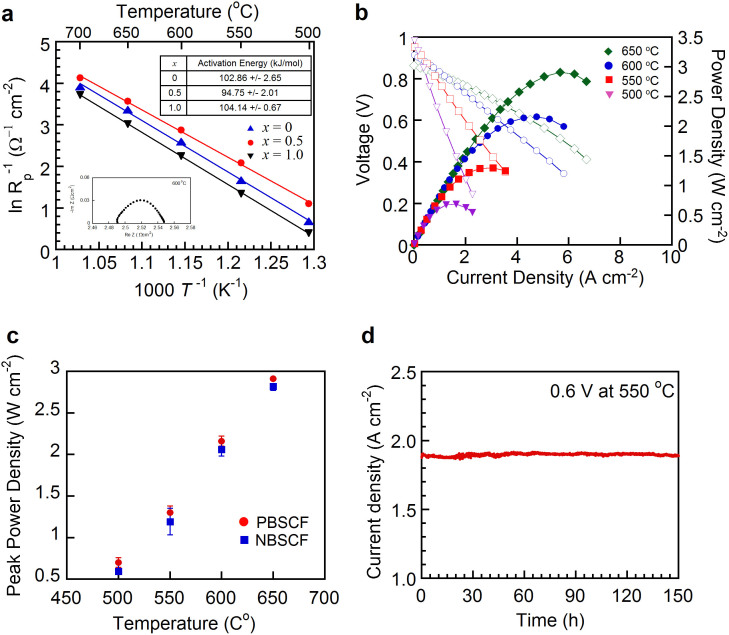
Solid oxide fuel cells (SOFC) are the cleanest, most efficient, and cost-effective option for direct conversion to electricity of a wide variety of fuels. While significant progress has been made in anode materials with enhanced tolerance to coking and contaminant poisoning, cathodic polarization still contributes considerably to energy loss, more so at lower operating temperatures. Here we report a synergistic effect of co-doping in a cation-ordered double-perovskite material, PrBa0.5Sr0.5Co(2-x)Fe(x)O(5+δ), which has created pore channels that dramatically enhance oxygen ion diffusion and surface oxygen exchange while maintaining excellent compatibility and stability under operating conditions. Test cells based on these cathode materials demonstrate peak power densities ~2.2 W cm(-2) at 600°C, representing an important step toward commercially viable SOFC technologies.
固体氧化物燃料电池 (SOFC) 是将各种燃料直接转化为电能的最清洁、最高效和最具成本效益的选择。虽然在耐焦炭和污染物中毒的阳极材料方面已经取得了重大进展,但阴极极化仍然会导致相当大的能量损失,在较低的工作温度下更是如此。在这里,我们报告了在阳离子有序双钙钛矿材料 PrBa0.5Sr0.5Co(2-x)Fe(x)O(5+δ) 中进行共掺杂的协同效应,这种材料形成了孔道,极大地提高了氧离子扩散和表面氧交换,同时在工作条件下保持了优异的兼容性和稳定性。基于这些阴极材料的测试电池在 600°C 时的峰值功率密度约为 2.2 W cm(-2),这是朝着商业可行的 SOFC 技术迈出的重要一步。