Mascelli Samantha, Barla Annalisa, Raso Alessandro, Mosci Sofia, Nozza Paolo, Biassoni Roberto, Morana Giovanni, Huber Martin, Mircean Cristian, Fasulo Daniel, Noy Karin, Wittemberg Gayle, Pignatelli Sara, Piatelli Gianluca, Cama Armando, Garré Maria Luisa, Capra Valeria, Verri Alessandro
Neurosurgery Unit, Istituto Giannina Gaslini, via G, Gaslini 5, 16147, Genoa, Italy.
BMC Cancer. 2013 Aug 15;13:387. doi: 10.1186/1471-2407-13-387.
Paediatric low-grade gliomas (LGGs) encompass a heterogeneous set of tumours of different histologies, site of lesion, age and gender distribution, growth potential, morphological features, tendency to progression and clinical course. Among LGGs, Pilocytic astrocytomas (PAs) are the most common central nervous system (CNS) tumours in children. They are typically well-circumscribed, classified as grade I by the World Health Organization (WHO), but recurrence or progressive disease occurs in about 10-20% of cases. Despite radiological and neuropathological features deemed as classic are acknowledged, PA may present a bewildering variety of microscopic features. Indeed, tumours containing both neoplastic ganglion and astrocytic cells occur at a lower frequency.
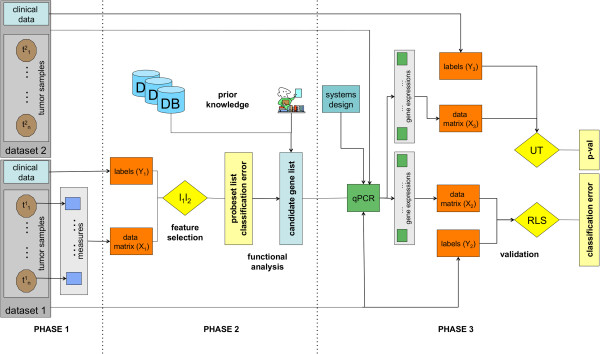
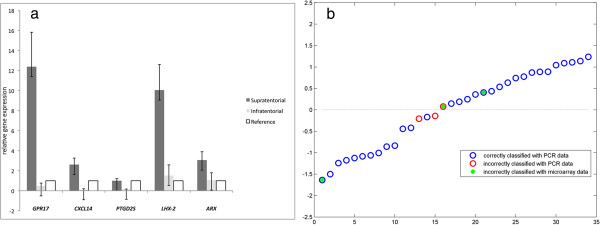
Gene expression profiling on 40 primary LGGs including PAs and mixed glial-neuronal tumours comprising gangliogliomas (GG) and desmoplastic infantile gangliogliomas (DIG) using Affymetrix array platform was performed. A biologically validated machine learning workflow for the identification of microarray-based gene signatures was devised. The method is based on a sparsity inducing regularization algorithm l₁l₂ that selects relevant variables and takes into account their correlation. The most significant genetic signatures emerging from gene-chip analysis were confirmed and validated by qPCR.
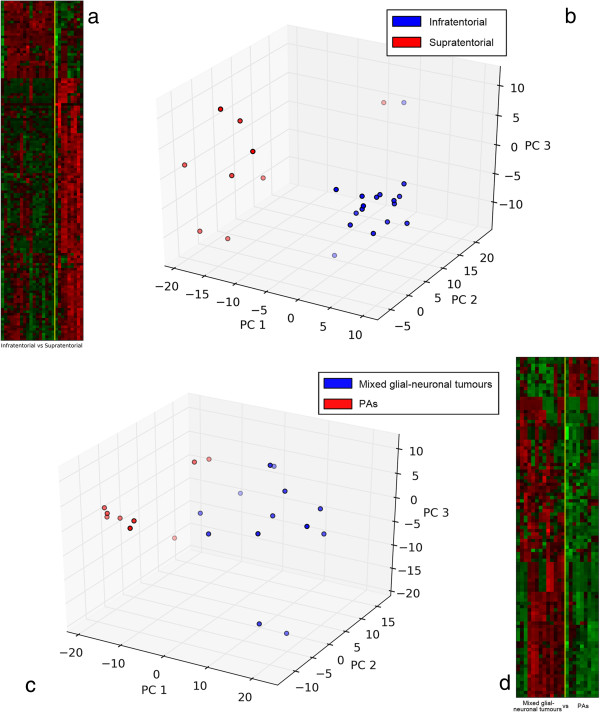
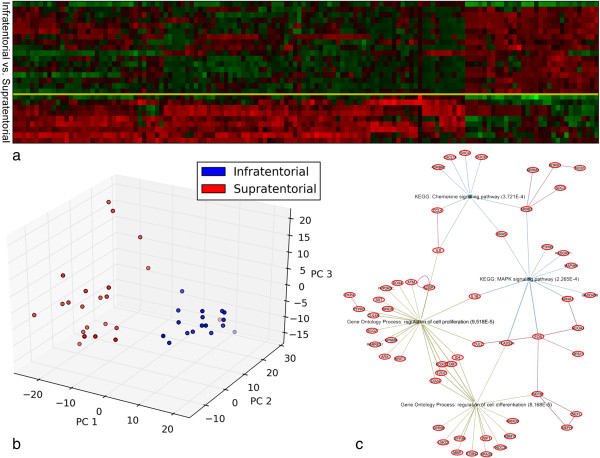
We identified an expression signature composed by a biologically validated list of 15 genes, able to distinguish infratentorial from supratentorial LGGs. In addition, a specific molecular fingerprinting distinguishes the supratentorial PAs from those originating in the posterior fossa. Lastly, within supratentorial tumours, we also identified a gene expression pattern composed by neurogenesis, cell motility and cell growth genes which dichotomize mixed glial-neuronal tumours versus PAs. Our results reinforce previous observations about aberrant activation of the mitogen-activated protein kinase (MAPK) pathway in LGGs, but still point to an active involvement of TGF-beta signaling pathway in the PA development and pick out some hitherto unreported genes worthy of further investigation for the mixed glial-neuronal tumours.
The identification of a brain region-specific gene signature suggests that LGGs, with similar pathological features but located at different sites, may be distinguishable on the basis of cancer genetics. Molecular fingerprinting seems to be able to better sub-classify such morphologically heterogeneous tumours and it is remarkable that mixed glial-neuronal tumours are strikingly separated from PAs.
小儿低级别胶质瘤(LGGs)包含一组组织学、病变部位、年龄和性别分布、生长潜能、形态特征、进展倾向及临床病程各异的肿瘤。在LGGs中,毛细胞型星形细胞瘤(PAs)是儿童最常见的中枢神经系统(CNS)肿瘤。它们通常边界清晰,被世界卫生组织(WHO)归类为I级,但约10 - 20%的病例会出现复发或疾病进展。尽管公认有被视为典型的放射学和神经病理学特征,但PA可能呈现出令人困惑的多种微观特征。确实,同时含有肿瘤性神经节细胞和星形细胞的肿瘤出现频率较低。
使用Affymetrix阵列平台对40例原发性LGGs进行基因表达谱分析,这些LGGs包括PAs以及包含神经节胶质瘤(GG)和促纤维增生性婴儿型神经节胶质瘤(DIG)的混合性胶质 - 神经元肿瘤。设计了一种经过生物学验证的机器学习工作流程来识别基于微阵列的基因特征。该方法基于一种稀疏诱导正则化算法l₁l₂,它选择相关变量并考虑它们的相关性。通过qPCR对基因芯片分析中出现的最显著基因特征进行了确认和验证。
我们鉴定出一个由15个经过生物学验证的基因组成的表达特征,能够区分幕下LGGs和幕上LGGs。此外,一种特定的分子指纹图谱可将幕上PAs与起源于后颅窝的PAs区分开来。最后,在幕上肿瘤中,我们还鉴定出一种由神经发生、细胞运动和细胞生长基因组成的基因表达模式,该模式可将混合性胶质 - 神经元肿瘤与PAs区分开来。我们的结果强化了先前关于LGGs中丝裂原活化蛋白激酶(MAPK)途径异常激活的观察结果,但仍指出转化生长因子 - β信号通路在PA发展中积极参与,并找出了一些迄今未报道的基因,这些基因对于混合性胶质 - 神经元肿瘤值得进一步研究。
脑区特异性基因特征的鉴定表明,具有相似病理特征但位于不同部位的LGGs,在癌症遗传学基础上可能是可区分的。分子指纹图谱似乎能够更好地对这种形态学上异质性的肿瘤进行亚分类,并且值得注意的是,混合性胶质 - 神经元肿瘤与PAs明显分开。