Dawadi Prafulla N, Cook Diane J, Schmitter-Edgecombe Maureen, Parsey Carolyn
School of Electrical Engineering and Computer Sciences, Washington State University, Pullman, WA, USA.
Technol Health Care. 2013;21(4):323-43. doi: 10.3233/THC-130734.
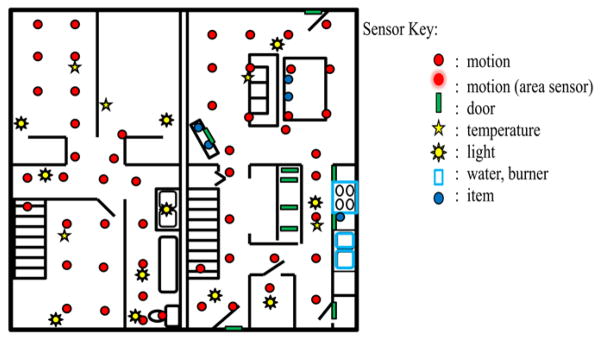
The goal of this work is to develop intelligent systems to monitor the wellbeing of individuals in their home environments.
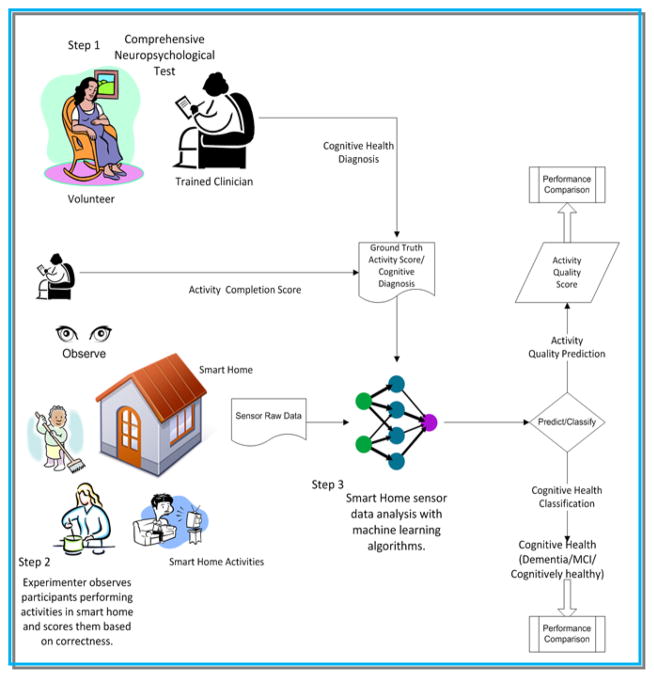
This paper introduces a machine learning-based method to automatically predict activity quality in smart homes and automatically assess cognitive health based on activity quality.
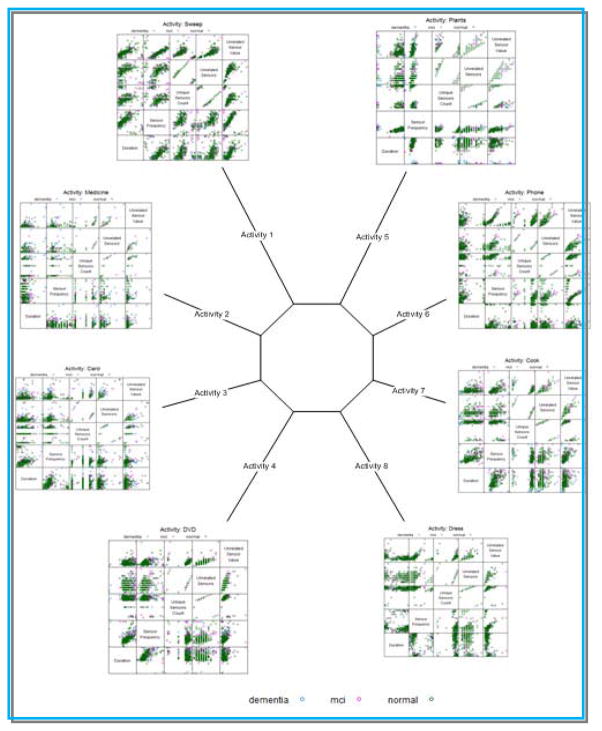
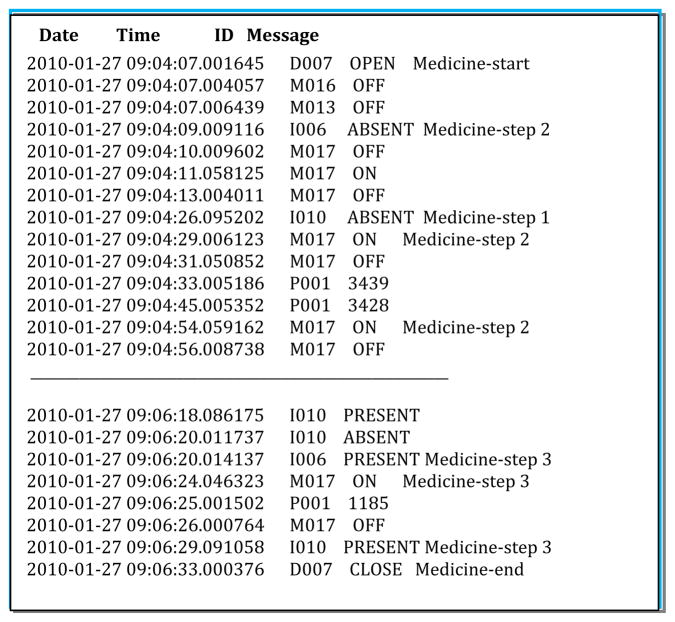
This paper describes an automated framework to extract set of features from smart home sensors data that reflects the activity performance or ability of an individual to complete an activity which can be input to machine learning algorithms. Output from learning algorithms including principal component analysis, support vector machine, and logistic regression algorithms are used to quantify activity quality for a complex set of smart home activities and predict cognitive health of participants.
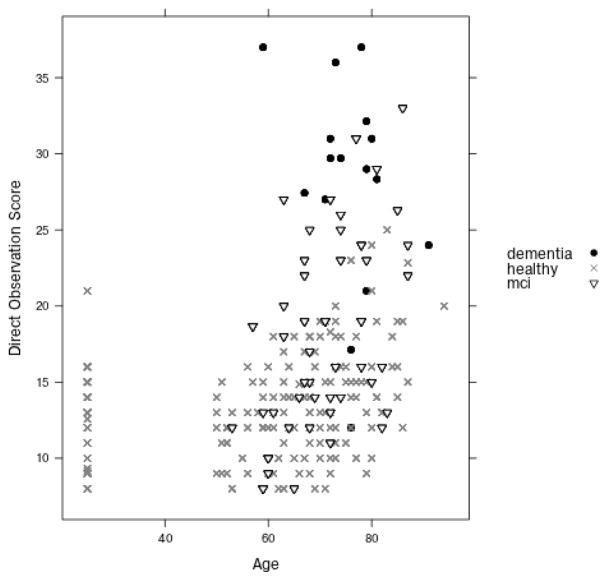
Smart home activity data was gathered from volunteer participants (n=263) who performed a complex set of activities in our smart home testbed. We compare our automated activity quality prediction and cognitive health prediction with direct observation scores and health assessment obtained from neuropsychologists. With all samples included, we obtained statistically significant correlation (r=0.54) between direct observation scores and predicted activity quality. Similarly, using a support vector machine classifier, we obtained reasonable classification accuracy (area under the ROC curve=0.80, g-mean=0.73) in classifying participants into two different cognitive classes, dementia and cognitive healthy.
The results suggest that it is possible to automatically quantify the task quality of smart home activities and perform limited assessment of the cognitive health of individual if smart home activities are properly chosen and learning algorithms are appropriately trained.
这项工作的目标是开发智能系统,以监测个体在家庭环境中的健康状况。
本文介绍一种基于机器学习的方法,用于自动预测智能家居中的活动质量,并基于活动质量自动评估认知健康状况。
本文描述了一个自动化框架,用于从智能家居传感器数据中提取一组特征,这些特征反映了个体完成某项活动的表现或能力,可作为机器学习算法的输入。包括主成分分析、支持向量机和逻辑回归算法在内的学习算法的输出,用于量化一系列复杂智能家居活动的活动质量,并预测参与者的认知健康状况。
智能家居活动数据来自志愿者参与者(n = 263),他们在我们的智能家居测试平台上进行了一系列复杂的活动。我们将自动活动质量预测和认知健康预测与直接观察得分以及从神经心理学家处获得的健康评估进行比较。纳入所有样本后,我们在直接观察得分与预测的活动质量之间获得了具有统计学意义的相关性(r = 0.54)。同样,使用支持向量机分类器,我们在将参与者分为痴呆和认知健康两个不同认知类别时获得了合理的分类准确率(ROC曲线下面积 = 0.80,几何均值 = 0.73)。
结果表明,如果正确选择智能家居活动并对学习算法进行适当训练,就有可能自动量化智能家居活动的任务质量,并对个体的认知健康进行有限的评估。