Departamento de Genética Humana, Instituto Nacional de Saúde Dr. Ricardo Jorge, Lisboa, Portugal.
PLoS Genet. 2013;9(8):e1003529. doi: 10.1371/journal.pgen.1003529. Epub 2013 Aug 8.
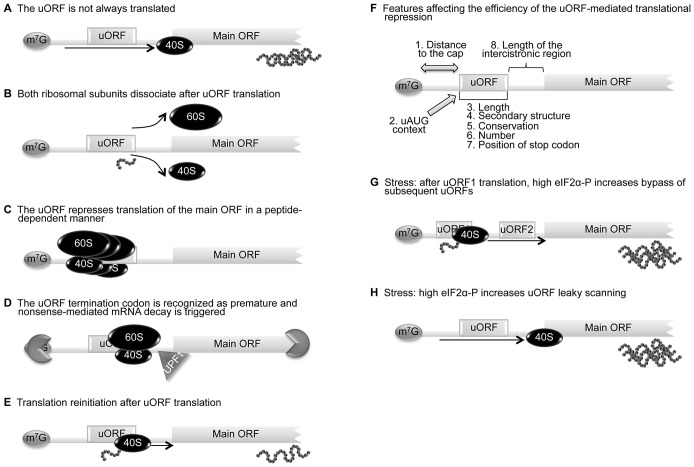
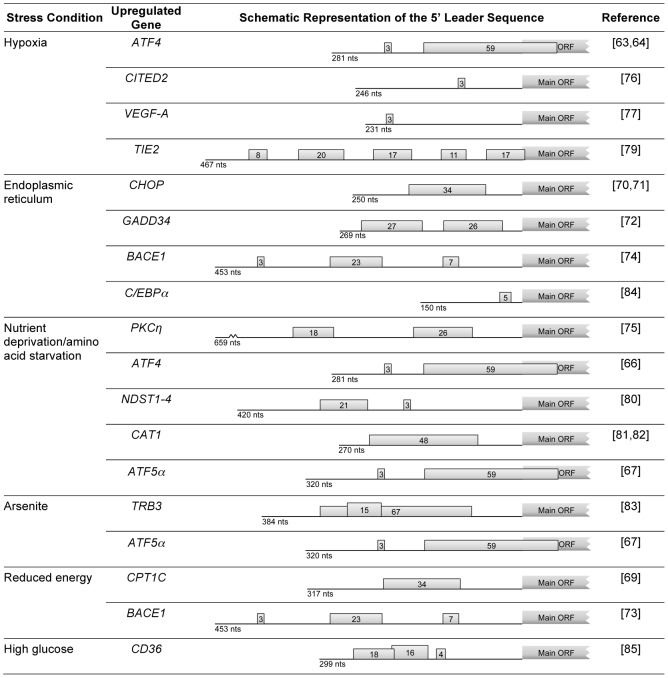
Upstream open reading frames (uORFs) are major gene expression regulatory elements. In many eukaryotic mRNAs, one or more uORFs precede the initiation codon of the main coding region. Indeed, several studies have revealed that almost half of human transcripts present uORFs. Very interesting examples have shown that these uORFs can impact gene expression of the downstream main ORF by triggering mRNA decay or by regulating translation. Also, evidence from recent genetic and bioinformatic studies implicates disturbed uORF-mediated translational control in the etiology of many human diseases, including malignancies, metabolic or neurologic disorders, and inherited syndromes. In this review, we will briefly present the mechanisms through which uORFs regulate gene expression and how they can impact on the organism's response to different cell stress conditions. Then, we will emphasize the importance of these structures by illustrating, with specific examples, how disturbed uORF-mediated translational control can be involved in the etiology of human diseases, giving special importance to genotype-phenotype correlations. Identifying and studying more cases of uORF-altering mutations will help us to understand and establish genotype-phenotype associations, leading to advancements in diagnosis, prognosis, and treatment of many human disorders.
上游开放阅读框(uORFs)是主要的基因表达调控元件。在许多真核生物 mRNA 中,一个或多个 uORFs 位于起始密码子之前。事实上,多项研究表明,几乎一半的人类转录本存在 uORFs。非常有趣的例子表明,这些 uORFs 可以通过触发 mRNA 降解或调节翻译来影响下游主要 ORF 的基因表达。此外,最近的遗传和生物信息学研究证据表明,uORF 介导的翻译控制失调与许多人类疾病的病因有关,包括恶性肿瘤、代谢或神经紊乱以及遗传综合征。在这篇综述中,我们将简要介绍 uORFs 调节基因表达的机制,以及它们如何影响生物体对不同细胞应激条件的反应。然后,我们将通过举例说明 uORF 介导的翻译控制失调如何参与人类疾病的病因,特别强调这些结构的重要性,从而阐明其重要性,特别关注基因型-表型相关性。识别和研究更多的 uORF 改变突变将有助于我们理解和建立基因型-表型相关性,从而推动许多人类疾病的诊断、预后和治疗的进展。