Laboratory of Regulation of Gene Expression, Institute of Microbiology, Academy of Sciences of the Czech Republic, Prague, Czech Republic.
PLoS Genet. 2011 Jul;7(7):e1002137. doi: 10.1371/journal.pgen.1002137. Epub 2011 Jul 7.
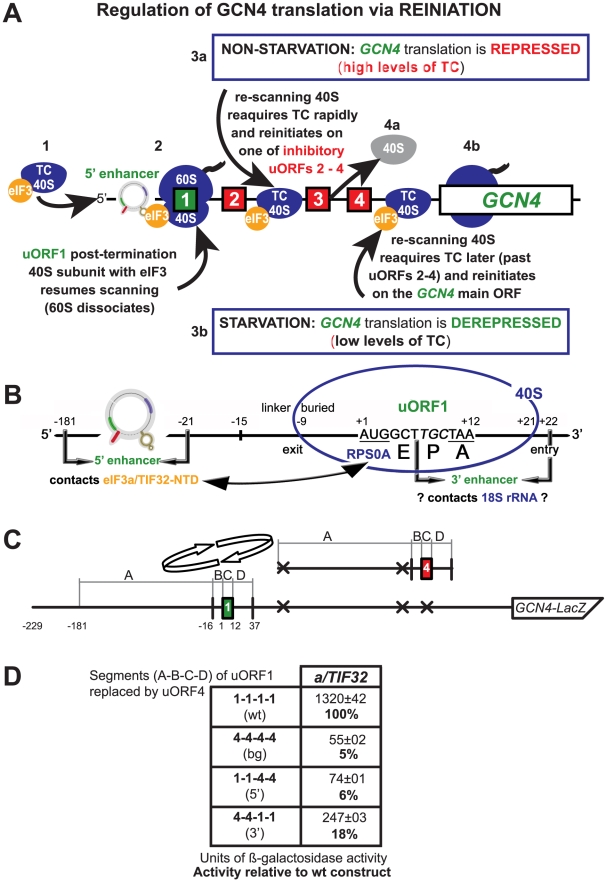
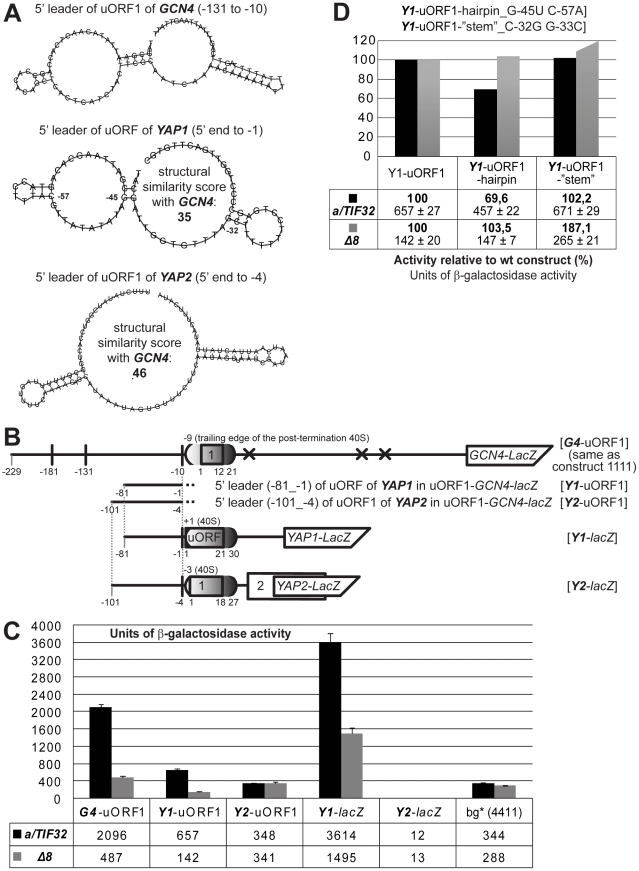
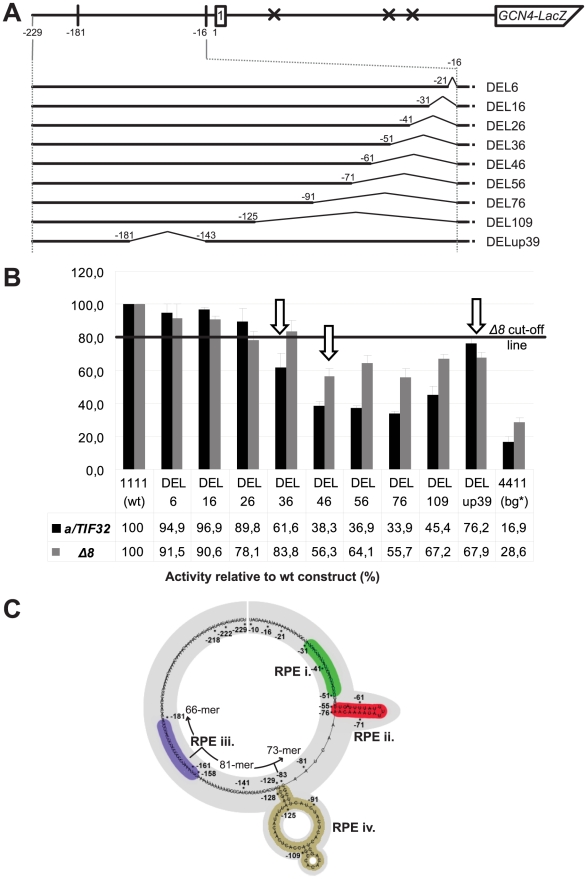
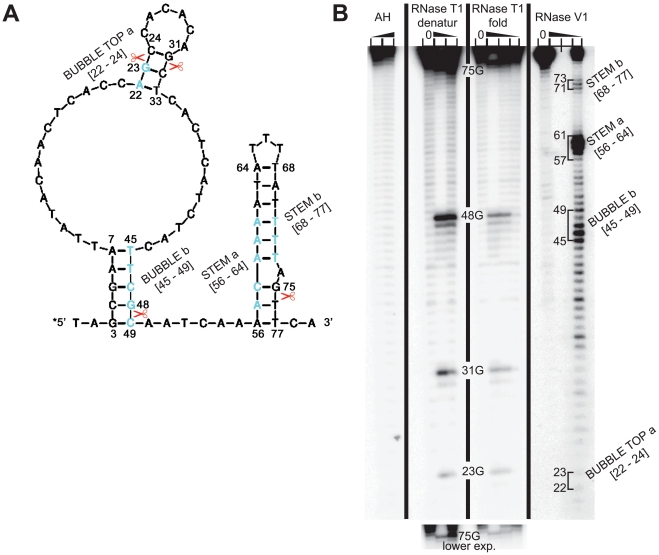
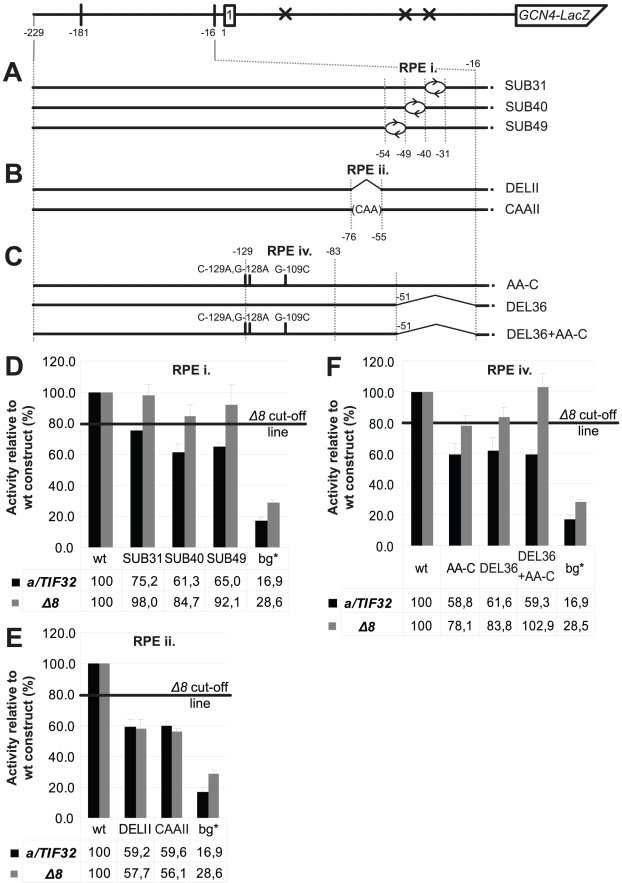
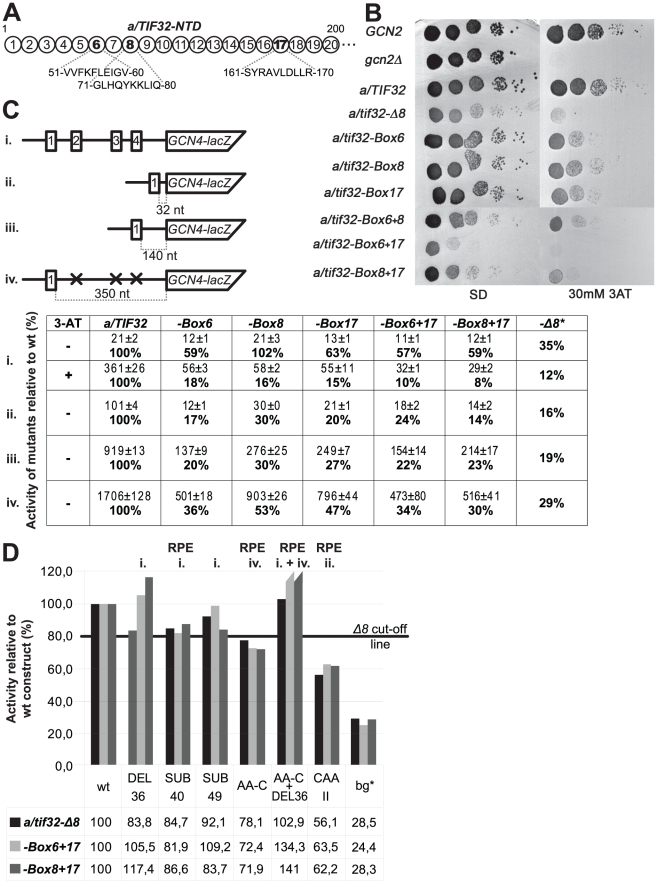
Reinitiation is a gene-specific translational control mechanism characterized by the ability of some short upstream uORFs to retain post-termination 40S subunits on mRNA. Its efficiency depends on surrounding cis-acting sequences, uORF elongation rates, various initiation factors, and the intercistronic distance. To unravel effects of cis-acting sequences, we investigated previously unconsidered structural properties of one such a cis-enhancer in the mRNA leader of GCN4 using yeast genetics and biochemistry. This leader contains four uORFs but only uORF1, flanked by two transferrable 5' and 3' cis-acting sequences, and allows efficient reinitiation. Recently we showed that the 5' cis-acting sequences stimulate reinitiation by interacting with the N-terminal domain (NTD) of the eIF3a/TIF32 subunit of the initiation factor eIF3 to stabilize post-termination 40S subunits on uORF1 to resume scanning downstream. Here we identify four discernible reinitiation-promoting elements (RPEs) within the 5' sequences making up the 5' enhancer. Genetic epistasis experiments revealed that two of these RPEs operate in the eIF3a/TIF32-dependent manner. Likewise, two separate regions in the eIF3a/TIF32-NTD were identified that stimulate reinitiation in concert with the 5' enhancer. Computational modeling supported by experimental data suggests that, in order to act, the 5' enhancer must progressively fold into a specific secondary structure while the ribosome scans through it prior uORF1 translation. Finally, we demonstrate that the 5' enhancer's stimulatory activity is strictly dependent on and thus follows the 3' enhancer's activity. These findings allow us to propose for the first time a model of events required for efficient post-termination resumption of scanning. Strikingly, structurally similar RPE was predicted and identified also in the 5' leader of reinitiation-permissive uORF of yeast YAP1. The fact that it likewise operates in the eIF3a/TIF32-dependent manner strongly suggests that at least in yeasts the underlying mechanism of reinitiation on short uORFs is conserved.
重新起始是一种基因特异性的翻译控制机制,其特征是一些短的上游 UORF 能够在 mRNA 上保留终止后的 40S 亚基。其效率取决于周围的顺式作用序列、UORF 延伸速度、各种起始因子和两个起始密码子之间的距离。为了揭示顺式作用序列的影响,我们使用酵母遗传学和生物化学方法研究了 GCN4 mRNA 前导区中一个顺式增强子的以前未被考虑的结构特性。该前导区包含四个 UORF,但只有 UORF1 被两个可转移的 5'和 3'顺式作用序列所包围,并且允许有效的重新起始。最近,我们发现 5'顺式作用序列通过与起始因子 eIF3 的 N 端结构域(NTD)相互作用,刺激重新起始,从而稳定 UORF1 上终止后的 40S 亚基,以恢复下游扫描。在这里,我们在构成 5'增强子的 5'序列中鉴定了四个可识别的重新起始促进元件(RPE)。遗传上位实验表明,其中两个 RPE 以 eIF3a/TIF32 依赖的方式发挥作用。同样,在 eIF3a/TIF32-NTD 中也鉴定出两个单独的区域,它们与 5'增强子一起协同刺激重新起始。通过实验数据支持的计算建模表明,为了发挥作用,5'增强子必须在核糖体通过它扫描 UORF1 翻译之前,逐步折叠成特定的二级结构。最后,我们证明 5'增强子的刺激活性严格依赖于并因此遵循 3'增强子的活性。这些发现使我们能够首次提出一个有效的终止后扫描恢复所需事件的模型。引人注目的是,在酵母 YAP1 的重新起始允许的 UORF 的 5'前导区中也预测并鉴定了结构上相似的 RPE。它同样以 eIF3a/TIF32 依赖的方式发挥作用的事实强烈表明,至少在酵母中,短 UORF 上重新起始的潜在机制是保守的。