Department of Medical Oncology, "Papageorgiou" Hospital, Aristotle University of Thessaloniki School of Medicine, Thessaloniki, Greece.
PLoS One. 2013 Aug 9;8(8):e70429. doi: 10.1371/journal.pone.0070429. eCollection 2013.
Local recurrence is the major manifestation of treatment failure in patients with operable laryngeal carcinoma. Established clinicopathological factors cannot sufficiently predict patients that are likely to recur after treatment. Additional tools are therefore required to accurately identify patients at high risk for recurrence. This study attempts to identify and independently validate gene expression models, prognostic of disease-free survival (DFS) in operable laryngeal cancer.
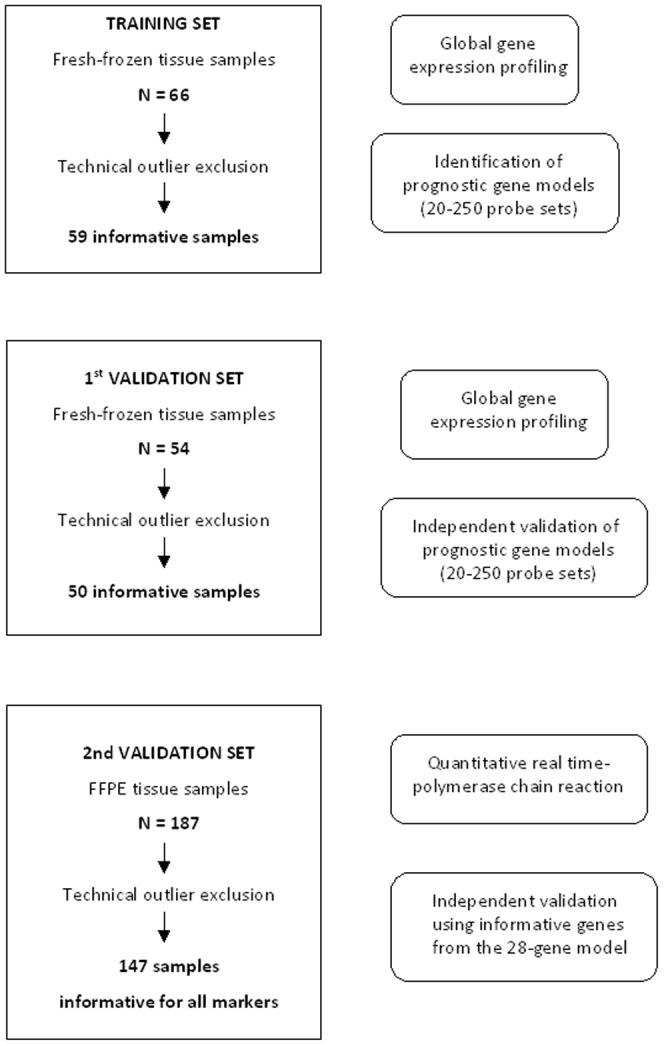
Using Affymetrix U133A Genechips, we profiled fresh-frozen tumor tissues from 66 patients with laryngeal cancer treated locally with surgery. We applied Cox regression proportional hazards modeling to identify multigene predictors of recurrence. Gene models were then validated in two independent cohorts of 54 and 187 patients (fresh-frozen and formalin-fixed tissue validation sets, respectively).
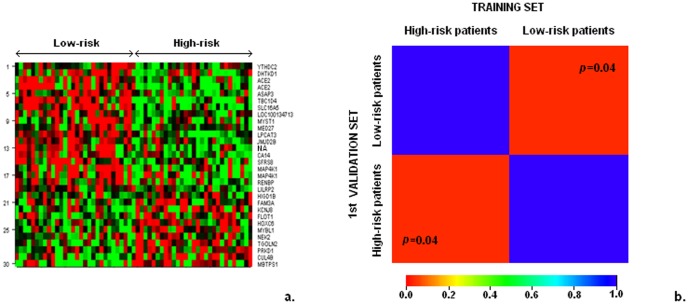
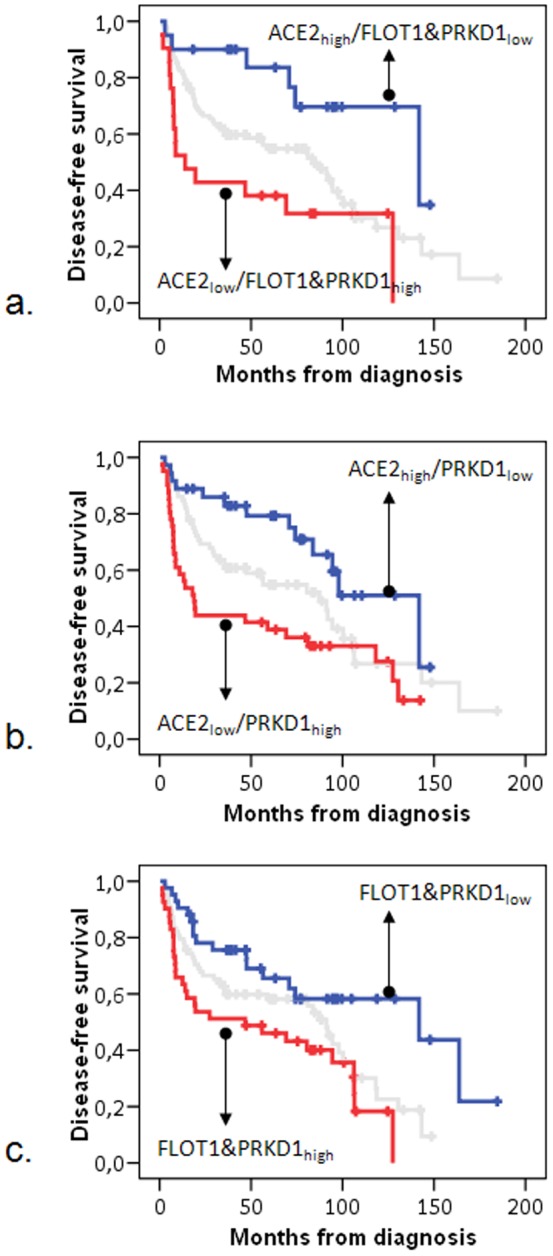
We focused on genes univariately associated with DFS (p<0.01) in the training set. Among several models comprising different numbers of genes, a 30-probe set model demonstrated optimal performance in both the training (log-rank, p<0.001) and 1(st) validation (p=0.010) sets. Specifically, in the 1(st) validation set, median DFS as predicted by the 30-probe set model, was 34 and 80 months for high- and low-risk patients, respectively. Hazard ratio (HR) for recurrence in the high-risk group was 3.87 (95% CI 1.28-11.73, Wald's p=0.017). Testing the expression of selected genes from the above model in the 2(nd) validation set, with qPCR, revealed significant associations of single markers, such as ACE2, FLOT1 and PRKD1, with patient DFS. High PRKD1 remained an unfavorable prognostic marker upon multivariate analysis (HR=2.00, 95% CI 1.28-3.14, p=0.002) along with positive nodal status.
We have established and validated gene models that can successfully stratify patients with laryngeal cancer, based on their risk for recurrence. It seems worthy to prospectively validate PRKD1 expression as a laryngeal cancer prognostic marker, for routine clinical applications.
局部复发是可手术喉癌患者治疗失败的主要表现。既定的临床病理因素不能充分预测治疗后可能复发的患者。因此,需要额外的工具来准确识别复发风险高的患者。本研究试图鉴定和独立验证与可手术喉癌无病生存(DFS)相关的基因表达模型。
使用 Affymetrix U133A Genechips,我们对 66 例接受局部手术治疗的喉癌患者的新鲜冷冻肿瘤组织进行了基因表达谱分析。我们应用 Cox 回归比例风险模型来鉴定与复发相关的多基因预测因子。然后在两个独立的队列(分别为 54 例和 187 例新鲜冷冻和福尔马林固定组织验证集)中验证基因模型。
我们专注于训练集中与 DFS (p<0.01)单变量相关的基因。在包含不同数量基因的几个模型中,30 探针集模型在训练集(对数秩,p<0.001)和第一个验证集(p=0.010)中均表现出最佳性能。具体而言,在第一个验证集中,30 探针集模型预测的高风险和低风险患者的中位 DFS 分别为 34 个月和 80 个月。高风险组的复发风险比(HR)为 3.87(95%CI 1.28-11.73,Wald's p=0.017)。使用 qPCR 测试上述模型中选定基因的表达在第二个验证集中,单个标记(如 ACE2、FLOT1 和 PRKD1)与患者 DFS 显著相关。在多变量分析中,高 PRKD1 仍然是一个不利的预后标志物(HR=2.00,95%CI 1.28-3.14,p=0.002),同时伴有阳性淋巴结状态。
我们已经建立并验证了基于复发风险对喉癌患者进行分层的基因模型。前瞻性验证 PRKD1 表达作为喉癌预后标志物用于常规临床应用似乎是值得的。