Harte Research Institute for Gulf of Mexico Studies, Texas A&M University-Corpus Christi, Corpus Christi, Texas, United States of America.
PLoS One. 2013 Aug 7;8(8):e70540. doi: 10.1371/journal.pone.0070540. eCollection 2013.
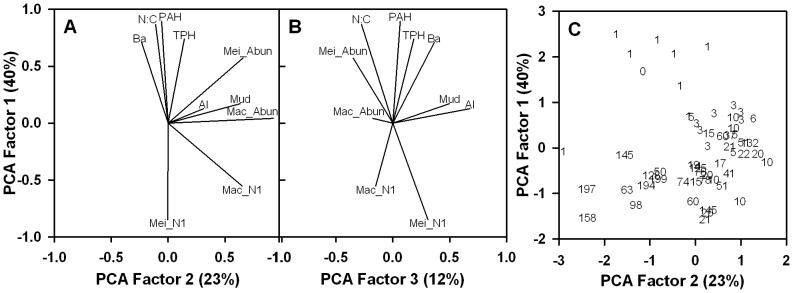
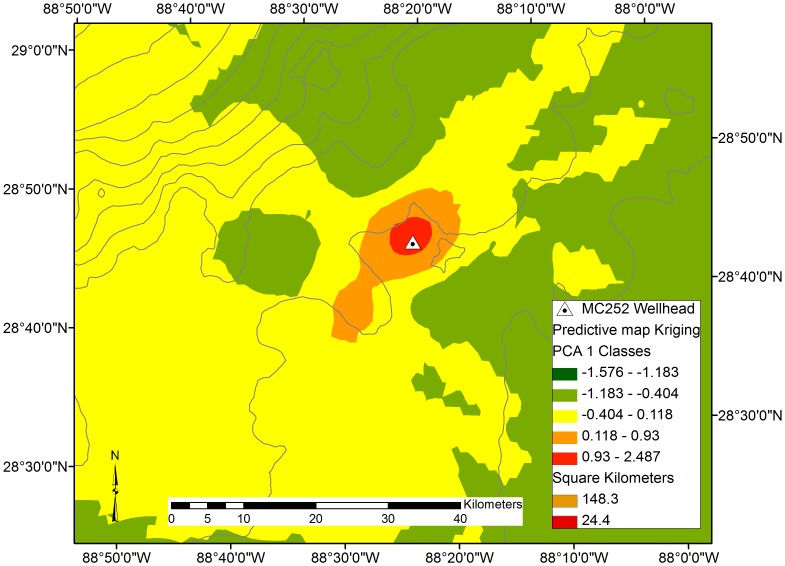
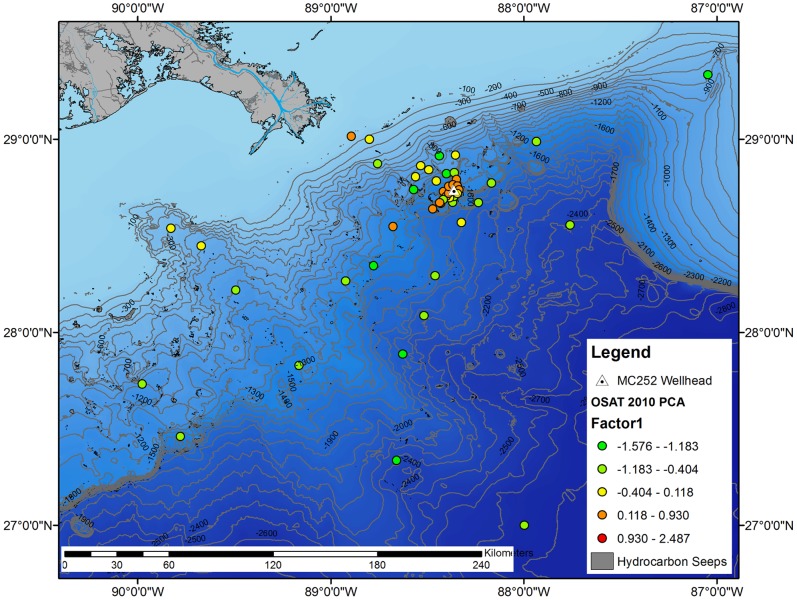
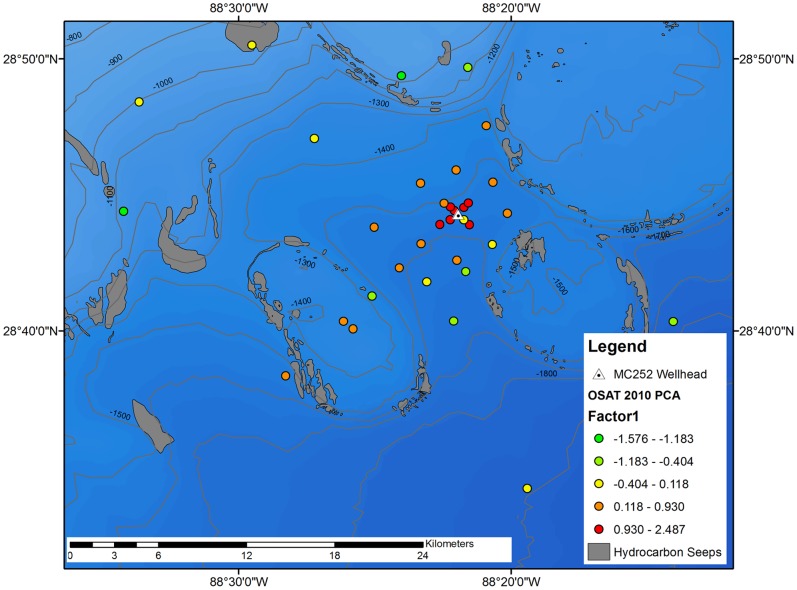
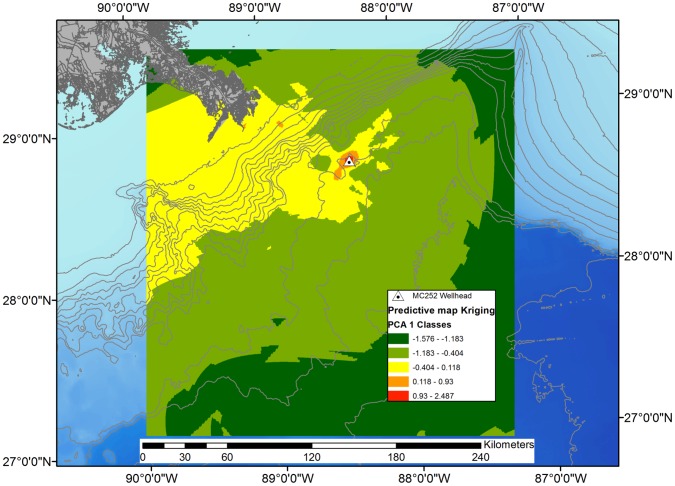
The Deepwater Horizon (DWH) accident in the northern Gulf of Mexico occurred on April 20, 2010 at a water depth of 1525 meters, and a deep-sea plume was detected within one month. Oil contacted and persisted in parts of the bottom of the deep-sea in the Gulf of Mexico. As part of the response to the accident, monitoring cruises were deployed in fall 2010 to measure potential impacts on the two main soft-bottom benthic invertebrate groups: macrofauna and meiofauna. Sediment was collected using a multicorer so that samples for chemical, physical and biological analyses could be taken simultaneously and analyzed using multivariate methods. The footprint of the oil spill was identified by creating a new variable with principal components analysis where the first factor was indicative of the oil spill impacts and this new variable mapped in a geographic information system to identify the area of the oil spill footprint. The most severe relative reduction of faunal abundance and diversity extended to 3 km from the wellhead in all directions covering an area about 24 km(2). Moderate impacts were observed up to 17 km towards the southwest and 8.5 km towards the northeast of the wellhead, covering an area 148 km(2). Benthic effects were correlated to total petroleum hydrocarbon, polycyclic aromatic hydrocarbons and barium concentrations, and distance to the wellhead; but not distance to hydrocarbon seeps. Thus, benthic effects are more likely due to the oil spill, and not natural hydrocarbon seepage. Recovery rates in the deep sea are likely to be slow, on the order of decades or longer.
墨西哥湾北部的深海地平线(DWH)事故发生于 2010 年 4 月 20 日,水深 1525 米,一个月内检测到深海羽流。石油接触并持续存在于墨西哥湾深海底部的部分地区。作为对事故的应对措施的一部分,2010 年秋季部署了监测巡航,以测量对两个主要的软底底栖无脊椎动物群体(大型动物和小型动物)的潜在影响。使用多管取样器采集沉积物,以便同时采集用于化学、物理和生物学分析的样品,并使用多元方法进行分析。通过主成分分析创建一个新变量来确定漏油事件的影响范围,第一个因子指示漏油事件的影响,然后将这个新变量映射到地理信息系统中,以识别漏油事件影响范围。在所有方向上,从井口延伸到 3 公里的范围内,动物群的丰度和多样性相对减少最为严重,覆盖面积约 24 平方公里。在井口的西南方向和东北方向 17 公里和 8.5 公里处观察到中等影响,覆盖面积为 148 平方公里。底栖生物的影响与总石油烃、多环芳烃和钡浓度以及与井口的距离有关,但与烃渗漏无关。因此,底栖生物的影响更可能是由于石油泄漏,而不是自然烃渗漏。深海的恢复速度可能很慢,大约需要几十年或更长时间。