BMC Cancer. 2013 Aug 17;13:389. doi: 10.1186/1471-2407-13-389.
Global hypomethylation of repetitive DNA sequences is believed to occur early in tumorigenesis. There is a great interest in identifying factors that contribute to global DNA hypomethylation and associated cancer risk. We tested the hypothesis that plasma S-adenosylmethionine (SAM) level alone or in combination with genetic variation in DNA methyltransferases (DNMT1, DNMT3A and DNMT3B) was associated with global DNA methylation extent at long interspersed nucleotide element-1 (LINE-1) sequences.
Plasma SAM level and LINE-1 DNA methylation index were measured using stored blood samples collected from 440 healthy Singaporean Chinese adults during 1994-1999. Genetic polymorphisms of 13 loci in DNMT1, DNMT3A and DNMT3B were determined.
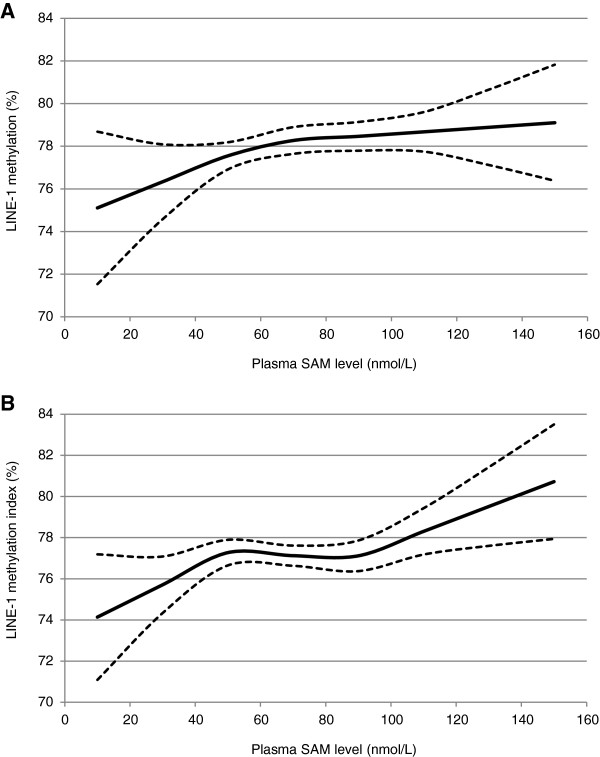
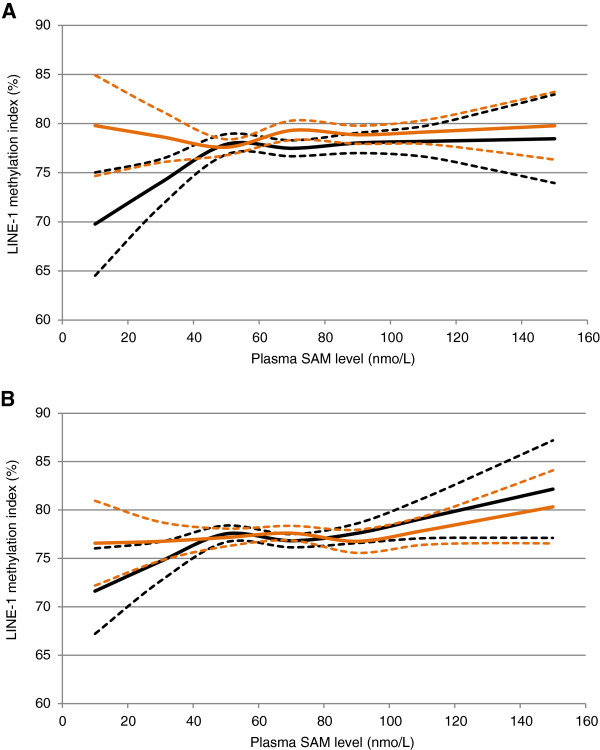
LINE-1 methylation index was significantly higher in men than in women (p = 0.001). LINE-1 methylation index was positively associated with plasma SAM levels (p ≤ 0.01), with a plateau at approximately 78% of LINE-1 methylation index (55 nmol/L plasma SAM) in men and 77% methylation index (50 nmol/L plasma SAM) in women. In men only, the T allele of DNMT1 rs21124724 was associated with a statistically significantly higher LINE-1 methylation index (ptrend = 0.001). The DNMT1 rs2114724 genotype modified the association between plasma SAM and LINE-1 methylation index at low levels of plasma SAM in men.
Circulating SAM level was associated with LINE-1 methylation status among healthy Chinese adults. The DNMT1 genetic polymorphism may exert a modifying effect on the association between SAM and LINE-1 methylation status in men, especially when plasma SAM level is low. Our findings support a link between plasma SAM and global DNA methylation status at LINE-1 sequences.
人们认为,重复 DNA 序列的全球低甲基化发生在肿瘤发生的早期。人们非常感兴趣的是确定导致全球 DNA 低甲基化和相关癌症风险的因素。我们检验了这样一个假设,即单独的血浆 S-腺苷甲硫氨酸(SAM)水平或与 DNA 甲基转移酶(DNMT1、DNMT3A 和 DNMT3B)的遗传变异相结合,与长散布核元件-1(LINE-1)序列的全基因组 DNA 甲基化程度相关。
使用 1994-1999 年期间采集的 440 名新加坡华裔健康成年人的储存血液样本,测量血浆 SAM 水平和 LINE-1 DNA 甲基化指数。确定了 DNMT1、DNMT3A 和 DNMT3B 中 13 个基因座的遗传多态性。
LINE-1 甲基化指数在男性中显著高于女性(p=0.001)。LINE-1 甲基化指数与血浆 SAM 水平呈正相关(p≤0.01),男性的 LINE-1 甲基化指数约为 78%(血浆 SAM 55 nmol/L)和女性的 77%甲基化指数(血浆 SAM 50 nmol/L)时达到平台。仅在男性中,DNMT1 rs21124724 的 T 等位基因与 LINE-1 甲基化指数显著相关(ptrend=0.001)。DNMT1 rs2114724 基因型修饰了男性低血浆 SAM 水平时血浆 SAM 与 LINE-1 甲基化指数之间的关联。
循环 SAM 水平与中国汉族健康成年人的 LINE-1 甲基化状态相关。DNMT1 遗传多态性可能对男性 SAM 与 LINE-1 甲基化状态之间的关联产生修饰作用,尤其是当血浆 SAM 水平较低时。我们的研究结果支持了血浆 SAM 与 LINE-1 序列全基因组 DNA 甲基化状态之间的联系。