First Department of Surgery, University of Fukui, 23-3, Eiheiji-cho, Yoshida-gun, Fukui, Japan.
World J Surg Oncol. 2013 Aug 17;11(1):203. doi: 10.1186/1477-7819-11-203.
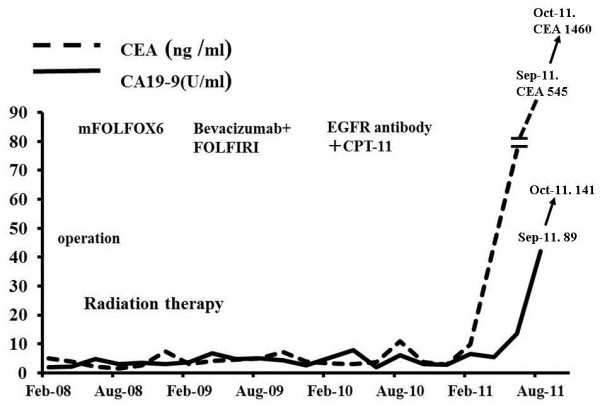
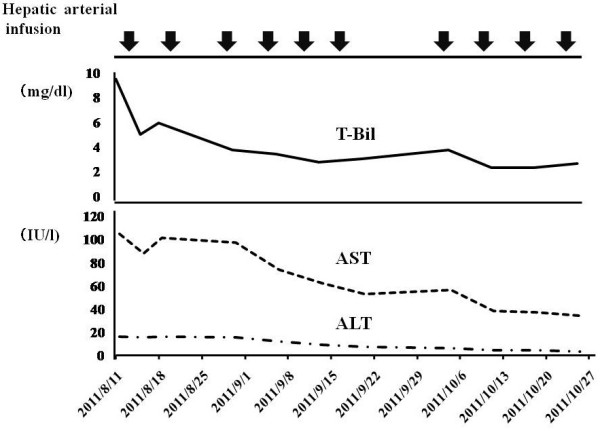
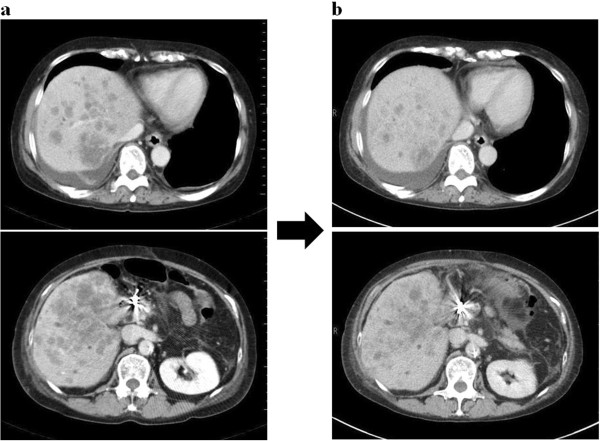
We report here a case of partial response to hepatic arterial infusion chemotherapy in a patient who developed serious hepatic failure due to unresectable colorectal cancer and hepatic metastasis and showed resistance to systemic chemotherapy with molecular targeted drugs, mFOLFOX6, and FOLFIRI. The patient was a 60-year-old woman who underwent sigmoidectomy for sigmoid colon cancer, lateral posterior hepatic segmentectomy for metastatic liver cancer, and postoperative radiation therapy for metastatic lung cancer. As first-line systemic chemotherapy, mFOLFOX6 (oxaliplatin, 5-fluorouracil, and leucovorin), bevacizumab + FOLFIRI (irinotecan, 5-fluorouracil, leucovorin), and anti-epidermal growth factor receptor antibody + irinotecan were administered, in that order. However, recurrent hepatic metastasis was exacerbated, which induced serious hepatic failure manifested by general malaise, jaundice, abnormal hepatic function, difficulty in walking due to bilateral lower extremity edema, and decreased appetite. The patient was admitted in a serious condition. After hospitalization, the patient received hepatic arterial infusion chemotherapy with 5-fluorouracil and l-leucovorin. After two complete courses, the symptoms improved. The patient's performance status also improved, and she was discharged from the hospital. Four months after discharge, the patient had continued outpatient chemotherapy and maintained excellent performance status. Although HAIC is not presently considered an alternative to systemic chemotherapy, it is sometimes effective in patients who show resistance to molecular targeted drug therapy, FOLFOX, and FOLFIRI, and in whom hepatic metastasis is a key factor in determining prognosis and serious hepatic failure. Further studies should be performed in the future to verify these findings.
我们在此报告一例患者,其因不可切除的结直肠癌和肝转移而导致严重肝衰竭,对包括分子靶向药物 mFOLFOX6 和 FOLFIRI 在内的全身化疗药物产生耐药,经肝动脉灌注化疗后部分缓解。患者为 60 岁女性,因乙状结肠癌接受乙状结肠切除术、肝后外侧段切除术治疗转移性肝癌,并接受转移性肺癌术后放疗。一线全身化疗采用 mFOLFOX6(奥沙利铂、5-氟尿嘧啶和亚叶酸钙)、贝伐珠单抗 + FOLFIRI(伊立替康、5-氟尿嘧啶、亚叶酸钙)和抗表皮生长因子受体抗体 +伊立替康,序贯治疗。然而,肝转移复发加重,导致严重肝衰竭,表现为全身不适、黄疸、肝功能异常、双下肢水肿导致行走困难和食欲下降。患者病情严重入院。住院后,患者接受了 5-氟尿嘧啶和 l-亚叶酸钙肝动脉灌注化疗。两个疗程后,症状改善。患者的体能状况也有所改善,出院。出院后 4 个月,患者继续门诊化疗,体能状况保持良好。尽管目前肝动脉灌注化疗不被认为是全身化疗的替代方法,但对于对分子靶向药物治疗、FOLFOX 和 FOLFIRI 耐药且肝转移是决定预后和严重肝衰竭的关键因素的患者,它有时是有效的。未来应进行更多研究来验证这些发现。