Departamento de Biomedicina Molecular, Centro de Investigación y de Estudios Avanzados Mexico City, Mexico.
Front Integr Neurosci. 2013 Aug 13;7:59. doi: 10.3389/fnint.2013.00059. eCollection 2013.
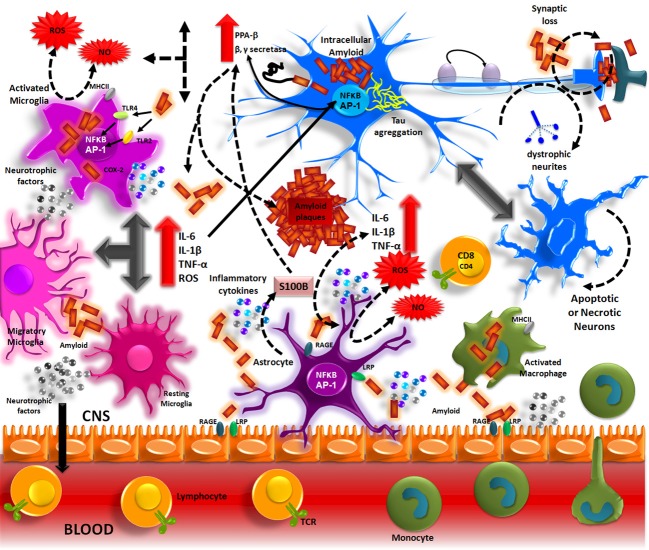
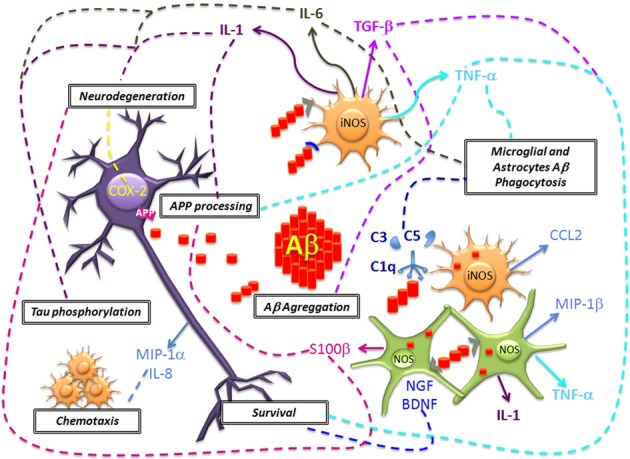
Alzheimer Disease (AD) is a neurodegenerative disorder and the most common form of dementia. Histopathologically is characterized by the presence of two major hallmarks, the intracellular neurofibrillary tangles (NFTs) and extracellular neuritic plaques (NPs) surrounded by activated astrocytes and microglia. NFTs consist of paired helical filaments of truncated tau protein that is abnormally hyperphosphorylated. The main component in the NP is the amyloid-β peptide (Aβ), a small fragment of 40-42 amino acids with a molecular weight of 4 kD. It has been proposed that the amyloid aggregates and microglia activation are able to favor the neurodegenerative process observed in AD patients. However, the role of inflammation in AD is controversial, because in early stages the inflammation could have a beneficial role in the pathology, since it has been thought that the microglia and astrocytes activated could be involved in Aβ clearance. Nevertheless the chronic activation of the microglia has been related with an increase of Aβ and possibly with tau phosphorylation. Studies in AD brains have shown an upregulation of complement molecules, pro-inflammatory cytokines, acute phase reactants and other inflammatory mediators that could contribute with the neurodegenerative process. Clinical trials and animal models with non-steroidal anti-inflammatory drugs (NSAIDs) indicate that these drugs may decrease the risk of developing AD and apparently reduce Aβ deposition. Finally, further studies are needed to determine whether treatment with anti-inflammatory strategies, may decrease the neurodegenerative process that affects these patients.
阿尔茨海默病(AD)是一种神经退行性疾病,也是最常见的痴呆症形式。组织病理学上的特征是存在两个主要标志,即细胞内神经原纤维缠结(NFTs)和细胞外神经突斑块(NPs),周围是活化的星形胶质细胞和小胶质细胞。NFTs 由截短的 tau 蛋白组成,这些 tau 蛋白异常过度磷酸化形成双螺旋丝。NP 的主要成分是淀粉样-β肽(Aβ),这是一种分子量为 4 kD 的 40-42 个氨基酸的小片段。有人提出,淀粉样蛋白聚集和小胶质细胞活化能够促进 AD 患者观察到的神经退行性过程。然而,炎症在 AD 中的作用存在争议,因为在早期阶段,炎症可能在病理学中具有有益作用,因为人们认为活化的小胶质细胞和星形胶质细胞可能参与 Aβ 的清除。然而,小胶质细胞的慢性活化与 Aβ的增加以及可能与 tau 磷酸化有关。AD 大脑的研究表明,补体分子、促炎细胞因子、急性期反应物和其他炎症介质的上调可能有助于神经退行性过程。非甾体抗炎药(NSAIDs)的临床试验和动物模型表明,这些药物可能降低 AD 的发病风险,并明显减少 Aβ的沉积。最后,需要进一步的研究来确定是否采用抗炎策略治疗可能会降低影响这些患者的神经退行性过程。