Department of Neuroscience, Icahn School of Medicine at Mount Sinai , New York, NY , USA.
Front Endocrinol (Lausanne). 2013 Aug 6;4:96. doi: 10.3389/fendo.2013.00096. eCollection 2013.
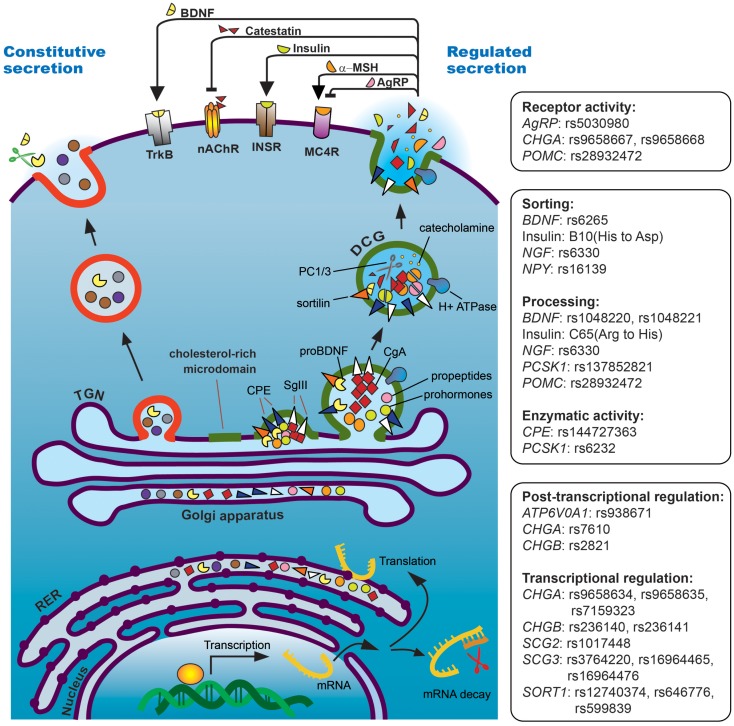
The regulated secretory pathway provides critical control of peptide, growth factor, and hormone release from neuroendocrine and endocrine cells, and neurons, maintaining physiological homeostasis. Propeptides and prohormones are packaged into dense core granules (DCGs), where they frequently undergo tissue-specific processing as the DCG matures. Proteins of the granin family are DCG components, and although their function is not fully understood, data suggest they are involved in DCG formation and regulated protein/peptide secretion, in addition to their role as precursors of bioactive peptides. Association of gene variation, including single nucleotide polymorphisms (SNPs), with neuropsychiatric, endocrine, and metabolic diseases, has implicated specific secreted proteins and peptides in disease pathogenesis. For example, a SNP at position 196 (G/A) of the human brain-derived neurotrophic factor gene dysregulates protein processing and secretion and leads to cognitive impairment. This suggests more generally that variants identified in genes encoding secreted growth factors, peptides, hormones, and proteins involved in DCG biogenesis, protein processing, and the secretory apparatus, could provide insight into the process of regulated secretion as well as disorders that result when it is impaired.
调控分泌途径为神经内分泌和内分泌细胞以及神经元中肽、生长因子和激素的释放提供了关键控制,维持生理内稳态。前肽和前激素被包装到致密核心颗粒 (DCG) 中,随着 DCG 的成熟,它们经常在组织特异性加工。颗粒蛋白家族的蛋白是 DCG 的组成部分,尽管它们的功能尚未完全了解,但数据表明它们参与了 DCG 的形成和受调控的蛋白质/肽分泌,除了作为生物活性肽前体的作用。基因变异(包括单核苷酸多态性 (SNP))与神经精神、内分泌和代谢疾病的关联表明,特定的分泌蛋白和肽在疾病发病机制中起作用。例如,人类脑源性神经营养因子基因 196 位(G/A)的 SNP 会使蛋白质加工和分泌失调,导致认知障碍。这表明,在编码参与 DCG 生物发生、蛋白质加工和分泌装置的分泌生长因子、肽、激素和蛋白质的基因中发现的变体,可以更深入地了解受调控的分泌过程以及当它受损时导致的疾病。