Department of Biochemistry and Molecular Biology, The University of Melbourne Melbourne, VIC, Australia ; Department of Biochemistry and Molecular Biology, Bio21 Molecular Science and Biotechnology Institute, The University of Melbourne Melbourne, VIC, Australia.
Front Genet. 2013 Aug 8;4:150. doi: 10.3389/fgene.2013.00150. eCollection 2013.
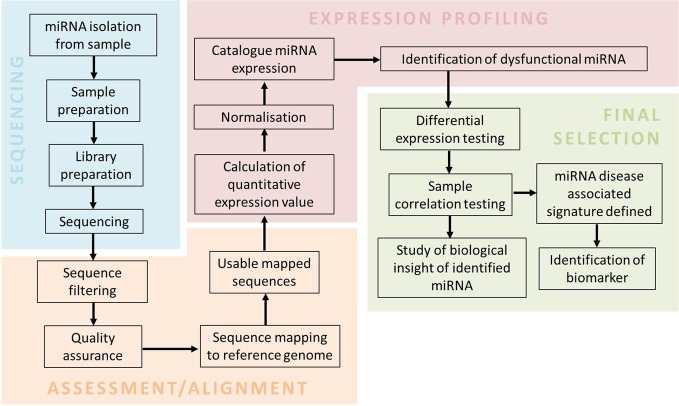
Diagnostic tools for neurodegenerative diseases such as Alzheimer's disease (AD) currently involve subjective neuropsychological testing and specialized brain imaging techniques. While definitive diagnosis requires a pathological brain evaluation at autopsy, neurodegenerative changes are believed to begin years before the clinical presentation of cognitive decline. Therefore, there is an essential need for reliable biomarkers to aid in the early detection of disease in order to implement preventative strategies. microRNAs (miRNA) are small non-coding RNA species that are involved in post-transcriptional gene regulation. Expression levels of miRNAs have potential as diagnostic biomarkers as they are known to circulate and tissue specific profiles can be identified in a number of bodily fluids such as plasma, CSF and urine. Recent developments in deep sequencing technology present a viable approach to develop biomarker discovery pipelines in order to profile miRNA signatures in bodily fluids specific to neurodegenerative diseases. Here we review the potential use of miRNA deep sequencing in biomarker identification from biological fluids and its translation into clinical practice.
用于神经退行性疾病(如阿尔茨海默病(AD))的诊断工具目前包括主观神经心理学测试和专门的脑成像技术。虽然明确的诊断需要在尸检时进行病理性脑评估,但据信神经退行性变化早在认知能力下降的临床症状出现前几年就已经开始了。因此,迫切需要可靠的生物标志物来帮助早期发现疾病,以便实施预防策略。 microRNAs(miRNA)是参与转录后基因调控的小非编码 RNA 种类。miRNA 的表达水平具有作为诊断生物标志物的潜力,因为已知它们会在体内循环,并且可以在许多体液(如血浆、CSF 和尿液)中识别出组织特异性图谱。深度测序技术的最新发展为开发生物标志物发现管道提供了一种可行的方法,以便对特定于神经退行性疾病的体液中的 miRNA 特征进行分析。在这里,我们回顾了 miRNA 深度测序在生物体液中生物标志物鉴定中的潜在用途及其转化为临床实践。