Lee Jeong Guil, Yoo Kwang Ho, Kwon Chang-Il, Ko Kwang Hyun, Hong Sung Pyo
Digestive Disease Center, CHA Bundang Medical Center, CHA University, Seongnam, Korea.
Clin Endosc. 2013 Jul;46(4):384-9. doi: 10.5946/ce.2013.46.4.384. Epub 2013 Jul 31.
BACKGROUND/AIMS: Some factors like stent wires, balloon dilatation and use of guide wires seems to increase perforation after self-expandable metal stent (SEMS) placement, but few studies mentioned about the relationship between angulation of malignant stricture and perforation. The present study aimed to confirm that more angular positioning of stents increases perforation.
This study was conducted with retrospectively evaluation at Digestive Disease Center, CHA Bundang Medical Center, CHA University. Between January 2002 and August 2011, SEMS was inserted in 130 patients with malignant colorectal obstruction. We studied the difference in the angle of stenosis between perforation and non-perforation groups using fluorography images.
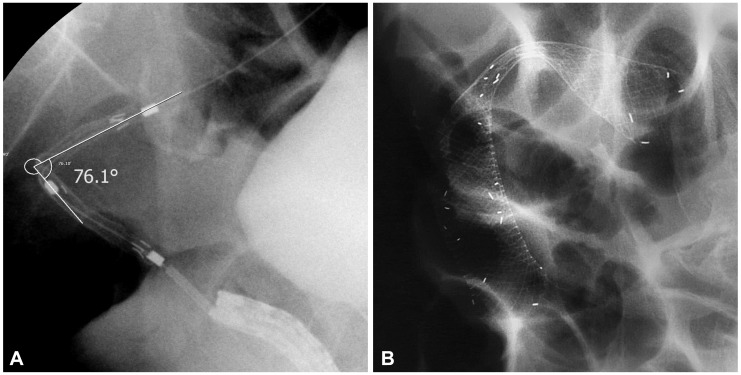
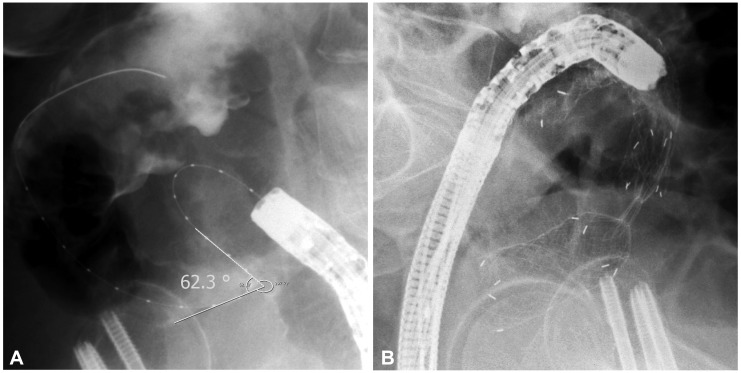
SEMS insertion was performed in 130 cases of obstruction due to colon cancer. Perforation occurred in eight patients (6.2%) of them. Thirteen cases were excluded from the analysis due to poor fluoroscopic images. Among the eight patients with perforation, the mean stenosis angle was 109.9° compared to 153.1° in the nonperforation group, indicating that the angle was more acute in the perforation group (p=0.016).
This study shows that more angular positioning of stent increases bowel perforation after SEMS placement for malignant colorectal obstruction.
背景/目的:一些因素,如支架丝、球囊扩张和导丝的使用,似乎会增加自膨式金属支架(SEMS)置入后穿孔的风险,但很少有研究提及恶性狭窄的角度与穿孔之间的关系。本研究旨在证实支架角度越大,穿孔风险越高。
本研究在CHA大学CHA盆唐医疗中心消化疾病中心进行回顾性评估。2002年1月至2011年8月期间,130例恶性大肠梗阻患者接受了SEMS置入。我们使用透视图像研究穿孔组和非穿孔组之间狭窄角度的差异。
130例结肠癌所致梗阻患者接受了SEMS置入。其中8例(6.2%)发生穿孔。13例因透视图像不佳被排除在分析之外。在8例穿孔患者中,平均狭窄角度为109.9°,而非穿孔组为153.1°,表明穿孔组的角度更尖锐(p = 0.016)。
本研究表明,对于恶性大肠梗阻患者,在SEMS置入后,支架角度越大,肠穿孔风险越高。