Authors' Affiliations: Paediatric Solid Tumour Biology and Therapeutics Team, Division of Clinical Studies, The Institute of Cancer Research; Children's and Young People's Unit Royal Marsden NHS Trust, Sutton; and Unit of Molecular Haematology and Cancer Biology, Institute of Child Health, London, United Kingdom.
Clin Cancer Res. 2013 Nov 1;19(21):5814-21. doi: 10.1158/1078-0432.CCR-13-0680. Epub 2013 Aug 21.
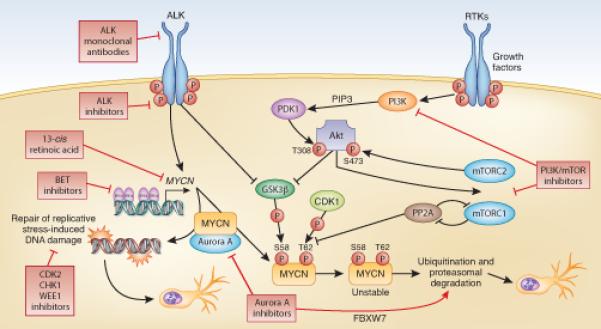
Clinical outcome remains poor in patients with high-risk neuroblastoma, in which chemoresistant relapse is common following high-intensity conventional multimodal therapy. Novel treatment approaches are required. Although recent genomic profiling initiatives have not revealed a high frequency of mutations in any significant number of therapeutically targeted genes, two exceptions, amplification of the MYCN oncogene and somatically acquired tyrosine kinase domain point mutations in anaplastic lymphoma kinase (ALK), present exciting possibilities for targeted therapy. In contrast with the situation with ALK, in which a robust pipeline of pharmacologic agents is available from early clinical use in adult malignancy, therapeutic targeting of MYCN (and MYC oncoproteins in general) represents a significant medicinal chemistry challenge that has remained unsolved for two decades. We review the latest approaches envisioned for blockade of ALK activity in neuroblastoma, present a classification of potential approaches for therapeutic targeting of MYCN, and discuss how recent developments in targeting of MYC proteins seem to make therapeutic inhibition of MYCN a reality in the clinic.
在高危神经母细胞瘤患者中,临床预后仍然较差,高强度常规多模态治疗后常发生化疗耐药复发。需要新的治疗方法。尽管最近的基因组分析计划并没有发现大量治疗靶点基因中有很高频率的突变,但有两个例外,即 MYCN 癌基因扩增和间变性淋巴瘤激酶(ALK)体细胞获得性酪氨酸激酶结构域点突变,为靶向治疗提供了令人兴奋的可能性。与 ALK 的情况形成对比,在这种情况下,从成人恶性肿瘤的早期临床应用中就有大量的药理学药物可用,而 MYCN(一般而言,还有 MYC 癌蛋白)的治疗靶向则代表了一个重大的药物化学挑战,在过去的二十年中一直未得到解决。我们回顾了目前设想用于阻断神经母细胞瘤中 ALK 活性的最新方法,提出了针对 MYCN 治疗靶向的潜在方法分类,并讨论了最近针对 MYC 蛋白的靶向治疗如何使 MYCN 的治疗抑制在临床上成为现实。