Department of Musculoskeletal Biology, Institute of Aging and Chronic Disease, University of Liverpool, Sherrington Buildings, Ashton St, Liverpool L69 3GE, UK.
Proc Biol Sci. 2013 Aug 21;280(1769):20131818. doi: 10.1098/rspb.2013.1818. Print 2013 Oct 22.
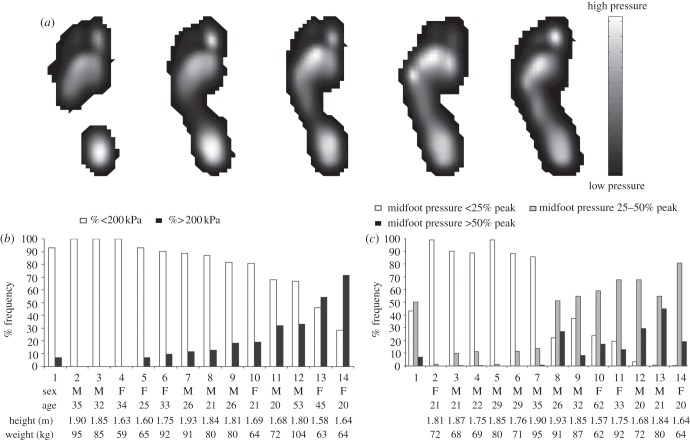
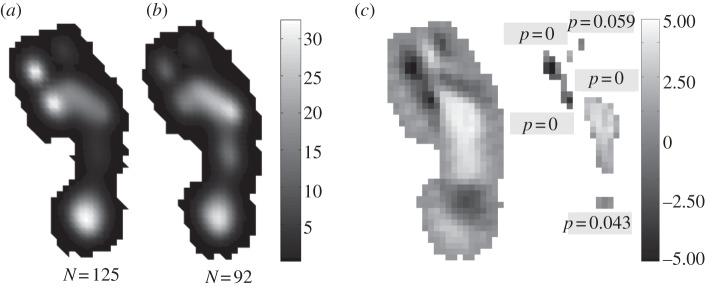
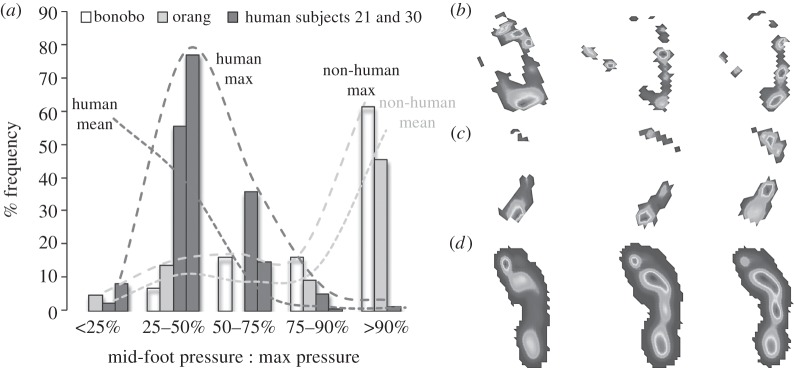
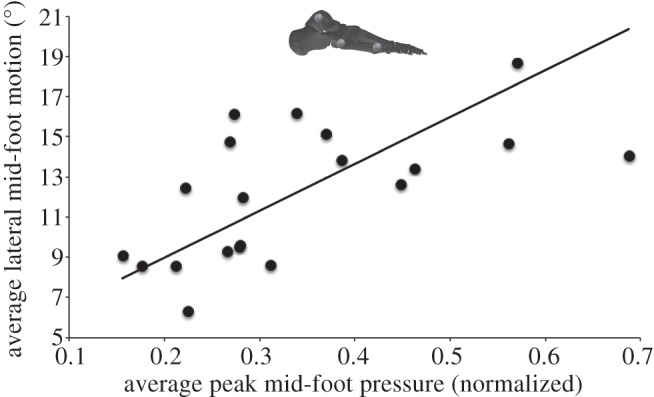
Fossil evidence for longitudinal arches in the foot is frequently used to constrain the origins of terrestrial bipedality in human ancestors. This approach rests on the prevailing concept that human feet are unique in functioning with a relatively stiff lateral mid-foot, lacking the significant flexion and high plantar pressures present in non-human apes. This paradigm has stood for more than 70 years but has yet to be tested objectively with quantitative data. Herein, we show that plantar pressure records with elevated lateral mid-foot pressures occur frequently in healthy, habitually shod humans, with magnitudes in some individuals approaching absolute maxima across the foot. Furthermore, the same astonishing pressure range is present in bonobos and the orangutan (the most arboreal great ape), yielding overlap with human pressures. Thus, while the mean tendency of habitual mechanics of the mid-foot in healthy humans is indeed consistent with the traditional concept of the lateral mid-foot as a relatively rigid or stabilized structure, it is clear that lateral arch stabilization in humans is not obligate and is often transient. These findings suggest a level of detachment between foot stiffness during gait and osteological structure, hence fossilized bone morphology by itself may only provide a crude indication of mid-foot function in extinct hominins. Evidence for thick plantar tissues in Ardipithecus ramidus suggests that a human-like combination of active and passive modulation of foot compliance by soft tissues extends back into an arboreal context, supporting an arboreal origin of hominin bipedalism in compressive orthogrady. We propose that the musculoskeletal conformation of the modern human mid-foot evolved under selection for a functionally tuneable, rather than obligatory stiff structure.
足部纵弓的化石证据常被用于推断人类祖先从四足向两足行走的起源。这种方法基于一个流行的概念,即人类的脚在功能上是独特的,其相对僵硬的中足外侧在运作,缺乏非人类猿类中存在的显著弯曲和高足底压力。这一范式已经存在了 70 多年,但尚未通过定量数据进行客观测试。本文中,我们展示了在健康、习惯穿鞋的人群中,经常出现中足外侧高足底压力的压力记录,一些个体的压力幅度接近整个足部的绝对最大值。此外,在倭黑猩猩和猩猩(最树栖的大型猿类)中也存在相同的惊人压力范围,与人类的压力重叠。因此,虽然健康人群中中足习惯力学的平均趋势确实与传统的中足外侧作为相对刚性或稳定结构的概念一致,但很明显,人类中足弓的稳定并不是强制性的,而且通常是短暂的。这些发现表明,在步态中足部刚度和骨骼结构之间存在一定程度的分离,因此化石骨骼形态本身可能仅能提供已灭绝原始人类中足功能的粗略指示。阿法南方古猿(Ardipithecus ramidus)中厚足底组织的证据表明,软组织对足部顺应性的主动和被动调节的人类组合可回溯到树栖环境,支持了树栖环境中原始人类两足行走的压缩正交起源。我们提出,现代人类中足的骨骼肌肉形态结构是在对功能可调而不是强制性僵硬结构的选择下进化而来的。