IRCCS-istituto di Ricerche Farmacologiche Mario Negri, Milan, italy.
Ther Clin Risk Manag. 2013;9:319-28. doi: 10.2147/TCRM.S35137. Epub 2013 Aug 8.
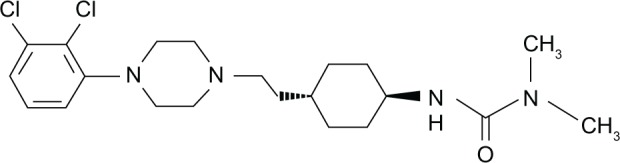
Cariprazine is a potential antipsychotic awaiting approval from the US Food and Drug Administration. It is a dopamine D2- and D3-receptor partial agonist, with higher affinity for D3 receptors, as opposed to the D2 antagonism of most older antipsychotic agents. Like most lipophilic antipsychotics, it undergoes extensive hepatic metabolism by cytochrome P450 (CYP), mainly the highly variable 3A4, with the formation of active metabolites. However, the parent compound - particularly its active didesmethyl derivative - is cleared very slowly, with elimination half-lives in schizophrenic patients ranging from 2-5 days for cariprazine to 2-3 weeks for didesmethyl-cariprazine. Exposure to the latter was several times that for cariprazine, although didesmethyl-cariprazine did not reach steady state within the 3 weeks of 12.5 mg/day dosing. Preliminary information on its therapeutic role comes from press releases and a few abstracts presented at scientific meetings. In short-term controlled trials, it was more effective than placebo in reducing positive and negative symptoms of schizophrenia, with an effective dose range of 1.5-12 mg/day. Although cariprazine was associated with a higher incidence of akathisia and extrapyramidal side effects than placebo, it did not cause weight gain, metabolic abnormalities, prolactin increase, or corrected QT prolongation. Similarly, cariprazine's efficacy and tolerability for the treatment of bipolar disorder (manic/mixed and depressive episodes) was established in the dose range of 3-12 mg/day, although again no long-term data are available. Well-designed clinical trials, mainly direct "head-to-head" comparisons with other second-generation antipsychotic agents, are needed to define the therapeutic role and safety profile of cariprazine in schizophrenia and bipolar mania.
卡利拉嗪是一种潜在的抗精神病药物,正在等待美国食品和药物管理局的批准。它是一种多巴胺 D2 和 D3 受体部分激动剂,与大多数较老的抗精神病药物的 D2 拮抗作用相反,对 D3 受体具有更高的亲和力。与大多数亲脂性抗精神病药物一样,它主要通过细胞色素 P450(CYP)进行广泛的肝代谢,主要是高度可变的 3A4,形成活性代谢物。然而,母体化合物 - 特别是其活性二去甲基衍生物 - 清除非常缓慢,精神分裂症患者的消除半衰期范围为卡利拉嗪的 2-5 天,二去甲基卡利拉嗪的 2-3 周。尽管二去甲基卡利拉嗪在 12.5 毫克/天剂量的 3 周内未达到稳定状态,但后者的暴露量是卡利拉嗪的数倍。关于其治疗作用的初步信息来自新闻稿和在科学会议上提交的一些摘要。在短期对照试验中,它在减轻精神分裂症的阳性和阴性症状方面比安慰剂更有效,有效剂量范围为 1.5-12 毫克/天。尽管卡利拉嗪与安慰剂相比,导致静坐不能和锥体外系副作用的发生率更高,但它不会导致体重增加、代谢异常、催乳素增加或纠正 QT 延长。同样,卡利拉嗪在 3-12 毫克/天的剂量范围内对双相情感障碍(躁狂/混合和抑郁发作)的疗效和耐受性已得到确立,尽管再次没有长期数据可用。需要精心设计的临床试验,主要是与其他第二代抗精神病药物的直接“头对头”比较,以确定卡利拉嗪在精神分裂症和双相躁狂中的治疗作用和安全性概况。