Wada Yoshiharu, Hamamoto Yoshiyuki, Kawasaki Yukiko, Honjo Sachiko, Fujimoto Kanta, Tatsuoka Hisato, Matsuoka Atsuko, Ikeda Hiroki, Fujikawa Jun, Koshiyama Hiroyuki
Center for Diabetes and Endocrinology.
Jpn Clin Med. 2013 May 15;4:41-3. doi: 10.4137/JCM.S10828. eCollection 2013.
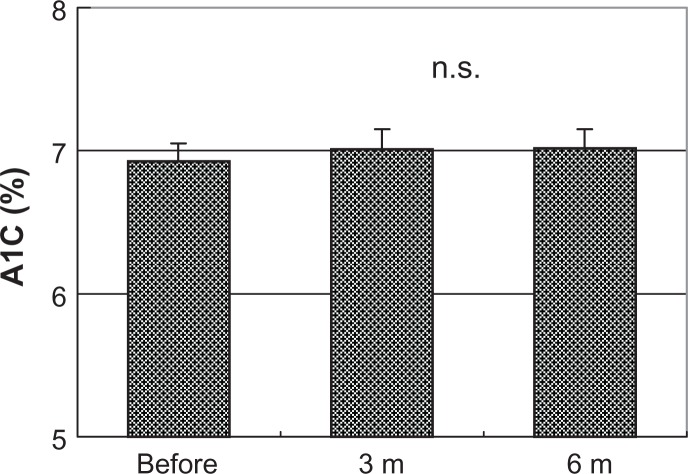
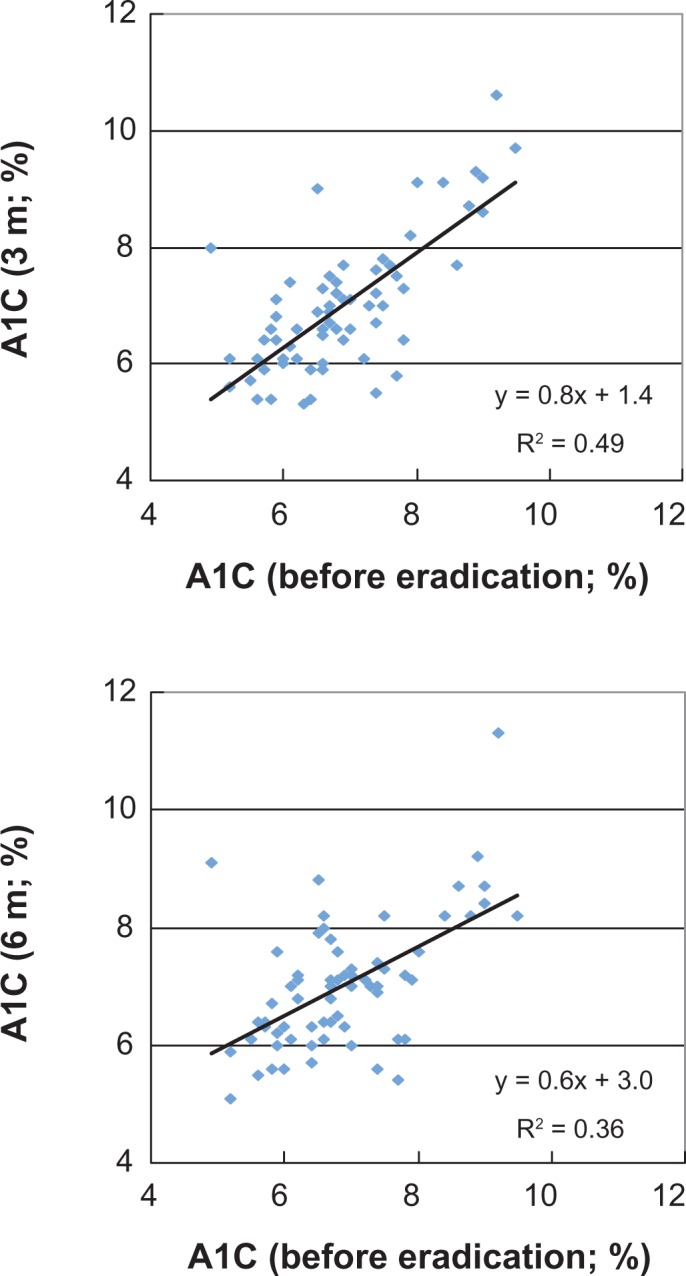
Since infection with Helicobacter pylori has been suggested to play a pathogenic role in diabetes mellitus, we investigated whether eradication therapy for H. pylori might affect glycemic control in Japanese subjects with type 2 diabetes. A total of 72 subjects (55 males, 17 females; aged 63.7 years) with type 2 diabetes who received eradication therapy for H. pylori were included. The change of their blood glycosylated hemoglobin (A1C) levels 3 months before (-3 m) the H. pylori eradication, as well as 3 months (3 m) and 6 months (6 m) after were evaluated. Their A1C levels did not show any significant change after therapy {6.9 [0.1]% (-3 m) to 7.0 [0.1]% (3 m); P = 0.3, 7.0 [0.1] (6 m); P = 0.3}. Our findings suggest that the eradication therapy for H. pylori does not, at least profoundly, affect glycemic control in Japanese subjects with type 2 diabetes.
由于有研究表明幽门螺杆菌感染在糖尿病发病中起致病作用,我们调查了幽门螺杆菌根除治疗是否会影响日本2型糖尿病患者的血糖控制。共有72例接受幽门螺杆菌根除治疗的2型糖尿病患者(55例男性,17例女性;年龄63.7岁)纳入研究。评估他们在幽门螺杆菌根除治疗前3个月(-3m)、治疗后3个月(3m)和6个月(6m)时糖化血红蛋白(A1C)水平的变化。治疗后他们的A1C水平没有显示出任何显著变化{(-3m时为6.9[0.1]%至3m时为7.0[0.1]%;P=0.3,6m时为7.0[0.1]%;P=0.3}。我们的研究结果表明,幽门螺杆菌根除治疗至少不会对日本2型糖尿病患者的血糖控制产生深远影响。