Center for the Study of Applied Psychology, Key Laboratory of Mental Health and Cognitive Science of Guangdong Province, School of Psychology, South China Normal University, Guangzhou, PR China.
PLoS One. 2013 Aug 13;8(8):e71229. doi: 10.1371/journal.pone.0071229. eCollection 2013.
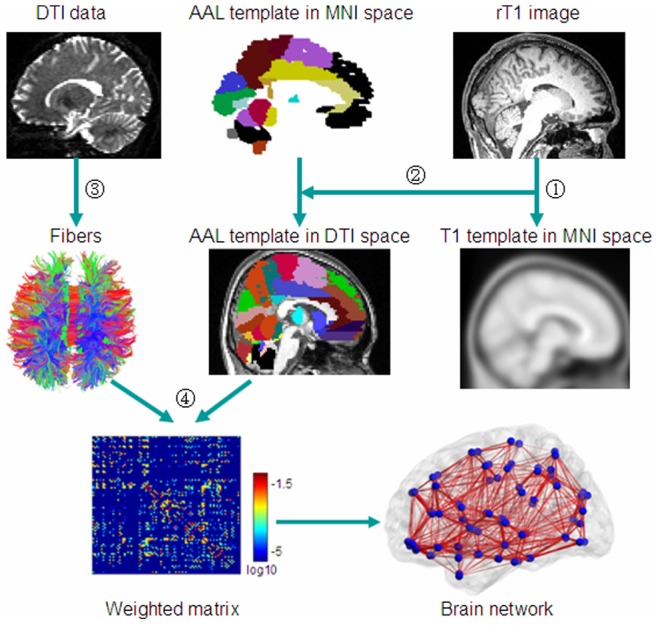
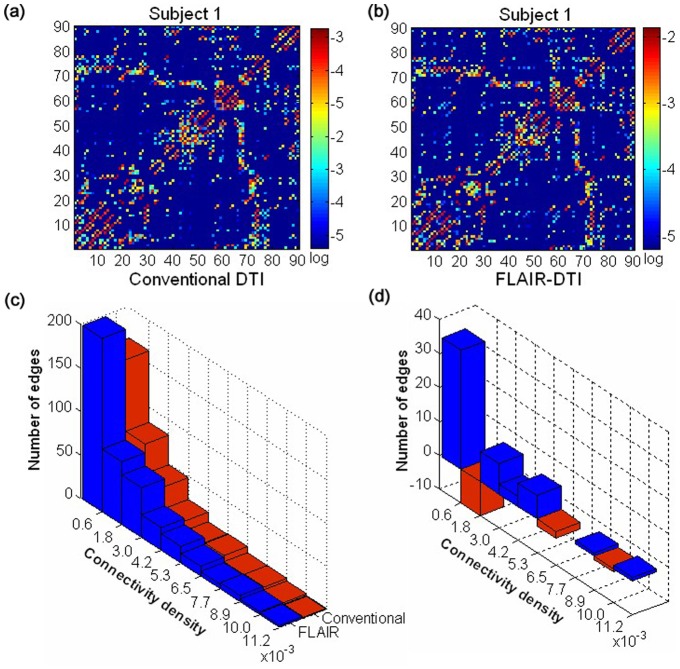
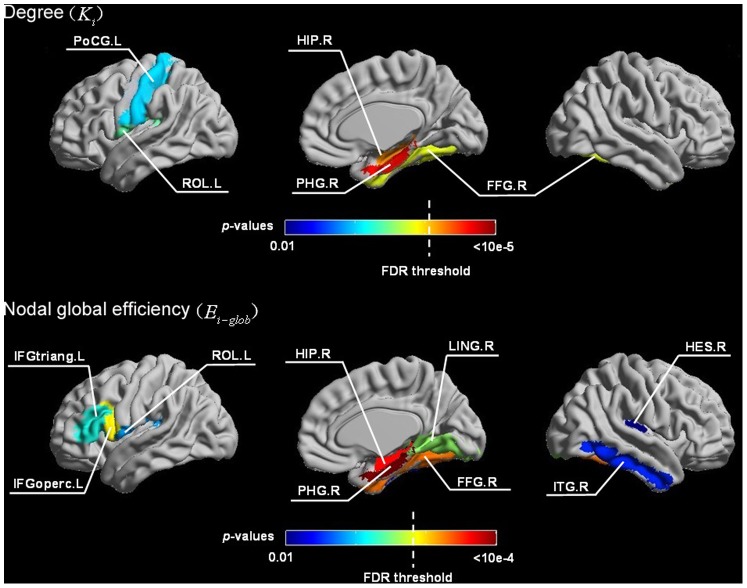
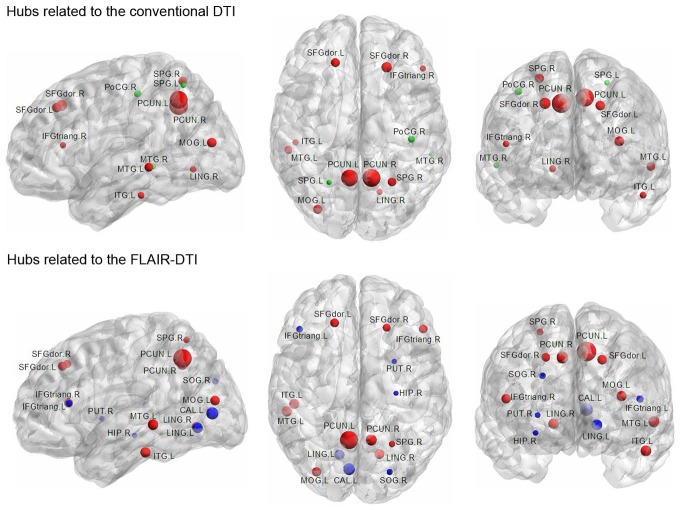
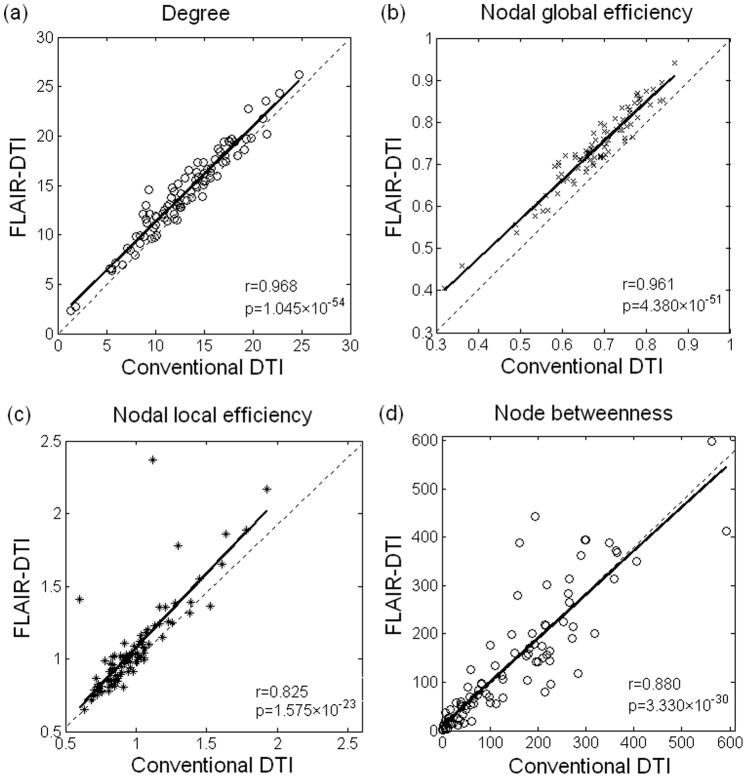
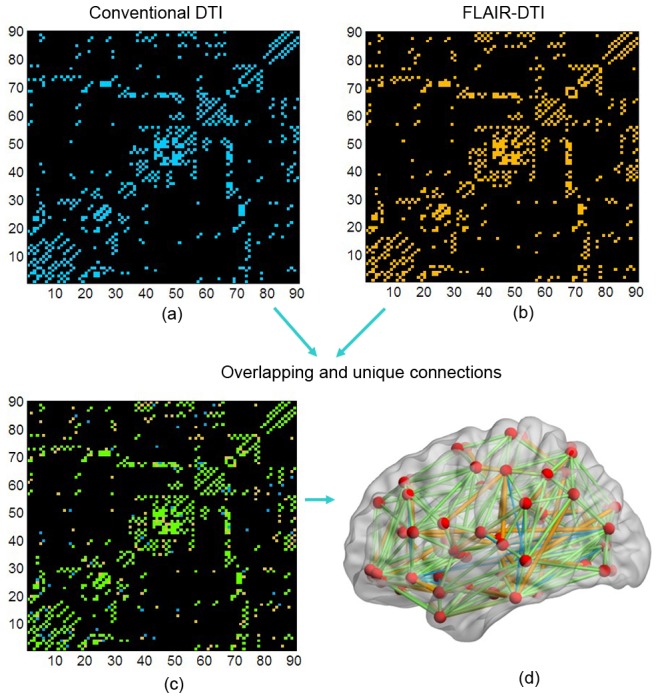
Diffusion-weighted MRI (DW-MRI), the only non-invasive technique for probing human brain white matter structures in vivo, has been widely used in both fundamental studies and clinical applications. Many studies have utilized diffusion tensor imaging (DTI) and tractography approaches to explore the topological properties of human brain anatomical networks by using the single tensor model, the basic model to quantify DTI indices and tractography. However, the conventional DTI technique does not take into account contamination by the cerebrospinal fluid (CSF), which has been known to affect the estimated DTI measures and tractography in the single tensor model. Previous studies have shown that the Fluid-Attenuated Inversion Recovery (FLAIR) technique can suppress the contribution of the CSF to the DW-MRI signal. We acquired DTI datasets from twenty-two subjects using both FLAIR-DTI and conventional DTI (non-FLAIR-DTI) techniques, constructed brain anatomical networks using deterministic tractography, and compared the topological properties of the anatomical networks derived from the two types of DTI techniques. Although the brain anatomical networks derived from both types of DTI datasets showed small-world properties, we found that the brain anatomical networks derived from the FLAIR-DTI showed significantly increased global and local network efficiency compared with those derived from the conventional DTI. The increases in the network regional topological properties derived from the FLAIR-DTI technique were observed in CSF-filled regions, including the postcentral gyrus, periventricular regions, inferior frontal and temporal gyri, and regions in the visual cortex. Because brain anatomical networks derived from conventional DTI datasets with tractography have been widely used in many studies, our findings may have important implications for studying human brain anatomical networks derived from DW-MRI data and tractography.
弥散加权磁共振成像(DW-MRI)是唯一一种可在体内无创探测人类大脑白质结构的技术,已广泛应用于基础研究和临床应用。许多研究利用扩散张量成像(DTI)和轨迹追踪方法,通过单张量模型来探索人类大脑解剖网络的拓扑性质,单张量模型是量化 DTI 指数和轨迹追踪的基本模型。然而,传统的 DTI 技术并未考虑到脑脊液(CSF)的污染,而 CSF 已知会影响单张量模型中估计的 DTI 测量值和轨迹追踪。先前的研究表明,液衰减反转恢复(FLAIR)技术可以抑制 CSF 对 DW-MRI 信号的贡献。我们使用 FLAIR-DTI 和传统 DTI(非 FLAIR-DTI)技术从 22 名受试者中获取 DTI 数据集,使用确定性轨迹追踪构建大脑解剖网络,并比较了两种 DTI 技术衍生的解剖网络的拓扑性质。尽管两种 DTI 数据集衍生的大脑解剖网络均表现出小世界特性,但我们发现 FLAIR-DTI 衍生的大脑解剖网络的全局和局部网络效率显著高于传统 DTI 衍生的网络。在 FLAIR-DTI 技术中,观察到 CSF 填充区域(包括中央后回、脑室周围区域、额下回和颞叶以及视觉皮层区域)的网络区域拓扑性质增加。由于基于常规 DTI 数据集的轨迹追踪衍生的大脑解剖网络已广泛应用于许多研究中,因此我们的发现可能对研究基于 DW-MRI 数据和轨迹追踪的人类大脑解剖网络具有重要意义。