Department of Psychosomatic Medicine and Psychotherapy, University Medical Center of the Johannes Gutenberg-University Mainz, Mainz, Germany.
PLoS One. 2013 Aug 13;8(8):e72014. doi: 10.1371/journal.pone.0072014. eCollection 2013.
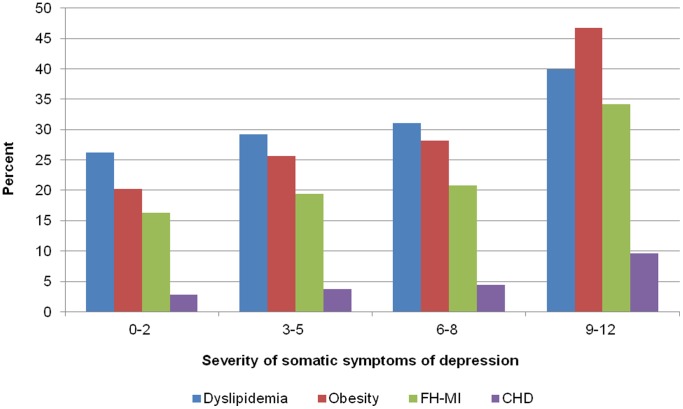
A current model suggested that the somatic symptom dimension accounts for the adverse effect of depression in patients with coronary heart disease (CHD). In order to test this model we sought to determine in a large population-based sample how symptom dimensions of depression are associated with CHD, biomarkers and traditional risk factors. The associations of cognitive and somatic symptom dimensions of depression with CHD, risk factors, endothelial function, and biomarkers of inflammation and myocardial stress were analyzed cross-sectionally in a sample of n = 5000 Mid-Europeans aged 35-74 years from the Gutenberg Health Study (GHS). Only the somatic symptom dimension of depression was associated with CHD, biomarkers (inflammation, vascular function) and cardio-vascular risk factors. When multivariable adjustment was applied by demographic and cardiovascular risk factors, the weak associations of the somatic symptom dimension with the biomarkers disappeared. However, the associations of the somatic symptom dimension with CHD, myocardial infarction, obesity, dyslipidemia and family history of myocardial infarction remained. Both dimensions of depression were independently associated with a previous diagnosis of depression and distressed personality (type D). Thus, our results partly confirm current models: Somatic, but not cognitive-affective symptom dimensions are responsible for the association between depression and CHD, inflammation, vascular function and cardiovascular risk factors in the general population. However, our findings challenge the assumptions that somatic depression might be due to inflammation or vascular dysfunction as consequence of progressed atherosclerotic disease. They rather emphasize a close interplay with life-style factors and with a family history of MI.
目前的模型表明,躯体症状维度解释了抑郁对冠心病(CHD)患者的不利影响。为了验证这一模型,我们试图在一个大型基于人群的样本中确定抑郁的症状维度与 CHD、生物标志物和传统危险因素的关系。在来自哥廷根健康研究(Gutenberg Health Study,GHS)的 n=5000 名年龄在 35-74 岁的中欧人群的横断面研究中,分析了抑郁的认知和躯体症状维度与 CHD、危险因素、内皮功能以及炎症和心肌应激的生物标志物之间的关系。只有抑郁的躯体症状维度与 CHD、生物标志物(炎症、血管功能)和心血管危险因素有关。当通过人口统计学和心血管危险因素进行多变量调整时,躯体症状维度与生物标志物的弱相关性消失了。然而,躯体症状维度与 CHD、心肌梗死、肥胖、血脂异常和心肌梗死家族史的关联仍然存在。抑郁的两个维度都与抑郁症的既往诊断和抑郁人格(D 型人格)独立相关。因此,我们的结果部分证实了目前的模型:躯体症状维度,但不是认知情感症状维度,与抑郁和 CHD、炎症、血管功能以及普通人群中的心血管危险因素有关。然而,我们的发现挑战了躯体性抑郁可能是由于进展性动脉粥样硬化疾病导致的炎症或血管功能障碍的假设。它们更加强调了与生活方式因素和心肌梗死家族史的密切相互作用。