Australian Rivers Institute-Coasts and Estuaries & Griffith School of Environment, Griffith University, Gold Coast, Queensland, Australia.
PLoS One. 2013 Aug 13;8(8):e72683. doi: 10.1371/journal.pone.0072683. eCollection 2013.
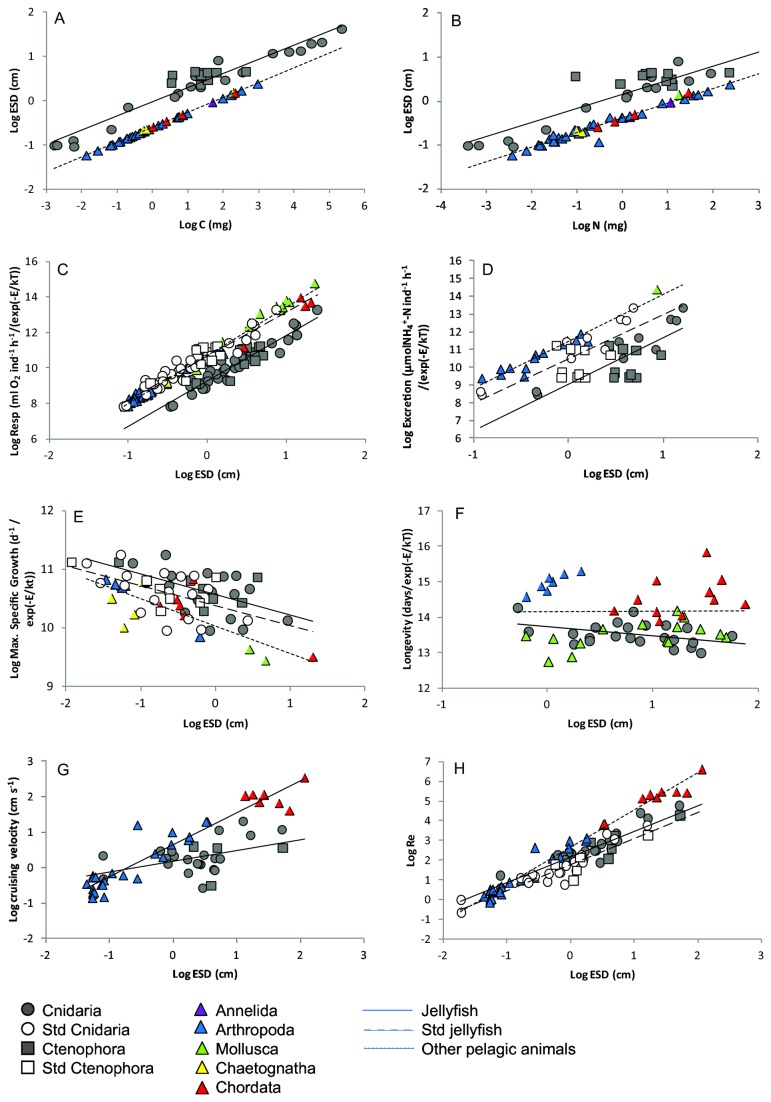
Jellyfish form spectacular blooms throughout the world's oceans. Jellyfish body plans are characterised by high water and low carbon contents which enables them to grow much larger than non-gelatinous animals of equivalent carbon content and to deviate from non-gelatinous pelagic animals when incorporated into allometric relationships. Jellyfish have, however, been argued to conform to allometric relationships when carbon content is used as the metric for comparison. Here we test the hypothesis that differences in allometric relationships for several key functional parameters remain for jellyfish even after their body sizes are scaled to their carbon content. Data on carbon and nitrogen contents, rates of respiration, excretion, growth, longevity and swimming velocity of jellyfish and other pelagic animals were assembled. Allometric relationships between each variable and the equivalent spherical diameters of jellyfish and other pelagic animals were compared before and after sizes of jellyfish were standardised for their carbon content. Before standardisation, the slopes of the allometric relationships for respiration, excretion and growth were the same for jellyfish and other pelagic taxa but the intercepts differed. After standardisation, slopes and intercepts for respiration were similar but excretion rates of jellyfish were 10× slower, and growth rates 2× faster than those of other pelagic animals. Longevity of jellyfish was independent of size. The slope of the allometric relationship of swimming velocity of jellyfish differed from that of other pelagic animals but because they are larger jellyfish operate at Reynolds numbers approximately 10× greater than those of other pelagic animals of comparable carbon content. We conclude that low carbon and high water contents alone do not explain the differences in the intercepts or slopes of the allometric relationships of jellyfish and other pelagic animals and that the evolutionary longevity of jellyfish and their propensity to form blooms is facilitated by their unique body plans.
水母在世界海洋中形成壮观的水华。水母的身体结构特点是含水量高、含碳量低,这使它们能够比同等碳含量的非凝胶状动物长得更大,并在纳入异速生长关系时偏离非凝胶状浮游动物。然而,有人认为,当使用碳含量作为比较的度量标准时,水母符合异速生长关系。在这里,我们检验了这样一个假设,即在将水母的体型按其碳含量进行缩放后,几个关键功能参数的异速生长关系仍然存在差异。我们收集了关于水母和其他浮游动物的碳和氮含量、呼吸率、排泄率、生长率、寿命和游泳速度的数据。在将水母的体型标准化为其碳含量之前和之后,比较了每个变量与水母和其他浮游动物等效球体直径之间的异速生长关系。在标准化之前,呼吸、排泄和生长的异速生长关系的斜率对于水母和其他浮游生物类群是相同的,但截距不同。在标准化之后,呼吸的斜率和截距相似,但水母的排泄率要慢 10 倍,生长率要快 2 倍。水母的寿命与体型无关。水母的游泳速度异速生长关系的斜率与其他浮游动物的斜率不同,但由于它们更大,水母的雷诺数大约是其他具有可比碳含量的浮游动物的 10 倍。我们得出的结论是,低碳和高含水量本身并不能解释水母和其他浮游动物的异速生长关系的截距或斜率的差异,而水母的进化寿命和它们形成水华的倾向是由它们独特的身体结构所促成的。