Lestari Trisasi, Ryll Sylvia, Kramer Axel
Hospital Management Graduate Program, Gadjah Mada University, Yogyakarta, Indonesia.
GMS Hyg Infect Control. 2013 Apr 29;8(1):Doc07. doi: 10.3205/dgkh000207. eCollection 2013.
A number of studies have shown that non-critical medical devices can be contaminated with pathogens, including those resistant to antibiotics and thus become a potential vector for transmission. Electrocardiography (ECG) lead wire are non-critical medical device which are always attached on patient skin during their stay in intensive care unit (ICU). In view of the patient's critical conditions and exposure to invasive procedures, identification and prevention of possible risks are important to prevent infection in ICUs.
The objective of this study was to determine the presence of bacterial and fungal contamination on cleaned and disinfected reusable ECG lead wires in intensive care units in a hospital.
A total of 408 cleaned ECG lead wires from 93 bed-side ECG devices and 43 ECG lead wires from 5 portable ECG devices from 4 intensive care units (ICUs) and 1 post-anaesthesia care unit (PACU) were sampled. ECG lead wires were stirred in 0.89% NaCl with added neutralizer for 30 seconds. Samples of the solutions were cultured directly on blood agar. The remaining solution was cultured on blood agar after sterile filtration. The number of colony forming units (CFUs) was counted and the microorganisms were identified.
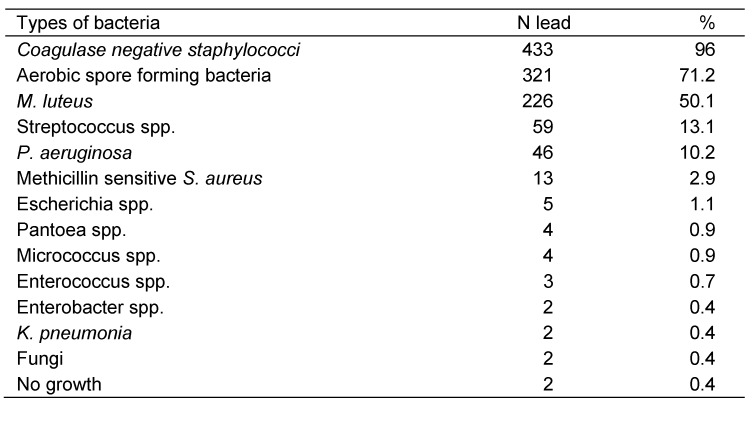
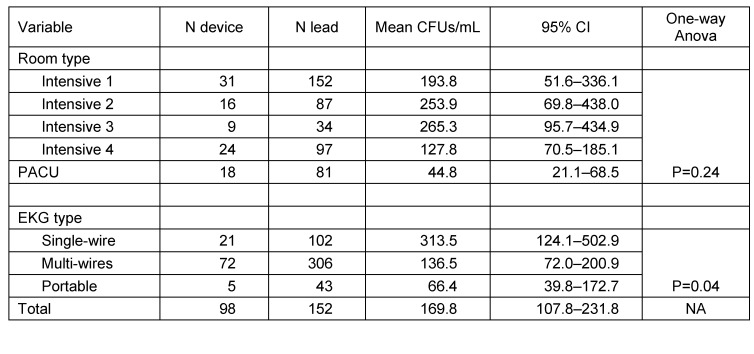
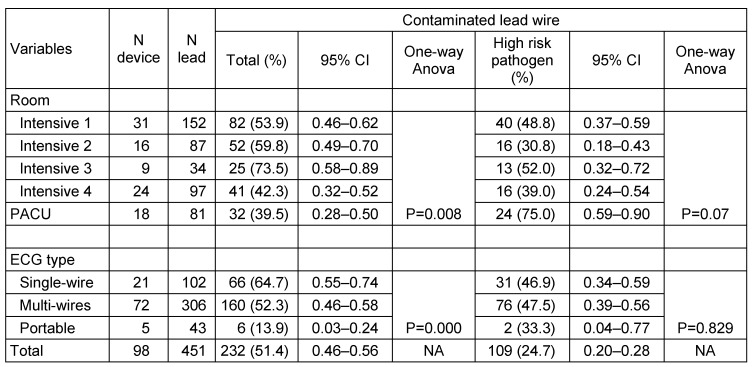
More than half of examined ECG lead wires (n=232; 51.4%) were contaminated with >30 CFUs/mL sample of bacteria or with risk pathogens. Gram-positive bacteria were the most frequently isolated organisms; particularly, coagulase negative staphylococci (96%) and aerobic spore forming bacteria (71.2%). Compared to ICUs, PACU had significantly lower proportion of contaminated ECG lead wires (p<0.05). The proportion of contaminated ECG lead wires, as well as mean number of cfus per ECG lead wire, was also significantly lower among multi-wire ECG leads compared to single-wire ECG leads.
Manually cleaned ECG lead wires may serve as a vector for transmission of nosocomial pathogens. The current reprocessing technique for ECG lead wires needs to be improved.
多项研究表明,非关键医疗设备可能被病原体污染,包括对抗生素耐药的病原体,从而成为潜在的传播媒介。心电图(ECG)导联线是非关键医疗设备,在重症监护病房(ICU)患者住院期间一直附着在患者皮肤上。鉴于患者的危急状况以及接受侵入性操作,识别和预防可能的风险对于预防ICU感染很重要。
本研究的目的是确定某医院重症监护病房中经清洁和消毒的可重复使用心电图导联线上细菌和真菌污染的情况。
从4个重症监护病房(ICU)和1个麻醉后护理单元(PACU)的93台床边心电图设备中总共采集了408根清洁后的心电图导联线样本,以及5台便携式心电图设备中的43根心电图导联线样本。将心电图导联线在添加了中和剂的0.89%氯化钠溶液中搅拌30秒。溶液样本直接接种在血琼脂上进行培养。剩余溶液经无菌过滤后接种在血琼脂上培养。计算菌落形成单位(CFU)数量并鉴定微生物。
超过一半的被检查心电图导联线(n = 232;51.4%)被每毫升样本中超过30 CFU的细菌或有风险的病原体污染。革兰氏阳性菌是最常分离出的微生物;特别是凝固酶阴性葡萄球菌(96%)和好氧芽孢形成菌(71.2%)。与ICU相比,PACU中被污染的心电图导联线比例显著更低(p < 0.05)。与单线心电图导联线相比,多线心电图导联线中被污染的心电图导联线比例以及每根心电图导联线的平均CFU数量也显著更低。
人工清洁的心电图导联线可能成为医院病原体传播的媒介。当前心电图导联线的再处理技术需要改进。