Institute for Materials and Surface Technology (IMST), University of Applied Sciences Kiel, Kiel 24149, Germany.
Nanoscale Res Lett. 2013 Aug 23;8(1):363. doi: 10.1186/1556-276X-8-363.
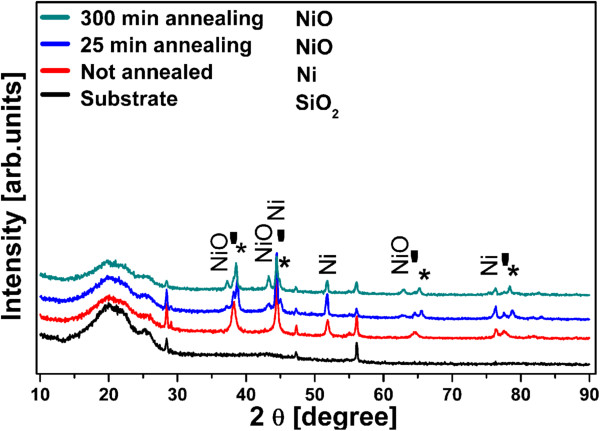
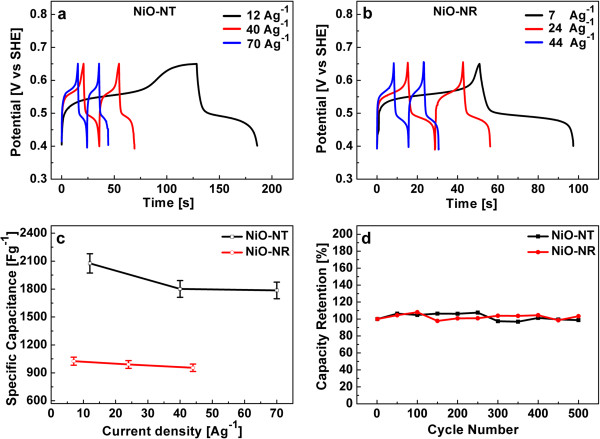
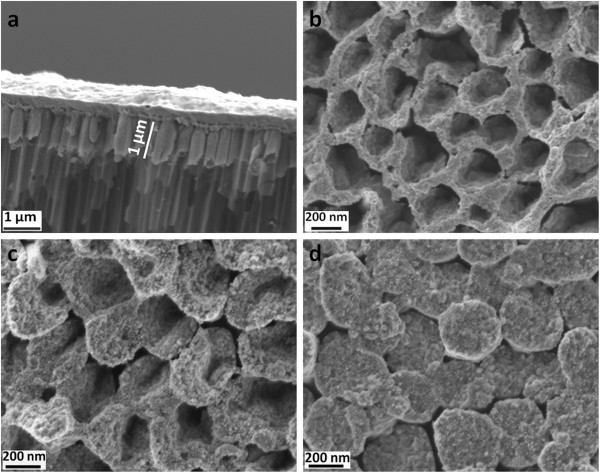
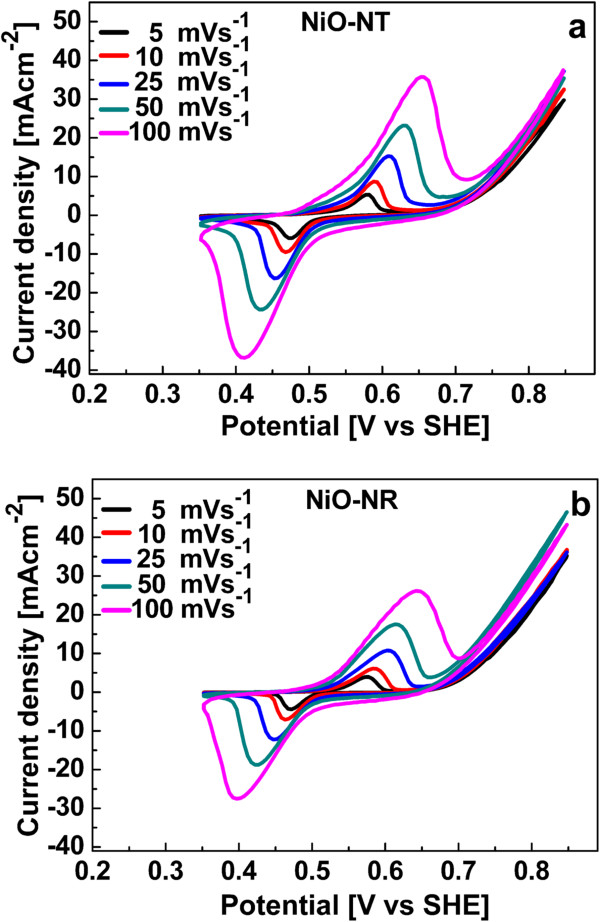
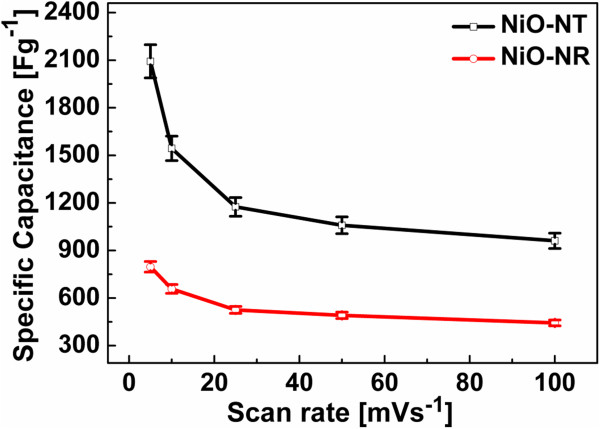
We process one-dimensional (1D) NiO nanostructures in anodized alumina templates starting from electrochemically deposited Ni nanotubes (NTs), and characterize their morphology-dependent supercapacitance behavior. The morphology of the 1D NiO nanostructures is controlled by the time of annealing at 450°C. After 25 min of annealing, the NTs start to close but maintain the tubular structure, and after a further 300 min of annealing time, the tubes are completely closed and nanorods (NRs) are formed. We show that the structures obtained are highly promising for supercapacitor applications; the performance of the NiO NT structure is with a specific capacitance of 2,093 F/g, the highest ever obtained for NiO, approaching the theoretical capacitance of this material. A suitable combination of nanocrystalline grain size and the high surface area akin to the tubular structure is responsible for this high performance. In contrast, the NiO NR structure is characterized by lower performance (797 F/g). A further attribute of the proposed structure is its high stability against galvanostatic charging-discharging cycling at high current densities, with almost no alteration to performance after 500 cycles.
我们从电化学沉积的 Ni 纳米管(NTs)开始,在氧化铝模板中处理一维(1D)NiO 纳米结构,并表征其形态依赖的超级电容行为。一维 NiO 纳米结构的形态由在 450°C 下退火的时间控制。在 25 分钟的退火后,NTs 开始关闭但仍保持管状结构,而在进一步的 300 分钟的退火时间后,管子完全关闭并形成纳米棒(NRs)。我们表明,所获得的结构非常适合超级电容器应用;NiO NT 结构的性能具有 2093 F/g 的比电容,这是迄今为止 NiO 的最高值,接近该材料的理论电容。纳米晶粒度的适当组合和类似于管状结构的高表面积是这种高性能的原因。相比之下,NiO NR 结构的性能较低(797 F/g)。所提出结构的另一个特点是它在高电流密度下对恒电流充放电循环具有很高的稳定性,在 500 次循环后性能几乎没有变化。