Helferty Melissa, Rotondo Jenny L, Martin Irene, Desai Shalini
Centre for Immunization and Respiratory Infectious Diseases, Public Health Agency of Canada, Ottawa, ON, Canada.
Int J Circumpolar Health. 2013 Aug 5;72. doi: 10.3402/ijch.v72i0.21606. eCollection 2013.
The International Circumpolar Surveillance network is a population-based surveillance system that collects data on invasive pneumococcal disease (IPD) in Northern Canada. A 7-valent pneumococcal conjugate vaccine was first introduced in some regions of Northern Canada in 2002, followed by 10-valent (2009) and 13-valent (PCV-13) vaccines (2010). A 23-valent polysaccharide (PPV-23) vaccine was first introduced in 1988 for special populations and adults aged 65 years and older. To describe the epidemiology in the context of pneumococcal vaccination programs, we analysed surveillance data from Northern Canada from 1999 to 2010.
A standardized case report form capturing demographic and clinical information was completed for all IPD cases in Northern Canada meeting the national case definition. Isolates were sent to a reference laboratory for confirmation, serotyping and antimicrobial resistance testing. Both laboratory and epidemiological data were sent to the Public Health Agency of Canada for analysis. Population denominators were obtained from Statistics Canada.
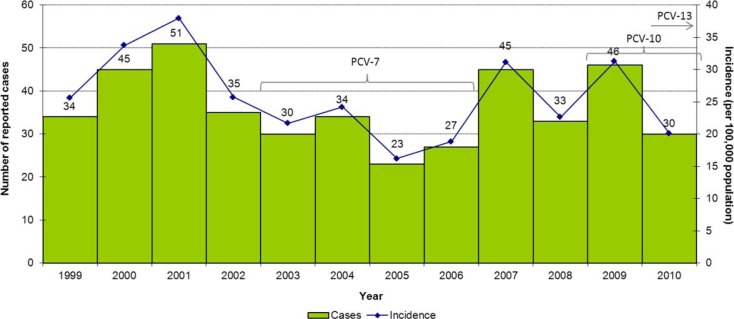
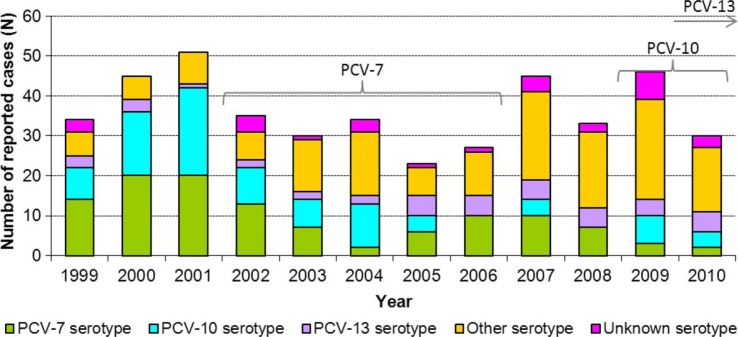
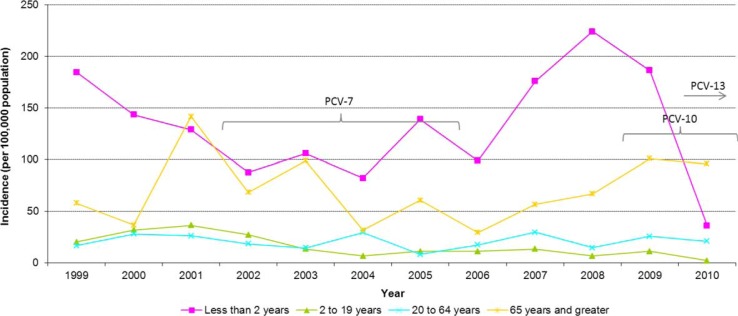
From 1999 to 2010, 433 IPD cases were reported (average 36 cases per year). Incidence was greatest among infants aged < 2 years and among those aged 65 years and older, with an average annual incidence of 133 and 67 cases per 100,000 population, respectively. After a peak in incidence in 2008, rates among infants have declined. Incidence rates varied from 2 to 16 times greater, depending on the year, among Aboriginals compared to non-Aboriginals. Hospitalization was reported in 89% of all cases and the case fatality ratio was 6.0%. Clinical manifestations varied, with some patients reporting > 1 manifestation. Pneumonia was the most common (70%), followed by bacteremia/septicaemia (30%) and meningitis (8%). Approximately, 42% of cases aged < 2 years in 2009 and 2010 had serotypes covered by the PCV-13. In addition, the majority (89%) of serotypes isolated in cases aged 65 years and older were included in the PPV-23 vaccine.
IPD continues to be a major cause of disease in Northern Canadian populations, with particularly high rates among infants and Aboriginals. Continued surveillance is needed to determine the impact of conjugate pneumococcal vaccine programs. Additional studies investigating factors that predispose infants and Aboriginal peoples would also be beneficial.
国际环北极监测网络是一个基于人群的监测系统,用于收集加拿大北部侵袭性肺炎球菌疾病(IPD)的数据。2002年,7价肺炎球菌结合疫苗首次在加拿大北部的一些地区引入,随后是10价(2009年)和13价(PCV-13)疫苗(2010年)。1988年,23价多糖(PPV-23)疫苗首次引入用于特殊人群和65岁及以上的成年人。为了描述肺炎球菌疫苗接种计划背景下的流行病学情况,我们分析了1999年至2010年加拿大北部的监测数据。
为加拿大北部所有符合国家病例定义的IPD病例填写了一份标准化的病例报告表,记录人口统计学和临床信息。分离株被送往参考实验室进行确认、血清分型和抗菌药物耐药性检测。实验室和流行病学数据均被发送至加拿大公共卫生署进行分析。人口分母数据来自加拿大统计局。
1999年至2010年,共报告了433例IPD病例(平均每年36例)。发病率在2岁以下婴儿和65岁及以上人群中最高,每10万人口的年均发病率分别为133例和67例。2008年发病率达到峰值后,婴儿中的发病率有所下降。与非原住民相比,原住民的发病率在不同年份相差2至16倍。所有病例中有89%报告住院,病死率为6.0%。临床表现各不相同,一些患者报告有多种表现。肺炎最为常见(70%),其次是菌血症/败血症(30%)和脑膜炎(8%)。2009年和2010年,2岁以下病例中约42%的血清型被PCV-13覆盖。此外,65岁及以上病例中分离出的大多数血清型(89%)都包含在PPV-23疫苗中。
IPD仍然是加拿大北部人群疾病的主要原因,在婴儿和原住民中发病率尤其高。需要持续监测以确定肺炎球菌结合疫苗计划的影响。开展更多研究调查导致婴儿和原住民易患该病的因素也将有益。