Department of Chemistry, University of Sheffield , Brook Hill, Sheffield S3 7HF, United Kingdom.
ACS Nano. 2013 Sep 24;7(9):7610-8. doi: 10.1021/nn402063b. Epub 2013 Aug 30.
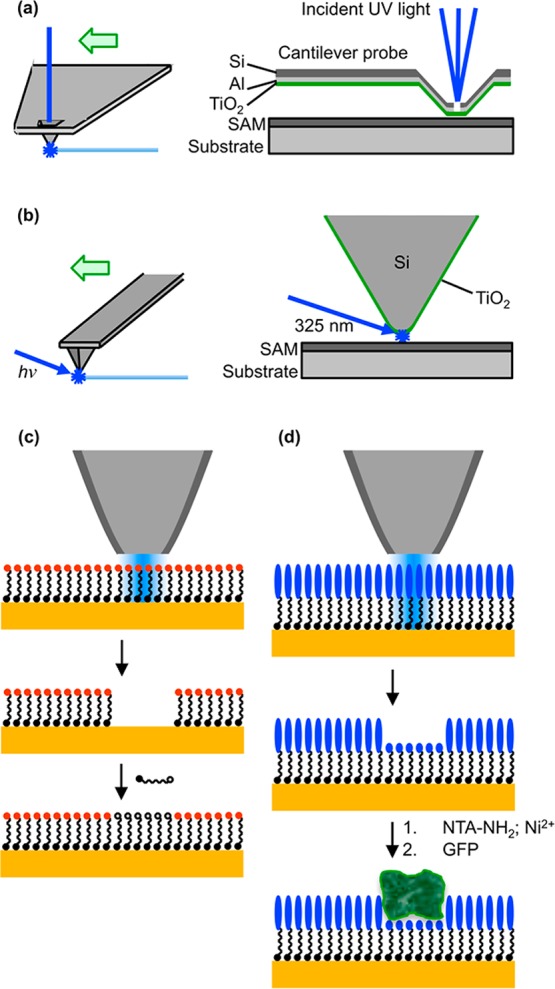
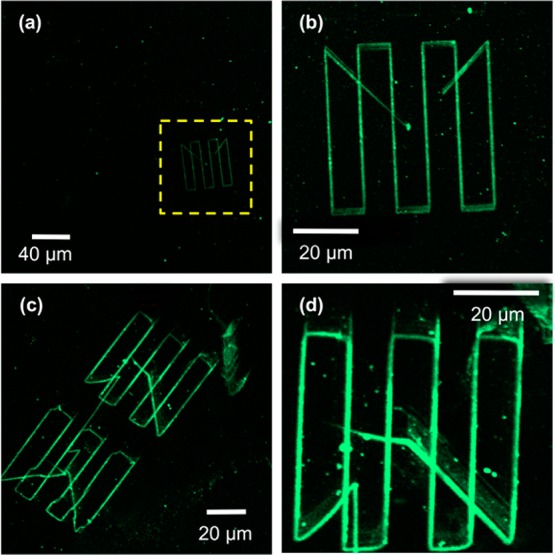
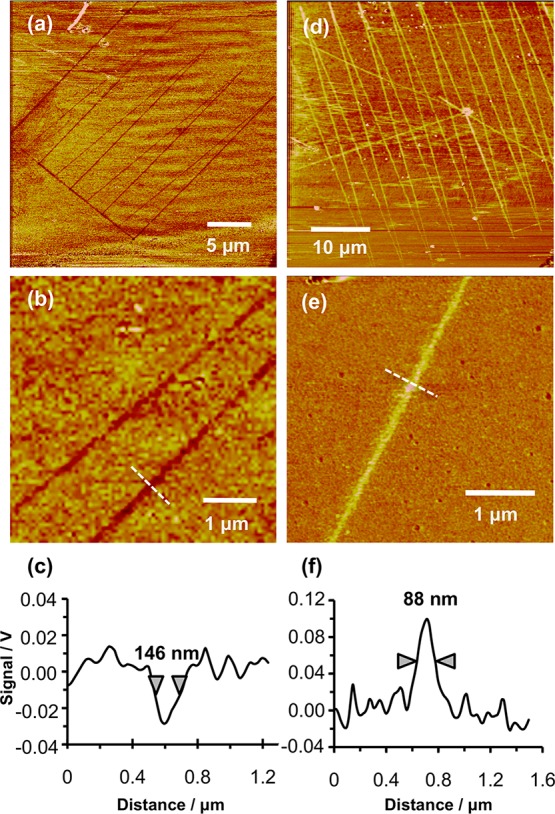
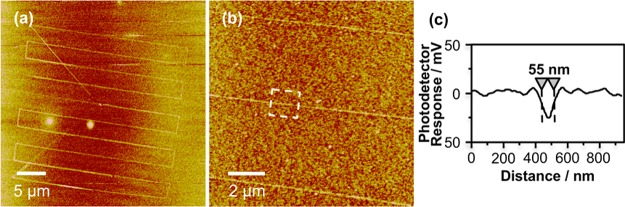
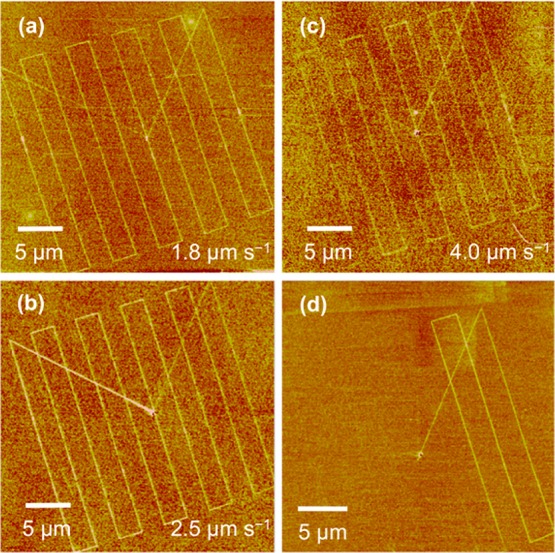
Self-assembled monolayers of alkylthiolates on gold and alkylsilanes on silicon dioxide have been patterned photocatalytically on sub-100 nm length-scales using both apertured near-field and apertureless methods. Apertured lithography was carried out by means of an argon ion laser (364 nm) coupled to cantilever-type near-field probes with a thin film of titania deposited over the aperture. Apertureless lithography was carried out with a helium-cadmium laser (325 nm) to excite titanium-coated, contact-mode atomic force microscope (AFM) probes. This latter approach is readily implementable on any commercial AFM system. Photodegradation occurred in both cases through the localized photocatalytic degradation of the monolayer. For alkanethiols, degradation of one thiol exposed the bare substrate, enabling refunctionalization of the bare gold by a second, contrasting thiol. For alkylsilanes, degradation of the adsorbate molecule provided a facile means for protein patterning. Lines were written in a protein-resistant film formed by the adsorption of oligo(ethylene glycol)-functionalized trichlorosilanes on glass, leading to the formation of sub-100 nm adhesive, aldehyde-functionalized regions. These were derivatized with aminobutylnitrilotriacetic acid, and complexed with Ni(2+), enabling the binding of histidine-labeled green fluorescent protein, which yielded bright fluorescence from 70-nm-wide lines that could be imaged clearly in a confocal microscope.
自组装金上的烷基硫醇单层和二氧化硅上的烷基硅烷已通过孔径近场和无孔径两种方法在亚 100nm 长度尺度上进行了光催化图案化。孔径光刻通过带有沉积在孔径上的二氧化钛薄膜的悬臂式近场探针与氩离子激光(364nm)耦合来进行。无孔径光刻则使用氦镉激光(325nm)来激发涂钛的接触模式原子力显微镜(AFM)探针。后一种方法可以很容易地在任何商业 AFM 系统上实现。在这两种情况下,光降解都是通过单层的局部光催化降解来实现的。对于烷硫醇,一个硫醇的降解暴露了裸露的基底,使得第二个对比硫醇能够对裸露的金进行再功能化。对于烷基硅烷,吸附物分子的降解为蛋白质图案化提供了一种简单的方法。在玻璃上吸附聚(乙二醇)功能化三氯硅烷形成的抗蛋白膜上写出线条,导致形成亚 100nm 的粘性、醛基功能化区域。这些区域被氨基丁基乙二胺三乙酸衍生化,并与 Ni(2+)络合,从而能够结合组氨酸标记的绿色荧光蛋白,其在 70nm 宽的线中产生明亮的荧光,可以在共聚焦显微镜中清晰成像。