Department of Nutrition Sciences, University of Alabama at Birmingham, Birmingham VA Medical Center, Birmingham, AL 35294-3360, USA.
Curr Opin Endocrinol Diabetes Obes. 2013 Oct;20(5):377-88. doi: 10.1097/01.med.0000433067.01671.f5.
The current medical model for obesity management is BMI-centric because BMI is the predominant measure used to gauge disease severity, as well as indications for various treatment modalities. Recent advancements in therapy and understanding of the relationship between BMI and obesity-related complications call for a re-examination of this approach.
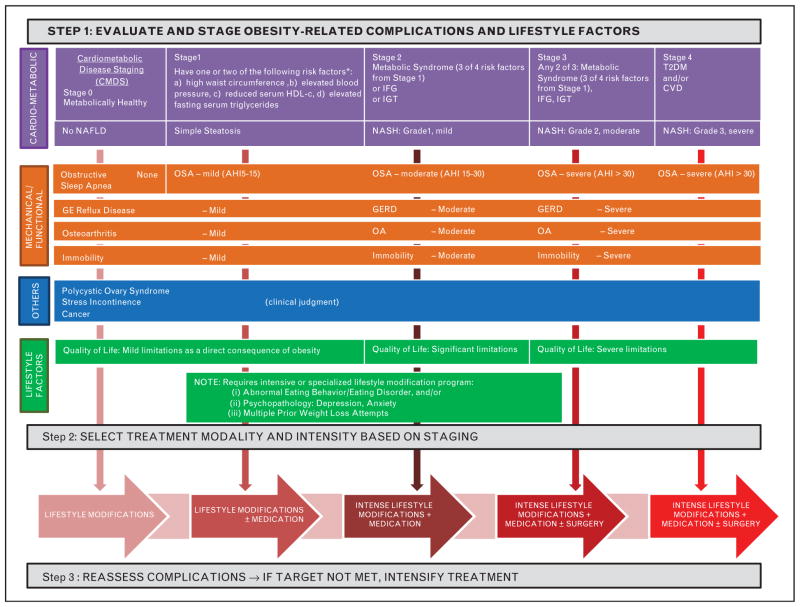
Advancements in treatment, including the recent approval of two new weight loss medications in the USA, have enabled development of new medical models for management of obesity. On the basis of accumulating data demonstrating the benefits of weight loss regarding multiple obesity-related complications (e.g., diabetes prevention, type 2 diabetes mellitus, cardiovascular disease risk, nonalcoholic steatohepatitis, sleep apnea), a complications-centric model is proposed that employs weight loss as a tool to treat and prevent obesity comorbidities. This model assures that the aggressiveness of therapy is commensurate with disease severity, and that therapy is directed at those obese patients who will benefit most from weight loss therapy. The treatment algorithm is comprehensive in addressing complications and quantitative when possible in the staging of risk or disease severity.
A complications-centric approach to obesity management identifies patients who will benefit most from weight loss, and optimizes patient outcomes, benefit/risk ratio, and the cost-effectiveness of interventions.
目的综述:目前肥胖管理的医学模式以 BMI 为中心,因为 BMI 是衡量疾病严重程度的主要指标,也是各种治疗方式的适应证指标。治疗方法的进步和对 BMI 与肥胖相关并发症之间关系的理解加深,要求重新审视这种方法。
最近的发现:治疗方法的进步,包括最近在美国批准的两种新的减肥药物,为肥胖管理的新医学模式的发展提供了可能。基于越来越多的数据表明减肥对多种肥胖相关并发症(如糖尿病预防、2 型糖尿病、心血管疾病风险、非酒精性脂肪性肝炎、睡眠呼吸暂停)有益,提出了一种以并发症为中心的模式,该模式将体重减轻作为治疗和预防肥胖合并症的手段。这种模式确保治疗的激进程度与疾病严重程度相称,并确保将治疗针对那些最能从减肥治疗中获益的肥胖患者。该治疗算法全面解决并发症,并尽可能对风险或疾病严重程度进行定量分期。
总结:肥胖管理的并发症为中心的方法确定了最能从减肥中获益的患者,并优化了患者的预后、获益/风险比以及干预措施的成本效益。