Institute of Computational Biology, Helmholtz Zentrum München, Ingolstädter Landstraße 1, 85764 Neuherberg, Germany and Department of Mathematics, Technische Universität München, Boltzmannstraße 3, 85747 Garching, Germany.
Nucleic Acids Res. 2013 Nov;41(21):9622-33. doi: 10.1093/nar/gkt752. Epub 2013 Aug 23.
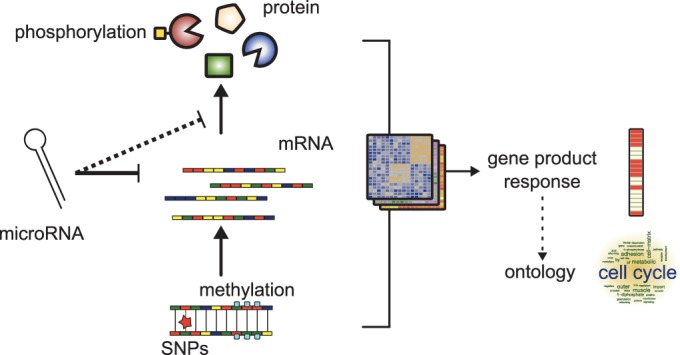
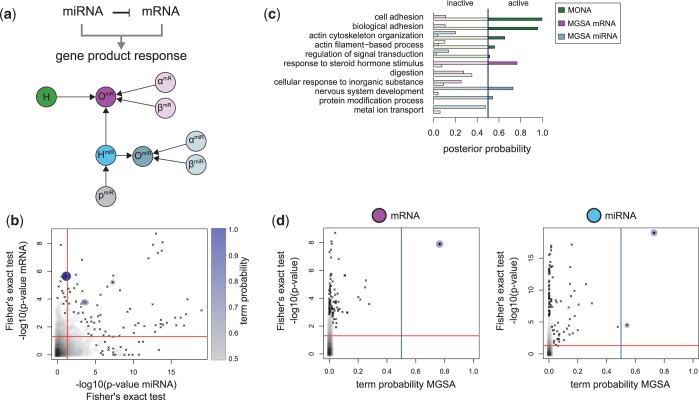
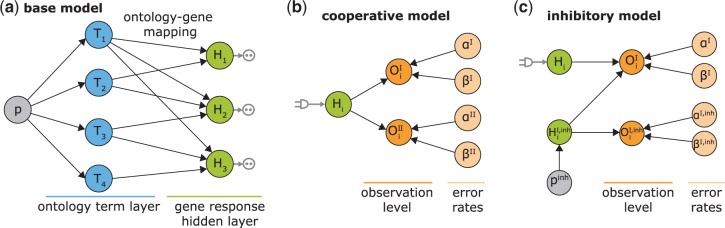
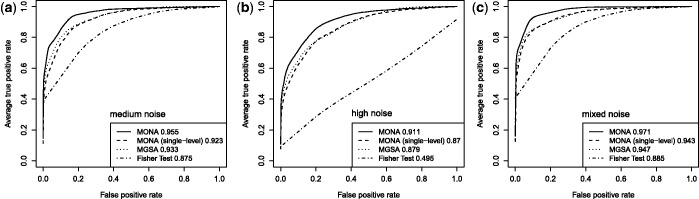
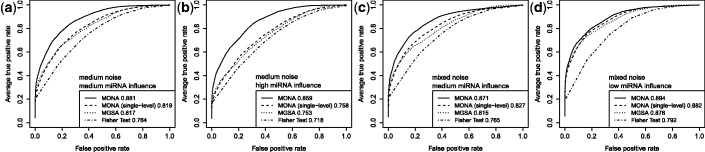
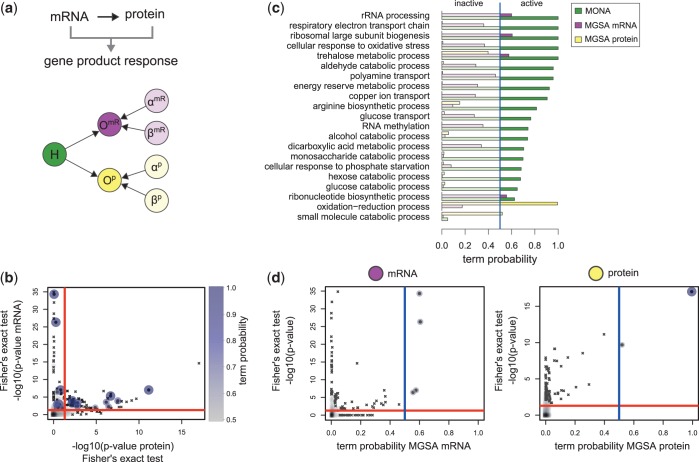
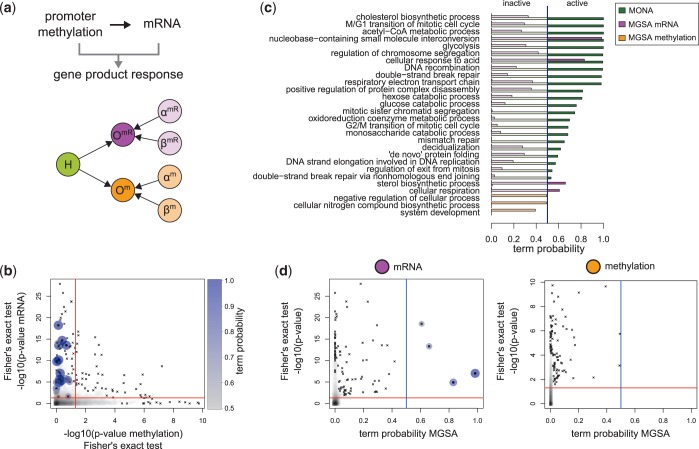
Modern high-throughput methods allow the investigation of biological functions across multiple 'omics' levels. Levels include mRNA and protein expression profiling as well as additional knowledge on, for example, DNA methylation and microRNA regulation. The reason for this interest in multi-omics is that actual cellular responses to different conditions are best explained mechanistically when taking all omics levels into account. To map gene products to their biological functions, public ontologies like Gene Ontology are commonly used. Many methods have been developed to identify terms in an ontology, overrepresented within a set of genes. However, these methods are not able to appropriately deal with any combination of several data types. Here, we propose a new method to analyse integrated data across multiple omics-levels to simultaneously assess their biological meaning. We developed a model-based Bayesian method for inferring interpretable term probabilities in a modular framework. Our Multi-level ONtology Analysis (MONA) algorithm performed significantly better than conventional analyses of individual levels and yields best results even for sophisticated models including mRNA fine-tuning by microRNAs. The MONA framework is flexible enough to allow for different underlying regulatory motifs or ontologies. It is ready-to-use for applied researchers and is available as a standalone application from http://icb.helmholtz-muenchen.de/mona.
现代高通量方法允许在多个“组学”水平上研究生物功能。这些水平包括 mRNA 和蛋白质表达谱,以及其他知识,如 DNA 甲基化和 microRNA 调节。对多组学感兴趣的原因是,当考虑所有组学水平时,最能从机制上解释细胞对不同条件的实际反应。为了将基因产物映射到它们的生物学功能,公共本体(如基因本体论)通常用于此。已经开发了许多方法来识别本体论中的术语,这些术语在一组基因中表现出过度表达。然而,这些方法不能适当地处理几种数据类型的任何组合。在这里,我们提出了一种新的方法来分析多个组学水平的集成数据,以同时评估它们的生物学意义。我们开发了一种基于模型的贝叶斯方法,用于在模块化框架中推断可解释的术语概率。我们的多水平本体分析(MONA)算法的性能明显优于单个水平的常规分析,即使对于包括 microRNA 对 mRNA 微调在内的复杂模型,也能产生最佳结果。MONA 框架足够灵活,可以允许不同的基础调节基序或本体。它可供应用研究人员使用,并可从 http://icb.helmholtz-muenchen.de/mona 获得独立应用程序。