Unit of Gene Therapy and Stem Cell Biology, Jules-Gonin Eye Hospital, University of Lausanne, Lausanne, Switzerland.
PLoS One. 2013 Aug 19;8(8):e71363. doi: 10.1371/journal.pone.0071363. eCollection 2013.
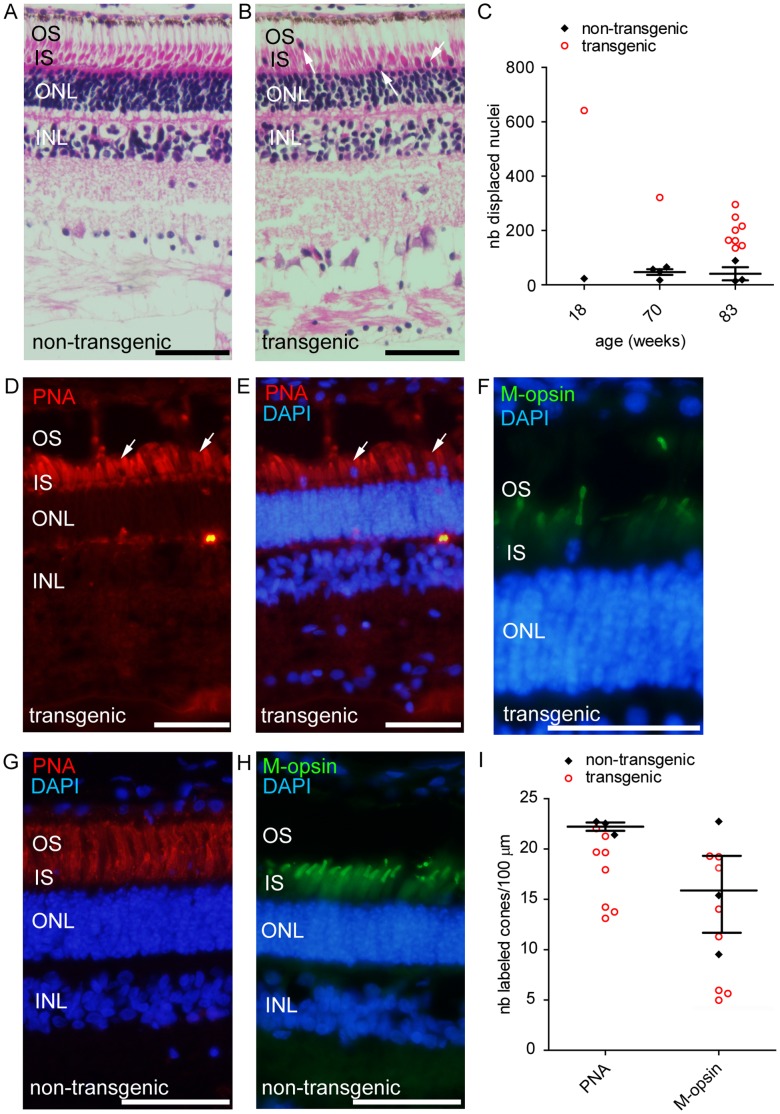
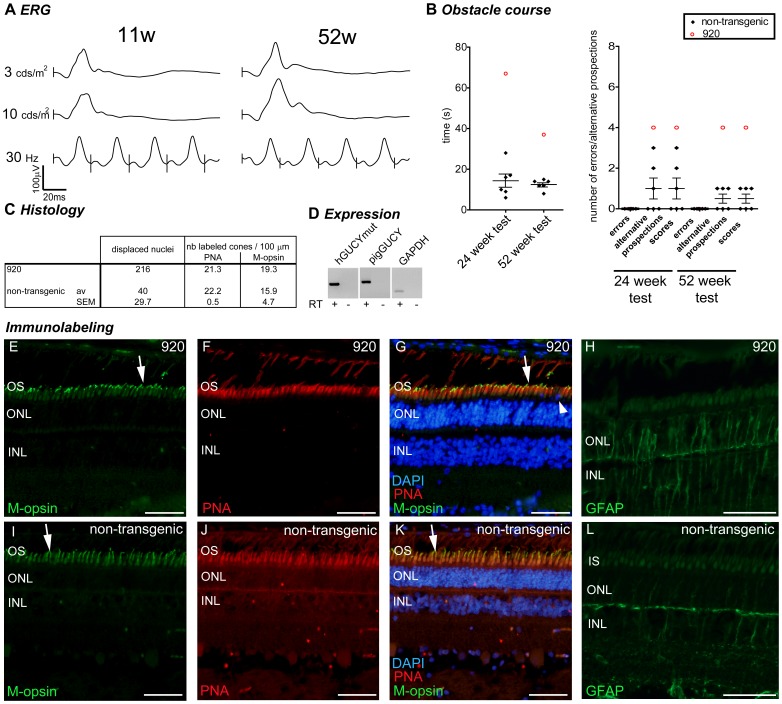
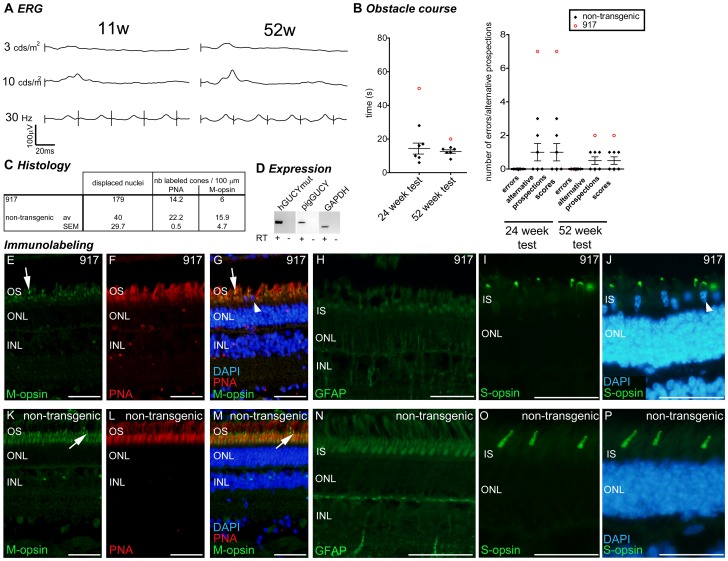
Large animal models are an important resource for the understanding of human disease and for evaluating the applicability of new therapies to human patients. For many diseases, such as cone dystrophy, research effort is hampered by the lack of such models. Lentiviral transgenesis is a methodology broadly applicable to animals from many different species. When conjugated to the expression of a dominant mutant protein, this technology offers an attractive approach to generate new large animal models in a heterogeneous background. We adopted this strategy to mimic the phenotype diversity encounter in humans and generate a cohort of pigs for cone dystrophy by expressing a dominant mutant allele of the guanylate cyclase 2D (GUCY2D) gene. Sixty percent of the piglets were transgenic, with mutant GUCY2D mRNA detected in the retina of all animals tested. Functional impairment of vision was observed among the transgenic pigs at 3 months of age, with a follow-up at 1 year indicating a subsequent slower progression of phenotype. Abnormal retina morphology, notably among the cone photoreceptor cell population, was observed exclusively amongst the transgenic animals. Of particular note, these transgenic animals were characterized by a range in the severity of the phenotype, reflecting the human clinical situation. We demonstrate that a transgenic approach using lentiviral vectors offers a powerful tool for large animal model development. Not only is the efficiency of transgenesis higher than conventional transgenic methodology but this technique also produces a heterogeneous cohort of transgenic animals that mimics the genetic variation encountered in human patients.
大型动物模型是理解人类疾病和评估新疗法在人类患者中适用性的重要资源。对于许多疾病,例如 Cone 营养不良,由于缺乏此类模型,研究工作受到阻碍。慢病毒转基因技术广泛适用于来自许多不同物种的动物。当与显性突变蛋白的表达结合使用时,这项技术为在异质背景下生成新的大型动物模型提供了一种有吸引力的方法。我们采用这种策略来模拟人类中遇到的表型多样性,并通过表达鸟苷酸环化酶 2D (GUCY2D) 基因的显性突变等位基因,来生成 Cone 营养不良的猪队列。60%的仔猪是转基因的,所有测试动物的视网膜中都检测到了突变的 GUCY2D mRNA。在 3 个月大时,转基因猪出现了视力功能障碍,在 1 岁时进行的后续观察表明,表型的进展随后会变得更慢。仅在转基因动物中观察到异常的视网膜形态,特别是在 Cone 光感受器细胞群体中。特别值得注意的是,这些转基因动物的表型严重程度存在差异,反映了人类的临床情况。我们证明,使用慢病毒载体的转基因方法为大型动物模型的开发提供了一种强大的工具。这种技术不仅比传统的转基因方法具有更高的转基因效率,而且还产生了模拟人类患者中遇到的遗传变异的异质转基因动物群体。