School of Physiotherapy, Curtin University, Perth, Western Australia, Australia ; Curtin Health Innovation Research Institute, Curtin University, Perth, Western Australia, Australia.
PLoS One. 2013 Aug 20;8(8):e71918. doi: 10.1371/journal.pone.0071918. eCollection 2013.
This cluster-randomised controlled trial determined the effectiveness of an evidence-based, pamphlet intervention in improving low back pain (LBP)-related beliefs among pharmacy consumers.
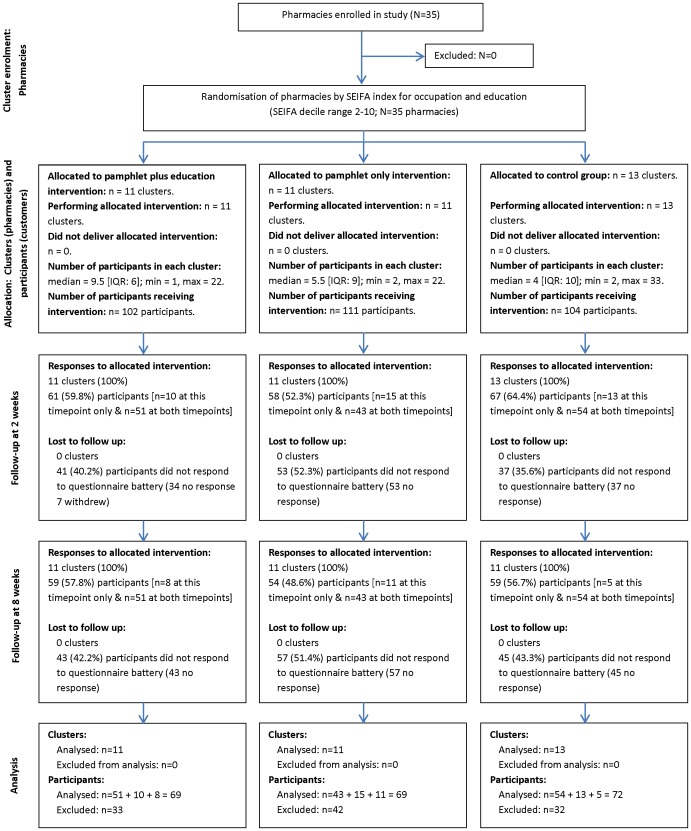
THIRTY FIVE COMMUNITY PHARMACIES WERE RANDOMISED TO THREE GROUPS: pamphlet+education intervention [n = 11]; pamphlet only intervention [n = 11]; control: usual care [n = 13]. Eligibility requirements for clusters included: community-based pharmacies and proprietor participation consent. Pharmacy consumers (N = 317) aged 18-65 years currently experiencing LBP participated. Intervention group allocation depended on the pharmacy attended. Individual-level outcomes were measured at pre-intervention (T0), at two (T1) and eight (T2) weeks post-intervention and included beliefs about LBP [Back Pain Beliefs Questionnaire (BBQ); Fear Avoidance Beliefs Questionnaire (FABQ)]. Secondary outcomes included pain severity, activity impairment and pamphlet perceived usefulness. Blinding to group allocation included primary investigators, outcome assessors and the statistician. Pharmacy staff and consumers were un-blinded.
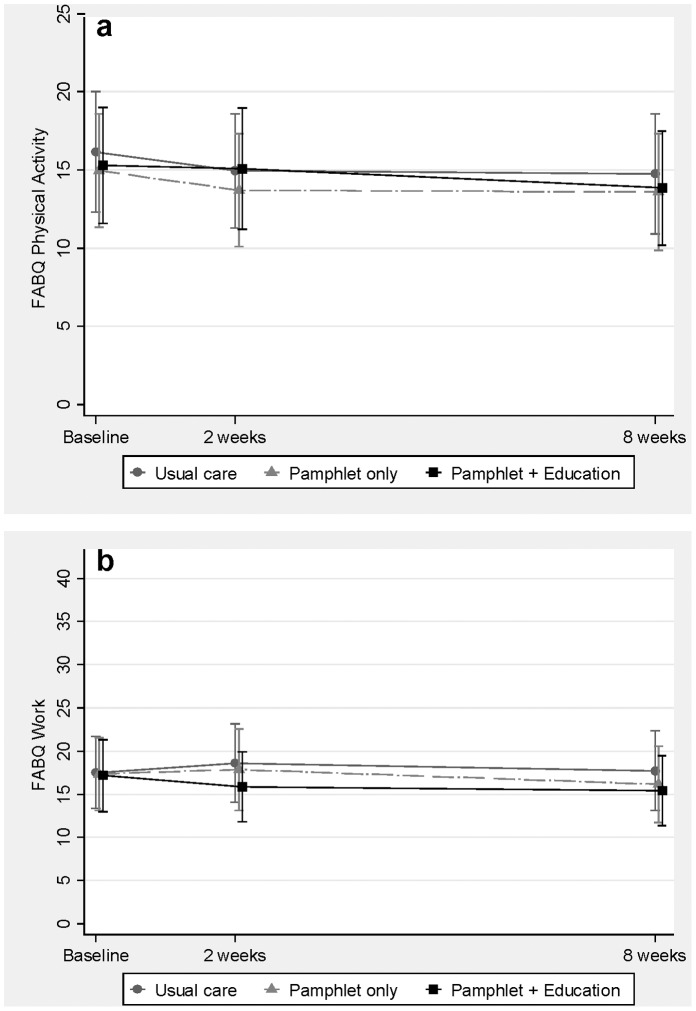
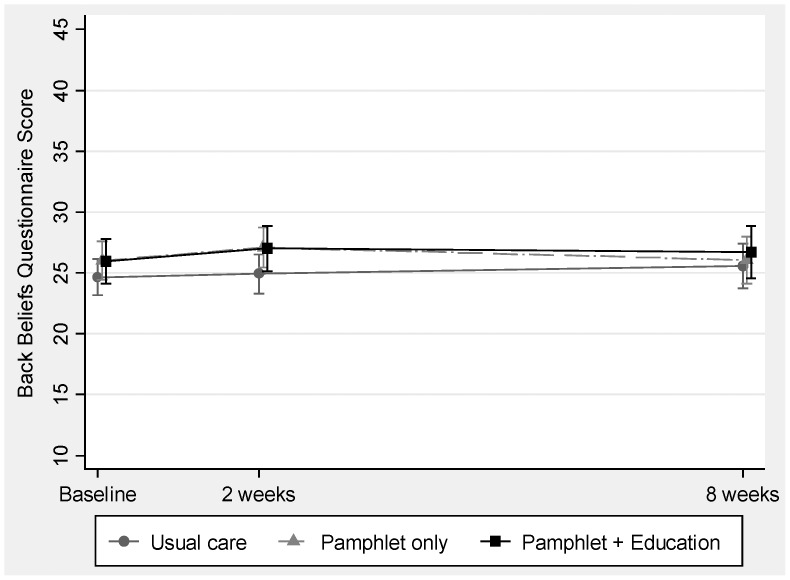
Of 35 pharmacies recruited (317 consumers), no clusters were lost to follow-up. Follow-up was available for n = 24 at 2 weeks only; n = 38 at 8 weeks only; n = 148 at both time points, with n = 148+24+38 = 210 analysed (107 excluded: no follow up). Adjusting for baseline scores demonstrated no significant differences in beliefs (2 or at 8 weeks) between pamphlet (with or without education) versus control, or between 'pamphlet with' versus 'without' education. Work-related fear (FABQ) was significantly lower in consumers receiving pamphlet (with or without education) versus control (difference -2.3, 95%CI: -4.4 to -0.2). There was no significant difference between "pamphlet with" versus "pamphlet without" groups. Consumers receiving the "pamphlet with" reported greater perceived usefulness than consumers receiving the "pamphlet without" (difference 0.9 (95%CI: 0.0 to 1.8)).
Community pharmacies provided a feasible primary care portal for implementing evidence-based information. The associated improvement in work-related LBP-beliefs for consumers receiving the pamphlet suggests this simple intervention may be a useful component of care.
ACTR.org.au ACTRN12611000053921.
本整群随机对照试验旨在确定基于证据的小册子干预措施在改善药房消费者腰痛(LBP)相关信念方面的有效性。
将 35 家社区药房随机分为三组:小册子+教育干预组[n=11];小册子干预组[n=11];对照组:常规护理[n=13]。群组的纳入标准包括:社区药房和店主参与同意。18-65 岁目前患有腰痛的药房消费者参与。干预组的分配取决于就诊的药房。个体水平的结果在干预前(T0)、干预后 2 周(T1)和 8 周(T2)进行测量,包括对腰痛的信念[腰痛信念问卷(BBQ);害怕回避信念问卷(FABQ)]。次要结果包括疼痛严重程度、活动障碍和小册子感知有用性。对组分配进行盲法处理的包括主要研究者、结果评估者和统计学家。药房工作人员和消费者没有被蒙蔽。
35 家招募的药房(317 名消费者)中,没有一个药房群在随访中丢失。仅在 2 周时可获得 n=24 例的随访;仅在 8 周时可获得 n=38 例的随访;在两个时间点均有 n=148 例的随访,n=148+24+38=210 例进行分析(107 例被排除:无随访)。调整基线评分后,小册子(带或不带教育)与对照组之间,或“带小册子”与“不带小册子”教育之间,在 2 或 8 周时的信念均无显著差异。接受小册子(带或不带教育)的消费者的工作相关恐惧(FABQ)显著低于对照组(差异-2.3,95%CI:-4.4 至-0.2)。“带小册子”组与“不带小册子”组之间无显著差异。接受“带小册子”的消费者比接受“不带小册子”的消费者报告的感知有用性更高(差异 0.9(95%CI:0.0 至 1.8))。
社区药房为实施循证信息提供了可行的初级保健门户。接受小册子的消费者的工作相关 LBP 信念得到改善,这表明这种简单的干预措施可能是护理的有用组成部分。
ACTR.org.au ACTRN12611000053921。