Fukushima Hirokata, Goto Yurie, Maeda Takaki, Kato Motoichiro, Umeda Satoshi
Faculty of Sociology, Kansai University, Osaka, Japan.
PLoS One. 2013 Aug 19;8(8):e72267. doi: 10.1371/journal.pone.0072267. eCollection 2013.
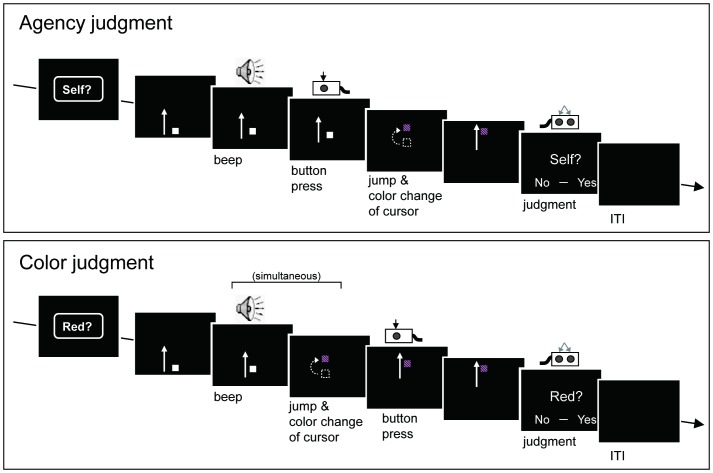
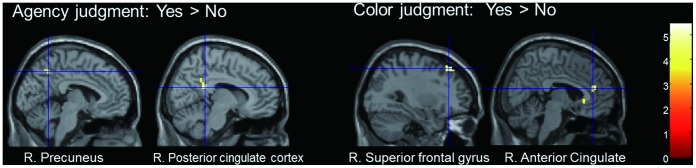
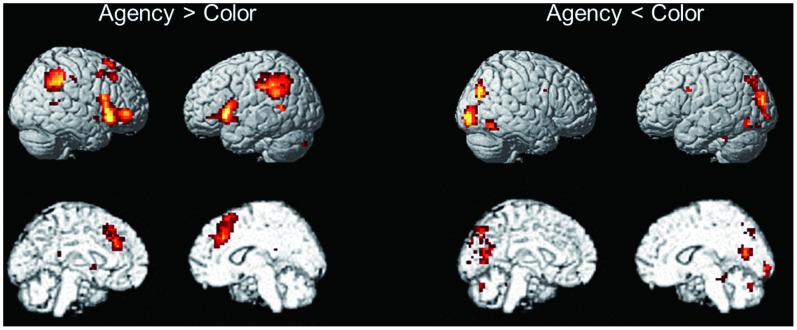
The sense of agency is the attribution of oneself as the cause of one's own actions and their effects. Accurate agency judgments are essential for adaptive behaviors in dynamic environments, especially in conditions of uncertainty. However, it is unclear how agency judgments are made in ambiguous situations where self-agency and non-self-agency are both possible. Agency attribution is thus thought to require higher-order neurocognitive processes that integrate several possibilities. Furthermore, neural activity specific to self-attribution, as compared with non-self-attribution, may reflect higher-order critical operations that contribute to constructions of self-consciousness. Based on these assumptions, the present study focused on agency judgments under ambiguous conditions and examined the neural correlates of this operation with functional magnetic resonance imaging. Participants performed a simple but demanding agency-judgment task, which required them to report on whether they attributed their own action as the cause of a visual stimulus change. The temporal discrepancy between the participant's action and the visual events was adaptively set to be maximally ambiguous for each individual on a trial-by-trial basis. Comparison with results for a control condition revealed that the judgment of agency was associated with activity in lateral temporo-parietal areas, medial frontal areas, the dorsolateral prefrontal area, and frontal operculum/insula regions. However, most of these areas did not differentiate between self- and non-self-attribution. Instead, self-attribution was associated with activity in posterior midline areas, including the precuneus and posterior cingulate cortex. These results suggest that deliberate self-attribution of an external event is principally associated with activity in posterior midline structures, which is imperative for self-consciousness.
能动感是将自身归因于自身行为及其后果的原因。准确的能动性判断对于动态环境中的适应性行为至关重要,尤其是在不确定的情况下。然而,尚不清楚在自我能动性和非自我能动性都有可能的模糊情境中,能动性判断是如何做出的。因此,能动性归因被认为需要整合多种可能性的高阶神经认知过程。此外,与非自我归因相比,自我归因特有的神经活动可能反映了有助于自我意识构建的高阶关键操作。基于这些假设,本研究聚焦于模糊条件下的能动性判断,并通过功能磁共振成像检查了这一操作的神经关联。参与者执行了一项简单但要求较高的能动性判断任务,该任务要求他们报告是否将自己的行为归因于视觉刺激变化的原因。参与者的行为与视觉事件之间的时间差异在每次试验的基础上进行适应性设置,以使每个个体的模糊性最大化。与对照条件的结果比较显示,能动性判断与颞顶叶外侧区域、内侧额叶区域、背外侧前额叶区域和额盖/岛叶区域的活动有关。然而,这些区域中的大多数并没有区分自我归因和非自我归因。相反,自我归因与包括楔前叶和后扣带回皮质在内的后中线区域的活动有关。这些结果表明,对外部事件的刻意自我归因主要与后中线结构的活动有关,而后中线结构对于自我意识至关重要。