You Zhipeng, Liao Meijiang, Zhang Hao, Yang Hsiuchin, Pan Xijian, Houghton John E, Sui Sen-Fang, Tai Phang C
Department of Biology and Center of Biotechnology and Drug Design, Georgia State University, Atlanta, Georgia, United States of America.
PLoS One. 2013 Aug 16;8(8):e72560. doi: 10.1371/journal.pone.0072560. eCollection 2013.
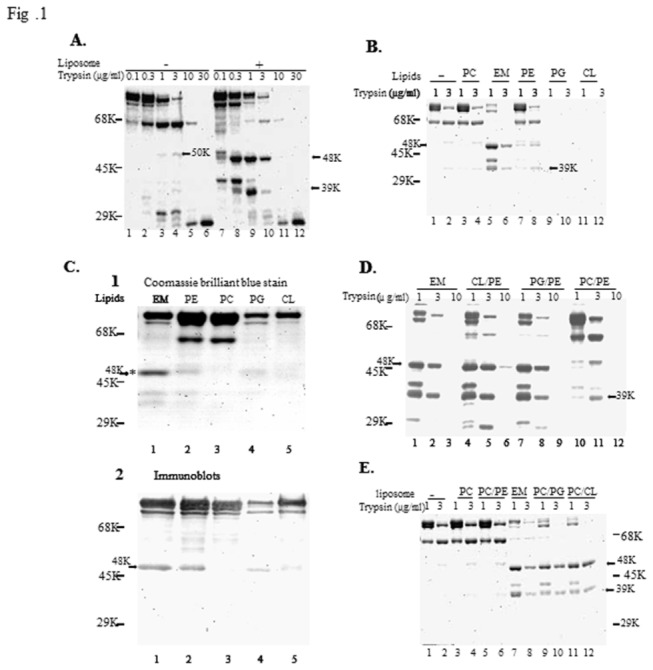
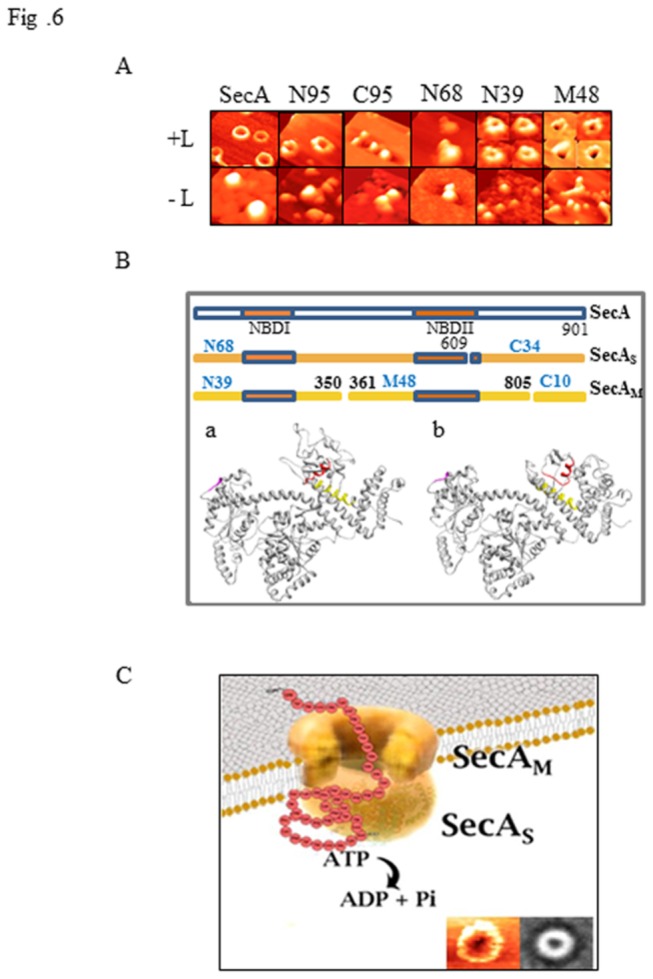
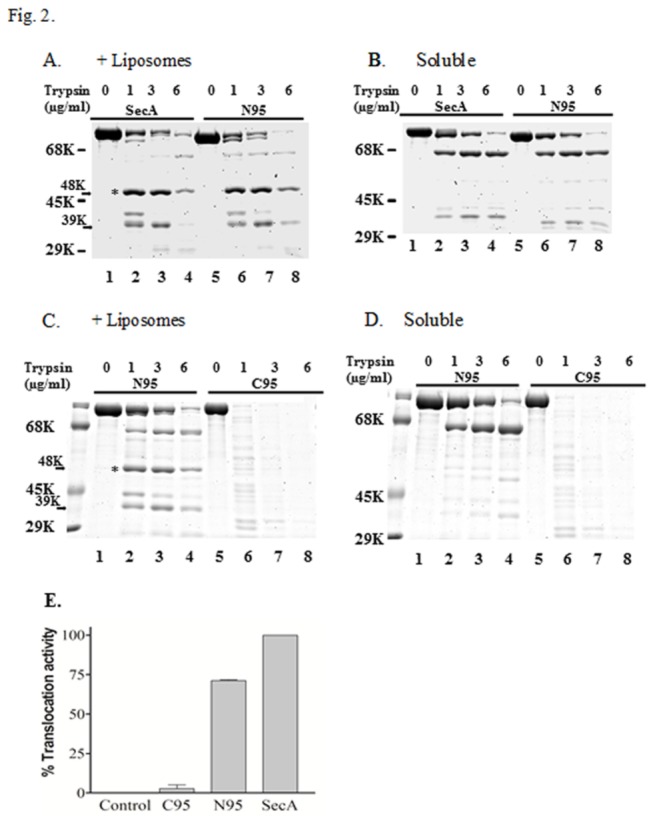
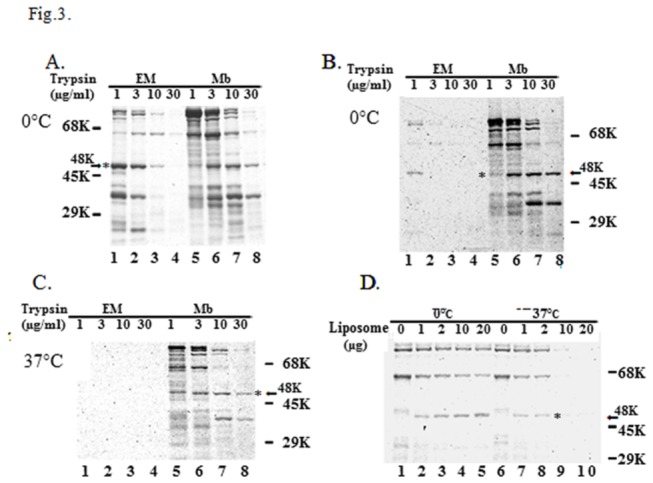
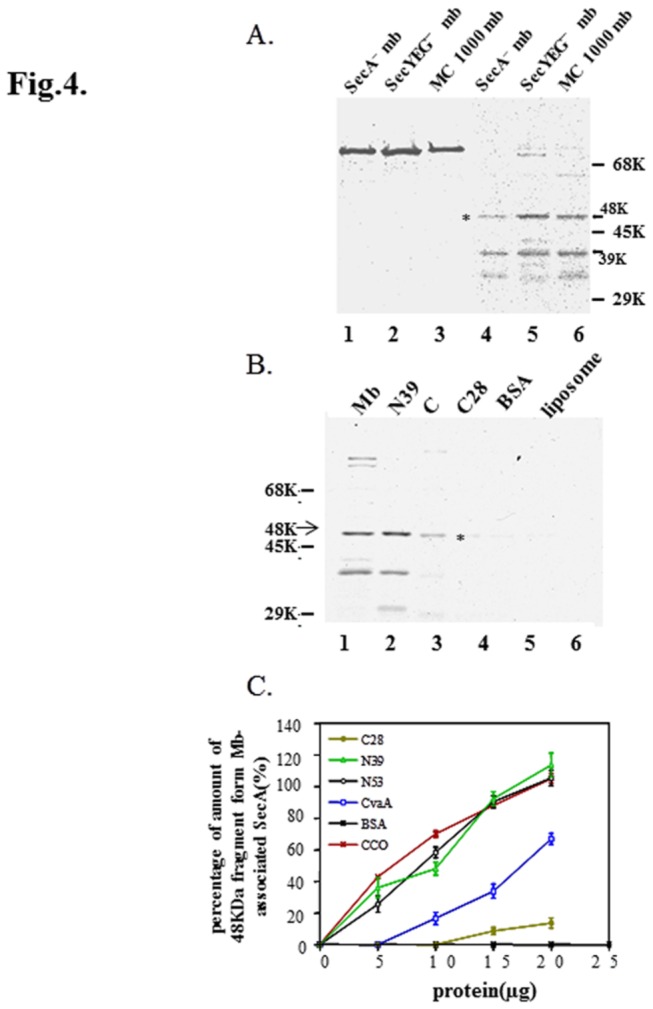
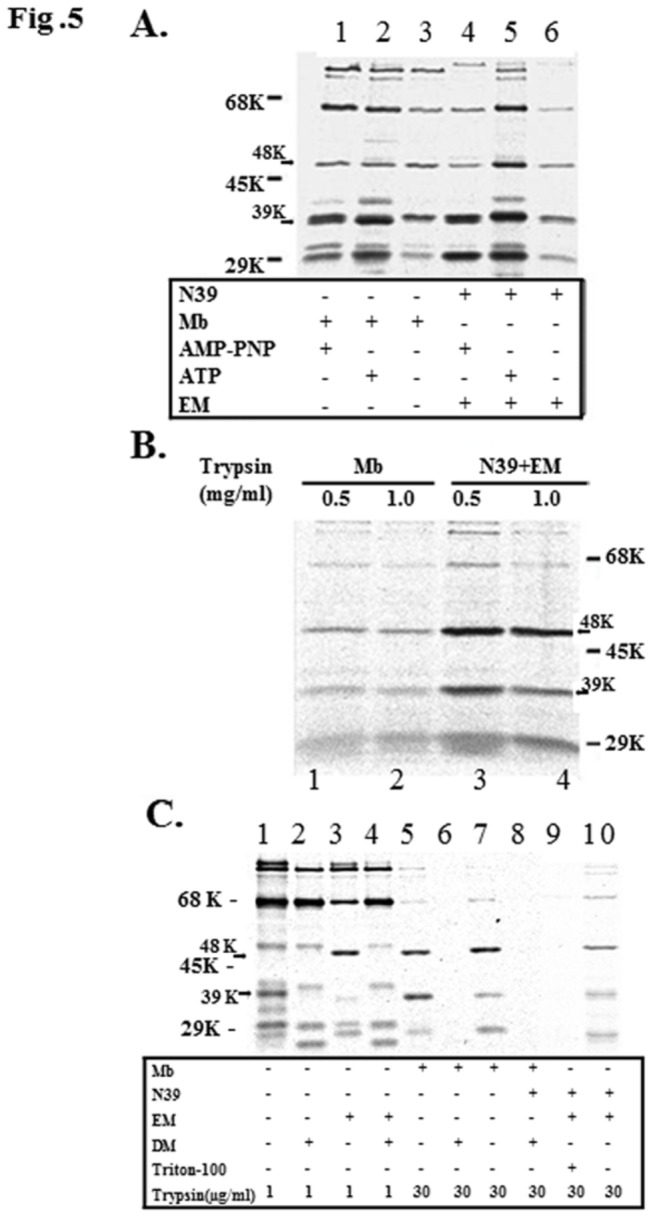
SecA, an essential component of the Sec machinery, exists in a soluble and a membrane form in Escherichia coli. Previous studies have shown that the soluble SecA transforms into pore structures when it interacts with liposomes, and integrates into membranes containing SecYEG in two forms: SecAS and SecAM; the latter exemplified by two tryptic membrane-specific domains, an N-terminal domain (N39) and a middle M48 domain (M48). The formation of these lipid-specific domains was further investigated. The N39 and M48 domains are induced only when SecA interacts with anionic liposomes. Additionally, the N-terminus, not the C-terminus of SecA is required for inducing such conformational changes. Proteolytic treatment and sequence analyses showed that liposome-embedded SecA yields the same M48 and N39 domains as does the membrane-embedded SecA. Studies with chemical extraction and resistance to trypsin have also shown that these proteoliposome-embedded SecA fragments exhibit the same stability and characteristics as their membrane-embedded SecA equivalents. Furthermore, the cloned lipid-specific domains N39 and M48, but not N68 or C34, are able to form partial, but imperfect ring-like structures when they interact with phospholipids. These ring-like structures are characteristic of a SecA pore-structure, suggesting that these domains contribute part of the SecA-dependent protein-conducting channel. We, therefore, propose a model in which SecA alone is capable of forming a lipid-specific, asymmetric dimer that is able to function as a viable protein-conducting channel in the membrane, without any requirement for SecYEG.
SecA是Sec转运机制的一个必需组分,在大肠杆菌中以可溶性和膜结合形式存在。先前的研究表明,可溶性SecA与脂质体相互作用时会转变为孔结构,并以两种形式整合到含有SecYEG的膜中:SecAS和SecAM;后者以两个胰蛋白酶膜特异性结构域为例,即N端结构域(N39)和中间的M48结构域(M48)。对这些脂质特异性结构域的形成进行了进一步研究。仅当SecA与阴离子脂质体相互作用时,N39和M48结构域才会被诱导产生。此外,诱导这种构象变化需要SecA的N端而非C端。蛋白水解处理和序列分析表明,脂质体包埋的SecA产生的M48和N39结构域与膜包埋的SecA相同。化学提取和对胰蛋白酶抗性的研究也表明,这些蛋白酶脂质体包埋的SecA片段与其膜包埋的SecA等效物具有相同的稳定性和特性。此外,克隆的脂质特异性结构域N39和M48,而非N68或C34,与磷脂相互作用时能够形成部分但不完美的环状结构。这些环状结构是SecA孔结构的特征,表明这些结构域构成了SecA依赖性蛋白质传导通道的一部分。因此,我们提出了一个模型,其中SecA单独能够形成脂质特异性的不对称二聚体,该二聚体能够在膜中作为可行的蛋白质传导通道发挥作用,而无需SecYEG。