Klatt Björn K, Burmeister Carina, Westphal Catrin, Tscharntke Teja, von Fragstein Maximilian
Agroecology, University of Göttingen, Göttingen, Germany.
PLoS One. 2013 Aug 20;8(8):e72724. doi: 10.1371/journal.pone.0072724. eCollection 2013.
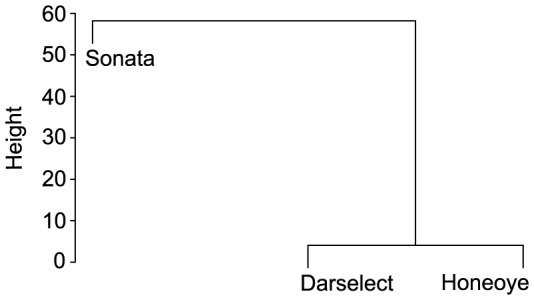
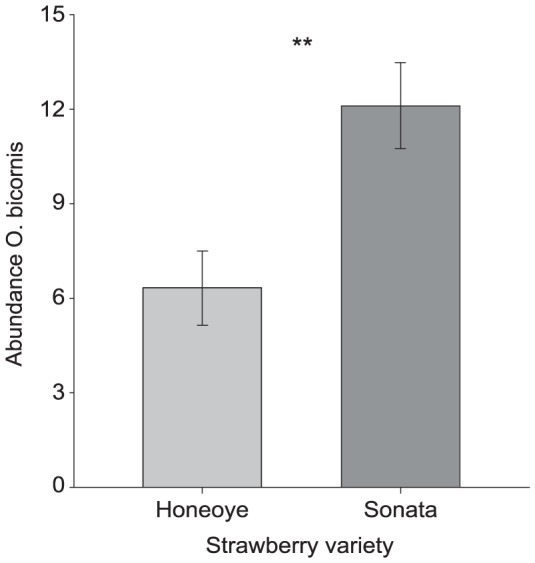
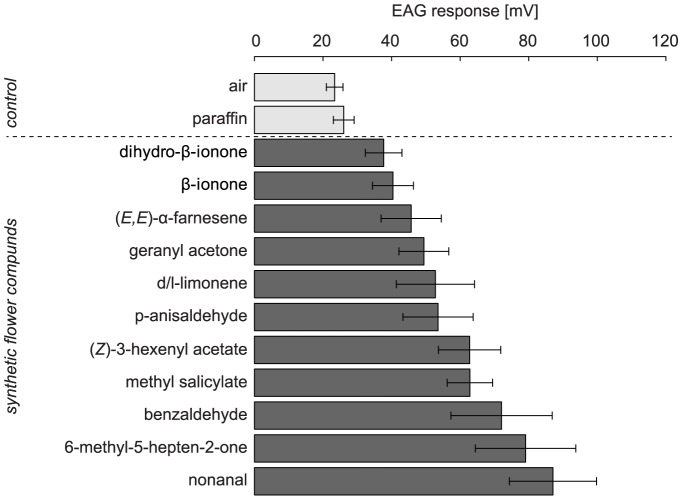
Pollination contributes to an estimated one third of global food production, through both the improvement of the yield and the quality of crops. Volatile compounds emitted by crop flowers mediate plant-pollinator interactions, but differences between crop varieties are still little explored. We investigated whether the visitation of crop flowers is determined by variety-specific flower volatiles using strawberry varieties (Fragaria x ananassa Duchesne) and how this affects the pollination services of the wild bee Osmia bicornis L. Flower volatile compounds of three strawberry varieties were measured via headspace collection. Gas chromatography showed that the three strawberry varieties produced the same volatile compounds but with quantitative differences of the total amount of volatiles and between distinct compounds. Electroantennographic recordings showed that inexperienced females of Osmia bicornis had higher antennal responses to all volatile compounds than to controls of air and paraffin oil, however responses differed between compounds. The variety Sonata was found to emit a total higher level of volatiles and also higher levels of most of the compounds that evoked antennal responses compared with the other varieties Honeoye and Darselect. Sonata also received more flower visits from Osmia bicornis females under field conditions, compared with Honeoye. Our results suggest that differences in the emission of flower volatile compounds among strawberry varieties mediate their attractiveness to females of Osmia bicornis. Since quality and quantity of marketable fruits depend on optimal pollination, a better understanding of the role of flower volatiles in crop production is required and should be considered more closely in crop-variety breeding.
授粉对全球粮食产量的贡献估计约为三分之一,它既能提高作物产量,又能提升作物品质。作物花朵释放的挥发性化合物介导着植物与传粉者之间的相互作用,但不同作物品种之间的差异仍鲜少被探究。我们使用草莓品种(凤梨草莓)研究了作物花朵的受访情况是否由品种特异性的花朵挥发性化合物决定,以及这如何影响野生蜜蜂角额壁蜂的授粉服务。通过顶空采集法测定了三个草莓品种的花朵挥发性化合物。气相色谱分析表明,这三个草莓品种产生的挥发性化合物相同,但挥发性化合物总量以及不同化合物之间存在定量差异。触角电位记录显示,未接触过的角额壁蜂雌蜂对所有挥发性化合物的触角反应均高于对空气和石蜡油对照的反应,不过不同化合物的反应有所不同。与其他品种哈尼耶及达赛莱克特相比,索纳塔品种释放的挥发性化合物总量更高,且大多数能引起触角反应的化合物水平也更高。在田间条件下,与哈尼耶相比,索纳塔也受到角额壁蜂雌蜂更多的花朵访查。我们的结果表明,草莓品种间花朵挥发性化合物释放的差异介导了它们对角额壁蜂雌蜂的吸引力。由于可销售果实的品质和数量取决于最佳授粉,因此需要更好地理解花朵挥发性化合物在作物生产中的作用,并且在作物品种育种中应更密切地加以考虑。