Mandal Asim K, Mercado Adriana, Foster Andria, Zandi-Nejad Kambiz, Mount David B
Renal Divisions VA Boston Healthcare System and Brigham and Women's Hospital Boston Massachusetts.
Renal Divisions Departamento de Nefrología Instituto Nacional de Cardiología Ignacio Chávez Mexico City Mexico.
Pharmacol Res Perspect. 2017 Feb 6;5(2):e00291. doi: 10.1002/prp2.291. eCollection 2017 Apr.
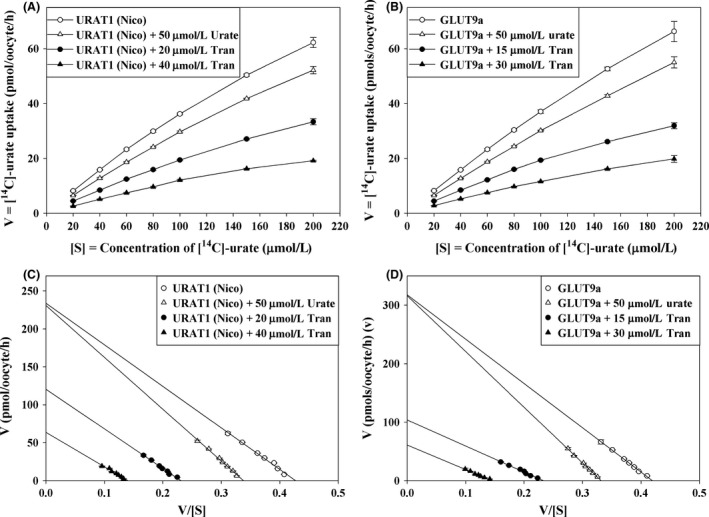
Uric acid, generated from the metabolism of purines, has both proven and emerging roles in human disease. Serum uric acid in humans is determined by production and by the net balance of reabsorption and secretion in kidney and intestine. In the human kidney, epithelial reabsorption dominates over secretion, such that in normal subjects there is at least 90% net reabsorption of filtered urate resulting in a fractional excretion of <10%. Tranilast, an anti-inflammatory drug with pleiotropic effects has a marked hypouricemic, uricosuric effect in humans. We report here that tranilast is a potent inhibitor of [C]-urate transport mediated by the major reabsorptive urate transporters (URAT1, GLUT9, OAT4, and OAT10) in oocytes; this provides an unequivocal molecular mechanism for the drug's uricosuric effect. Tranilast was found to inhibit urate transport mediated by URAT1 and GLUT9 in a fully reversible and noncompetitive (mixed) manner. In addition, tranilast inhibits the secretory urate transporters NPT1, OAT1, and OAT3 without affecting the secretory efflux pump ABCG2. Notably, while benzbromarone and probenecid inhibited urate as well as nicotinate transport, tranilast inhibited the urate transport function of URAT1, GLUT9, OAT4, OAT10, and NPT1, without significantly affecting nicotinate transport mediated by SMCT1 (IC ~1.1 mmol/L), SMCT2 (IC ~1.0 mmol/L), and URAT1 (IC ~178 mol/L). In summary, tranilast causes uricosuria by inhibiting all the major reabsorptive urate transporters, selectively affecting urate over nicotinate transport. These data have implications for the treatment of hyperuricemia and gout, the pharmacology of tranilast, and the structure-function analysis of urate transport.
尿酸由嘌呤代谢产生,在人类疾病中已被证实具有多种作用且不断有新的作用被发现。人体血清尿酸水平由尿酸生成以及肾脏和肠道对尿酸的重吸收与分泌的净平衡所决定。在人体肾脏中,上皮细胞对尿酸的重吸收作用强于分泌作用,因此在正常受试者中,滤过尿酸盐的净重吸收率至少为90%,导致尿酸排泄分数小于10%。曲尼司特是一种具有多种药理作用的抗炎药物,在人体中具有显著的降尿酸和促尿酸排泄作用。我们在此报告,曲尼司特是卵母细胞中主要重吸收性尿酸转运蛋白(URAT1、GLUT9、OAT4和OAT10)介导的[C] - 尿酸盐转运的强效抑制剂;这为该药物的促尿酸排泄作用提供了明确的分子机制。研究发现曲尼司特以完全可逆且非竞争性(混合型)方式抑制URAT1和GLUT9介导的尿酸盐转运。此外,曲尼司特抑制分泌性尿酸转运蛋白NPT1、OAT1和OAT3,但不影响分泌性外排泵ABCG2。值得注意的是,苯溴马隆和丙磺舒在抑制尿酸盐转运的同时也抑制烟酸盐转运,而曲尼司特抑制URAT1、GLUT9、OAT4、OAT10和NPT1的尿酸盐转运功能,对SMCT1(IC50约为1.1 mmol/L)、SMCT2(IC50约为1.0 mmol/L)和URAT1(IC50约为178 μmol/L)介导的烟酸盐转运无显著影响。总之,曲尼司特通过抑制所有主要的重吸收性尿酸转运蛋白导致促尿酸尿,选择性地影响尿酸盐而非烟酸盐的转运。这些数据对高尿酸血症和痛风的治疗、曲尼司特的药理学以及尿酸盐转运的结构 - 功能分析具有重要意义。