School of Nursing, The Hong Kong Polytechnic University, Hunghom, Kowloon, Hong Kong, China.
Age Ageing. 2014 Jan;43(1):91-7. doi: 10.1093/ageing/aft123. Epub 2013 Aug 26.
home visits and telephone calls are two often used approaches in transitional care but their differential effects are unknown.
to examine the overall effects of a transitional care programme for discharged medical patients and the differential effects of telephone calls only.
randomised controlled trial.
a regional hospital in Hong Kong.
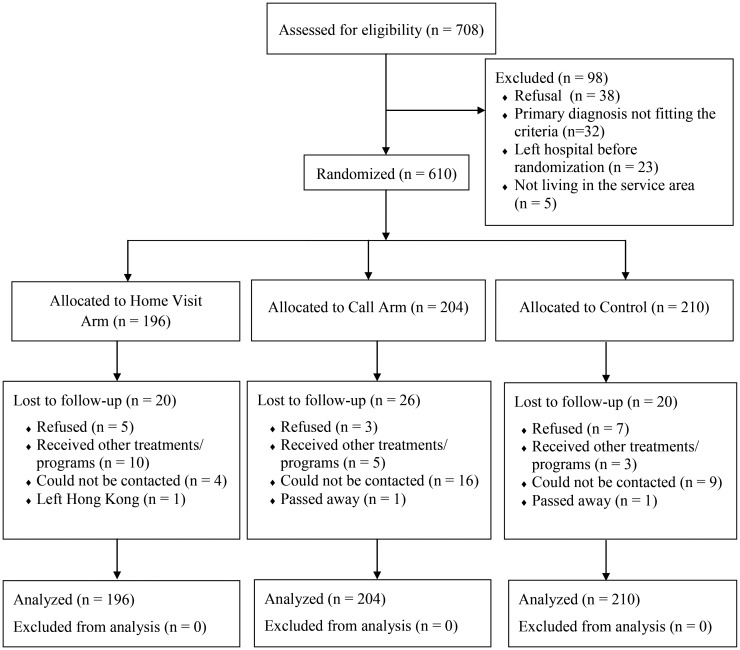
patients discharged from medical units fitting the inclusion criteria (n = 610) were randomly assigned to: control ('control', n = 210), home visits with calls ('home', n = 196) and calls only ('call', n = 204).
the home groups received alternative home visits and calls and the call groups calls only for 4 weeks. The control group received two placebo calls. The nurse case manager was supported by nursing students in delivering the interventions.
the home visit group (after 4 weeks 10.7%, after 12 weeks 21.4%) and the call group (11.8, 20.6%) had lower readmission rates than the control group (17.6, 25.7%). Significance differences were detected in intention-to-treat (ITT) analysis for the home and intervention group (home and call combined) at 4 weeks. In the per-protocol analysis (PPA) results, significant differences were found in all groups at 4 weeks. There was significant improvement in quality of life, self-efficacy and satisfaction in both ITT and PPA for the study groups.
this study has found that bundled interventions involving both home visits and calls are more effective in reducing readmissions. Many of the transitional care programmes use all-qualified nurses, and this study reveals that a mixed skills model seems to bring about positive effects as well.
家庭访视和电话随访是过渡护理中常用的两种方法,但它们的差异效果尚不清楚。
研究出院医疗患者过渡护理方案的总体效果及仅电话随访的差异效果。
随机对照试验。
中国香港一家地区医院。
符合纳入标准(n=610)的出院医疗患者被随机分配至:对照组(“对照组”,n=210)、家庭访视加电话随访组(“家庭访视组”,n=196)和仅电话随访组(“电话随访组”,n=204)。
家庭访视组接受交替家庭访视和电话随访,电话随访组仅接受电话随访,为期 4 周。对照组接受两次安慰剂电话随访。护士个案经理在实施干预措施时得到护理学生的支持。
家庭访视组(4 周后 10.7%,12 周后 21.4%)和电话随访组(11.8%,20.6%)的再入院率低于对照组(17.6%,25.7%)。意向治疗(ITT)分析显示,家庭访视组和干预组(家庭访视组和电话随访组联合)在 4 周时差异有统计学意义。在符合方案分析(PPA)结果中,4 周时所有组均差异有统计学意义。研究组在 ITT 和 PPA 中生活质量、自我效能和满意度均有显著改善。
本研究发现,包含家庭访视和电话随访的综合干预措施可更有效地降低再入院率。许多过渡护理方案都使用全部合格护士,本研究表明,混合技能模式似乎也能带来积极效果。