Center of Global Health, School of Public Health, School of Medicine, Zhejiang University, Hangzhou, China.
Institute of Global Health, University College London, London, UK.
Age Ageing. 2022 Jun 1;51(6). doi: 10.1093/ageing/afac151.
Quality of aftercare can crucially impact health status of older patients and reduce the extra burden of unplanned healthcare resource utilisation. However, evidence of effectiveness of primary healthcare in supporting aftercare, especially for older patients after discharge are limited.
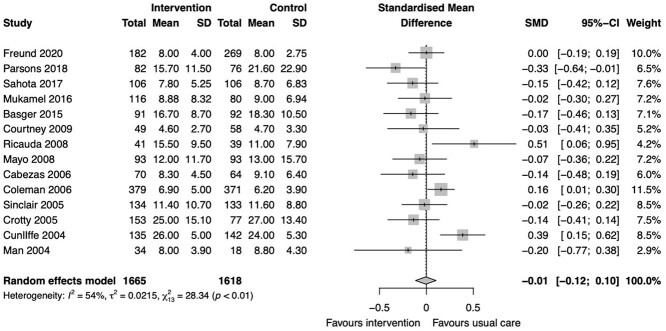
We searched for English articles of randomised controlled trials published between January 2000 and March 2022. All-cause hospital readmission rate and length of hospital stay were pooled using a random-effects model. Subgroup analyses were conducted to identify the relationship between intervention characteristics and the effectiveness on all-cause hospital readmission rate.
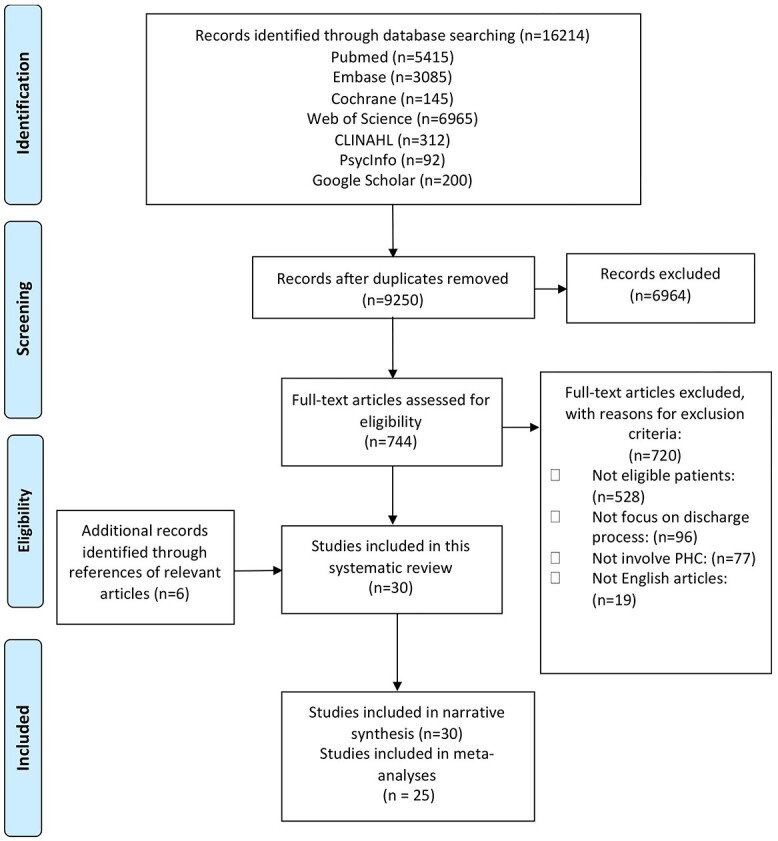
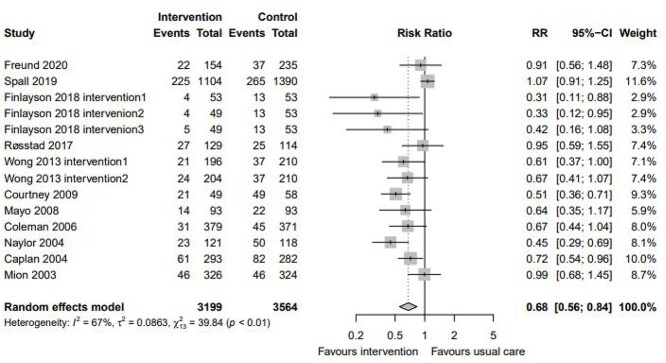
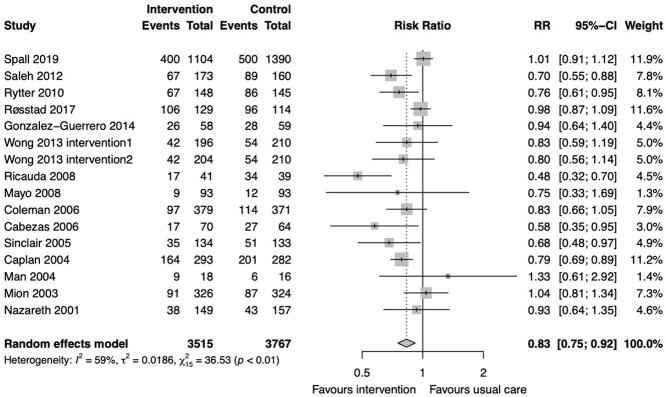
A total of 30 studies with 11,693 older patients were included in the review. Compared with patients in the control group, patients in the intervention group had 32% less risk of hospital readmission within 30 days (RR = 0.68, P < 0.001, 95%CI: 0.56-0.84), and 17% within 6 months (RR = 0.83, P < 0.001, 95%CI: 0.75-0.92). According to the subgroup analysis, continuity of involvement of primary healthcare in aftercare had significant effect with hospital readmission rates (P < 0.001). Economic evaluations from included studies suggested that aftercare intervention was cost-effective due to the reduction in hospital readmission rate and risk of further complications.
Integrating primary healthcare into aftercare was designed not only to improve the immediate transition that older patients faced but also to provide them with knowledge and skills to manage future health problems. There is a pressing need to introduce interventions at the primary healthcare level to support long-term care.
康复质量对老年患者的健康状况至关重要,并可减少非计划性医疗资源利用带来的额外负担。然而,支持康复服务的初级保健服务在改善患者健康状况方面的有效性证据有限,特别是针对出院后的老年患者。
我们检索了 2000 年 1 月至 2022 年 3 月期间发表的英文随机对照试验文章。使用随机效应模型汇总全因住院再入院率和住院时间。进行亚组分析以确定干预特征与全因住院再入院率之间的关系。
共纳入 30 项研究,涉及 11693 名老年患者。与对照组相比,干预组患者在 30 天内的住院再入院风险降低 32%(RR=0.68,P<0.001,95%CI:0.56-0.84),6 个月内的住院再入院风险降低 17%(RR=0.83,P<0.001,95%CI:0.75-0.92)。根据亚组分析,初级保健在康复服务中的持续参与对住院再入院率有显著影响(P<0.001)。纳入研究的经济评估表明,由于住院再入院率降低和进一步并发症风险降低,康复服务干预具有成本效益。
将初级保健纳入康复服务不仅旨在改善老年患者面临的即时过渡,还旨在为他们提供管理未来健康问题的知识和技能。迫切需要在初级保健层面引入干预措施,以支持长期护理。