Department of Pharmaceutical Sciences, St. Jude Children's Research Hospital, Memphis, Tennessee, USA.
J Am Med Inform Assoc. 2014 Feb;21(e1):e93-9. doi: 10.1136/amiajnl-2013-001993. Epub 2013 Aug 26.
Active clinical decision support (CDS) delivered through an electronic health record (EHR) facilitates gene-based drug prescribing and other applications of genomics to patient care.
We describe the development, implementation, and evaluation of active CDS for multiple pharmacogenetic test results reported preemptively.
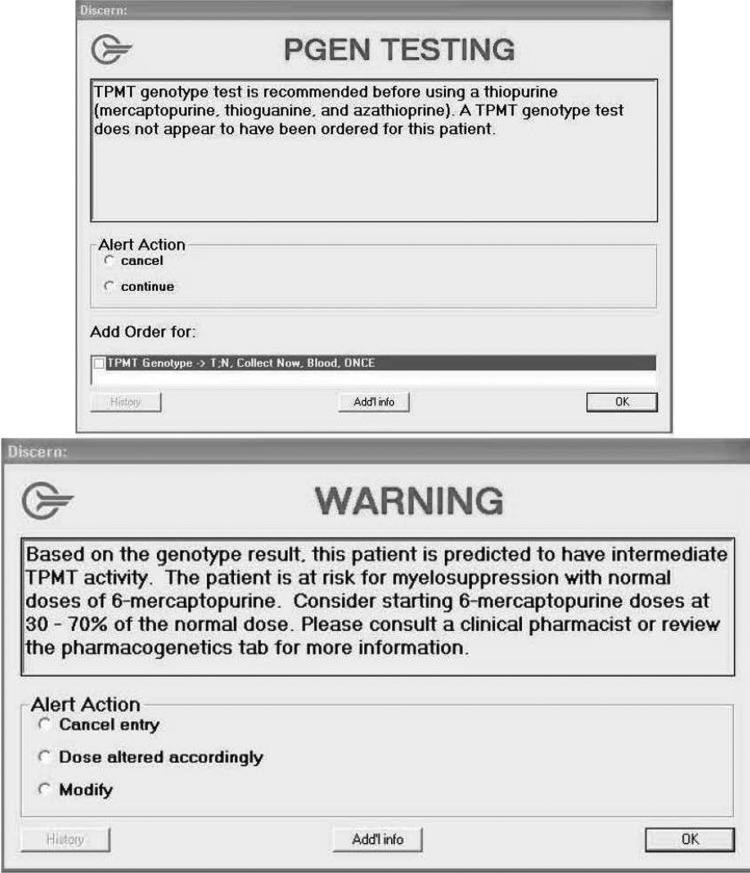
Clinical pharmacogenetic test results accompanied by clinical interpretations are placed into the patient's EHR, typically before a relevant drug is prescribed. Problem list entries created for high-risk phenotypes provide an unambiguous trigger for delivery of post-test alerts to clinicians when high-risk drugs are prescribed. In addition, pre-test alerts are issued if a very-high risk medication is prescribed (eg, a thiopurine), prior to the appropriate pharmacogenetic test result being entered into the EHR. Our CDS can be readily modified to incorporate new genes or high-risk drugs as they emerge.
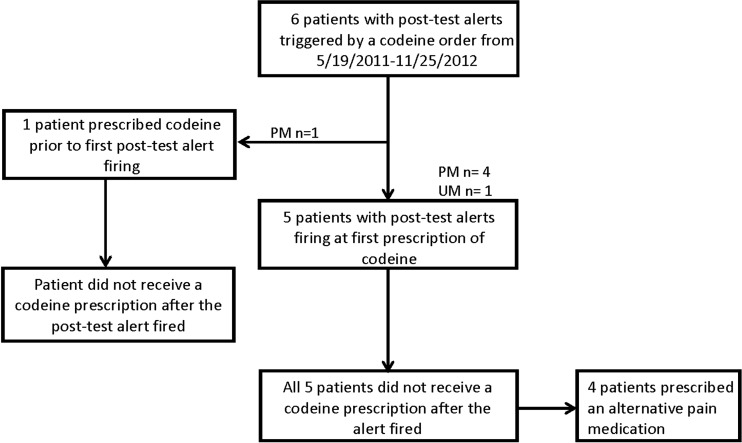
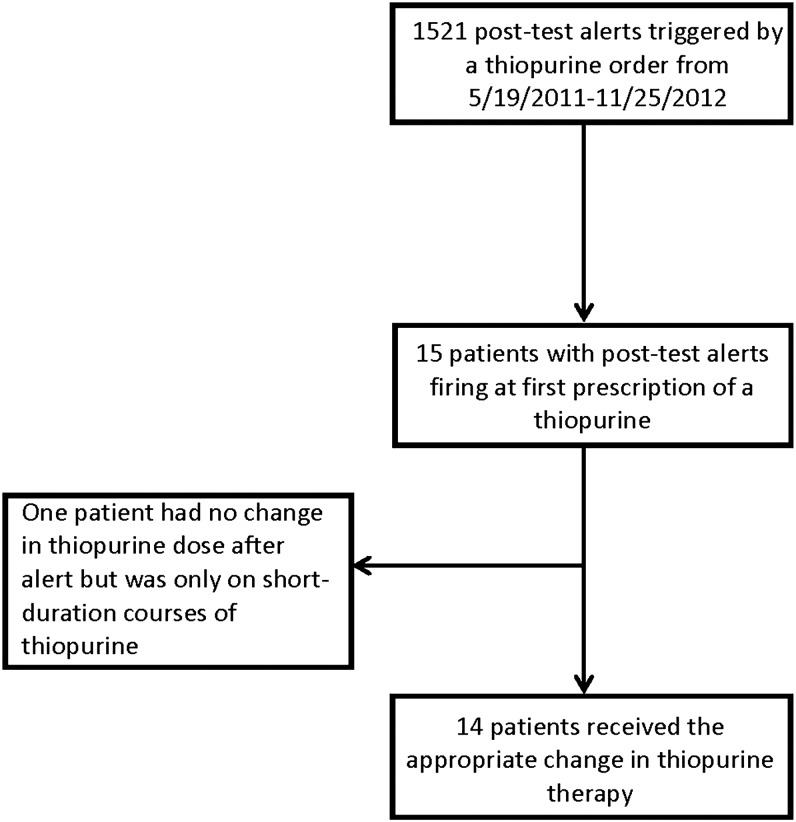
Through November 2012, 35 customized pharmacogenetic rules have been implemented, including rules for TPMT with azathioprine, thioguanine, and mercaptopurine, and for CYP2D6 with codeine, tramadol, amitriptyline, fluoxetine, and paroxetine. Between May 2011 and November 2012, the pre-test alerts were electronically issued 1106 times (76 for thiopurines and 1030 for drugs metabolized by CYP2D6), and the post-test alerts were issued 1552 times (1521 for TPMT and 31 for CYP2D6). Analysis of alert outcomes revealed that the interruptive CDS appropriately guided prescribing in 95% of patients for whom they were issued.
Our experience illustrates the feasibility of developing computational systems that provide clinicians with actionable alerts for gene-based drug prescribing at the point of care.
通过电子健康记录(EHR)提供的主动临床决策支持(CDS)有助于基于基因的药物处方和其他基因组学在患者护理中的应用。
我们描述了主动 CDS 的开发、实施和评估,用于预先报告的多种临床药物基因组学测试结果。
附有临床解释的临床药物基因组学测试结果被放入患者的 EHR 中,通常在开相关药物之前。为高风险表型创建的问题清单条目为在开高风险药物时向临床医生提供测试后警报提供了明确的触发机制。此外,如果开了非常高风险的药物(例如,硫嘌呤),并且尚未将适当的药物基因组学测试结果输入 EHR,则会发出测试前警报。我们的 CDS 可以轻松修改,以纳入新出现的基因或高风险药物。
截至 2012 年 11 月,已经实施了 35 条定制的药物基因组学规则,包括硫嘌呤、硫鸟嘌呤和巯基嘌呤的 TPMT 规则,以及可待因、曲马多、阿米替林、氟西汀和帕罗西汀的 CYP2D6 规则。在 2011 年 5 月至 2012 年 11 月期间,共发出了 1106 次测试前警报(76 次为硫嘌呤,1030 次为 CYP2D6 代谢药物),发出了 1552 次测试后警报(1521 次为 TPMT,31 次为 CYP2D6)。对警报结果的分析表明,在发出警报的患者中,有 95%的患者中断了 CDS,从而正确地指导了处方。
我们的经验表明,开发能够在护理点为基于基因的药物处方提供可操作警报的计算系统是可行的。