JAMA Neurol. 2013 Oct;70(10):1277-87. doi: 10.1001/jamaneurol.2013.3861.
We observed a significant correlation between cerebrospinal fluid (CSF) levels of tau proteins and α-synuclein, but not β-amyloid 1-42 (Aβ1-42), and lower concentration of CSF biomarkers, as compared with healthy controls, in a cohort of entirely untreated patients with Parkinson disease (PD) at the earliest stage of the disease studied so far.
To evaluate the baseline characteristics and relationship to clinical features of CSF biomarkers (Aβ1-42, total tau [T-tau], tau phosphorylated at threonine 181 [P-tau181], and α-synuclein) in drug-naive patients with early PD and demographically matched healthy controls enrolled in the Parkinson's Progression Markers Initiative (PPMI) study.
DESIGN, SETTING, AND PARTICIPANTS: Cross-sectional study of the initial 102 research volunteers (63 patients with PD and 39 healthy controls) of the PPMI cohort.
The CSF biomarkers were measured by INNO-BIA AlzBio3 immunoassay (Aβ1-42, T-tau, and P-tau181; Innogenetics Inc) or by enzyme-linked immunosorbent assay (α-synuclein). Clinical features including diagnosis, demographic characteristics, motor, neuropsychiatric, and cognitive assessments, and DaTscan were systematically assessed according to the PPMI study protocol.
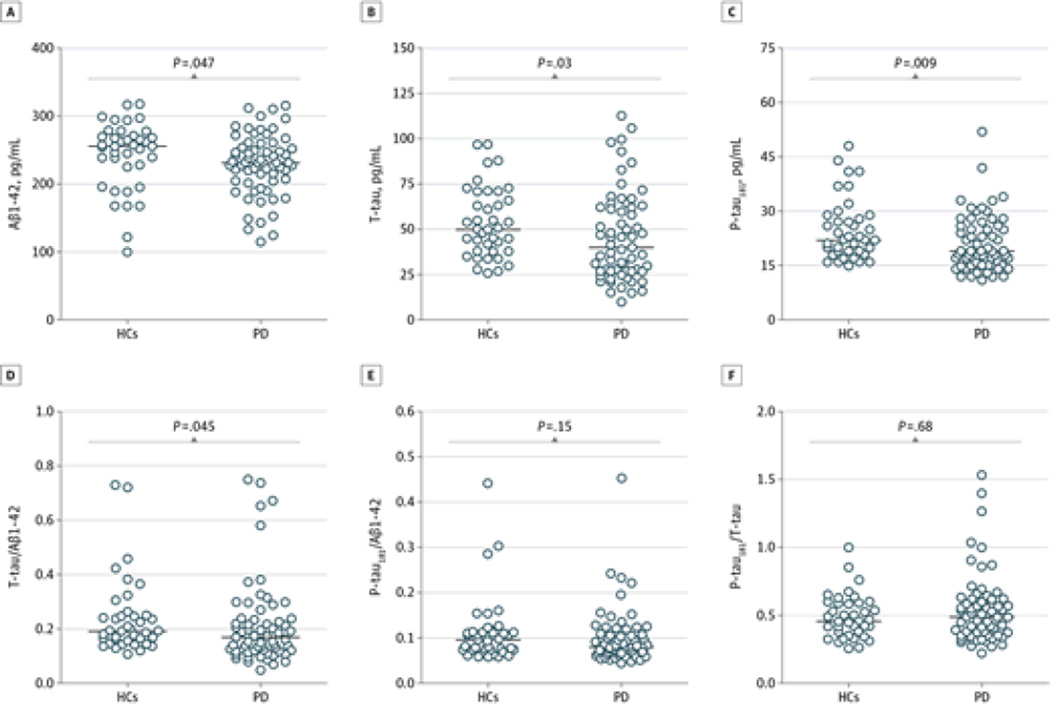
Slightly, but significantly, lower levels of Aβ1-42, T-tau, P-tau181, α-synuclein, and T-tau/Aβ1-42 were seen in subjects with PD compared with healthy controls but with a marked overlap between groups. Using multivariate regression analysis, we found that lower Aβ1-42 and P-tau181 levels were associated with PD diagnosis and that decreased CSF T-tau and α-synuclein were associated with increased motor severity. Notably, when we classified patients with PD by their motor phenotypes, lower CSF Aβ1-42 and P-tau181 concentrations were associated with the postural instability-gait disturbance-dominant phenotype but not with the tremor-dominant or intermediate phenotype. Finally, we found a significant correlation of the levels of α-synuclein with the levels of T-tau and P-tau181.
In this first report of CSF biomarkers in PPMI study subjects,we found that measures of CSF Aβ1-42, T-tau, P-tau181, and α-synuclein have prognostic and diagnostic potential in early-stage PD. Further investigations using the entire PPMI cohort will test the predictive performance of CSF biomarkers for PD progression
我们观察到在迄今为止研究的疾病早期阶段,与健康对照组相比,在完全未经治疗的帕金森病(PD)患者队列中,脑脊液(CSF)中的 tau 蛋白和 α-突触核蛋白水平与 CSF 生物标志物(Aβ1-42、总 tau [T-tau]、tau 磷酸化在苏氨酸 181 位 [P-tau181] 和 α-突触核蛋白)之间存在显著相关性,且浓度较低。
评估帕金森进展标志物倡议(PPMI)研究中入组的早期 PD 且未经药物治疗的患者和在人口统计学上匹配的健康对照组的 CSF 生物标志物(Aβ1-42、总 tau [T-tau]、tau 磷酸化在苏氨酸 181 位 [P-tau181] 和 α-突触核蛋白)的基线特征及其与临床特征的关系。
设计、地点和参与者:PPMI 队列的初始 102 名研究志愿者(63 名 PD 患者和 39 名健康对照者)的横断面研究。
通过 INNO-BIA AlzBio3 免疫测定法(Aβ1-42、T-tau 和 P-tau181;Innogenetics Inc)或酶联免疫吸附测定法(α-突触核蛋白)测量 CSF 生物标志物。根据 PPMI 研究方案,系统评估了临床特征,包括诊断、人口统计学特征、运动、神经精神和认知评估以及 DaTscan。
与健康对照组相比,PD 患者的 Aβ1-42、T-tau、P-tau181、α-突触核蛋白和 T-tau/Aβ1-42 水平略低,但差异有统计学意义,但两组之间存在明显重叠。通过多变量回归分析,我们发现较低的 Aβ1-42 和 P-tau181 水平与 PD 诊断相关,而 CSF T-tau 和 α-突触核蛋白降低与运动严重程度增加相关。值得注意的是,当我们根据患者的运动表型对 PD 患者进行分类时,较低的 CSF Aβ1-42 和 P-tau181 浓度与姿势不稳-步态障碍占主导的表型相关,而与震颤占主导或中间表型无关。最后,我们发现 α-突触核蛋白水平与 T-tau 和 P-tau181 水平存在显著相关性。
在 PPMI 研究对象的 CSF 生物标志物的首次报告中,我们发现 CSF Aβ1-42、T-tau、P-tau181 和 α-突触核蛋白的测量在早期 PD 中具有预后和诊断潜力。使用整个 PPMI 队列的进一步研究将测试 CSF 生物标志物对 PD 进展的预测性能。